Monday, May 9, 2011

Hudson River Exhibition Call for Entries

A national juried landscape exhibition called “The Great Hudson River Exhibition” is open for entries in all media including painting, drawing, printmaking, photography, sculpture, and mixed media.


Here’s more information:
Host organization: Mill Street Loft
Exhibition venue: Riverside Arts in Beacon
Juror: Bartholomew Bland, Curator of the Hudson River Museum in Yonkers, NY.
Entry deadline: May 31, 2011
Entry fee: $30 for first four images, $5.00 for each additional. Electronic or CD submission.
Exhibition dates: July 9-Sept. 3, 2011.
Opening reception: July 9, 4-8 pm
PDF of entry form
Facebook page
Image above by William Trost Richards

Sunday, May 8, 2011

Almost a Miniature Mom

Everyone at the farm was hoping that Skye, the miniature horse, would have her foal by Mother’s Day. But she’s not there quite yet.


She looks pretty uncomfortable. She stands uneasily and looks around every once in a while to see who’s doing all that kicking inside her.

Her patience will be rewarded. Three cheers for Skye! And thanks to moms everywhere for what you go through to make the rest of our lives possible!

Saturday, May 7, 2011

Men’s Adventure Magazines

The late 1950s and 1960s were the era of the male magazine, with names like Stag, True, For Men Only, Saga, Swank and Man’s World. There you’ll find “true” adventure and combat stories—typically about an average G.I. behind enemy lines put in command of a secret army of French gun-toting prostitutes to defeat the Italian army.


The new issue of Illustration magazine has a spotlight Charles Copeland (1924-1979), one of the illustrators who contributed to the men's pulps.

Copeland's work appears alongside other artists who became better known, such as Mort Kunstler and James Bama, and alongside writers who made it in the world of the ‘slick’ magazines and popular novels, such as Mario Puzo and Ian Fleming.

Illustration magazine #33 is on the newstands, but you can also order it on the website, or view thumbnail views of the contents. Dan Zimmer and his contributing writers like Lynn Munroe, who wrote the piece on Copeland, produce the magazine primarily as a labor of love, and since few in academia are devoting researchers to the topic, the key interviews with living illustrators who worked 50 years ago are being largely gathered by this magazine.
---------
Illustration Magazine
More about men's pulps at Illustrateur blog (in French)
Books:
It's a Man's World Adam Parfrey
Men's Adventure Magazines by Max Collins
More about this era of illustration at Today’s Inspiration blog

I.R. in Japanese

Imaginative Realism is now available in Japanese from the publisher Born Digital.
You can get it at Amazon.co.jp in the Japanese edition.

Born Digital / Imaginative Realism with sample pages in Japanese
Imaginative Realism in English from Amazon


Color and Light on Amazon internationally: USA | CA | UK | FR | DE | JP
Color and Light signed (and doodled in) by me, from the Dinotopia Store

Friday, May 6, 2011

Gaze Direction

Which way are these eyes looking? Do they seem to be looking right at you, or off to the side?


Our perception of gaze direction is influenced by the position of the iris inside the visible surface of the sclera (the white of the eye), but that’s only part of the story.

In 1824 William Henry Wollaston made exact duplicates of an engraved plate of eyes and eyebrows. He then placed them in two different facial contexts. One face is turned one way, and the other points in the opposite direction.


Surprisingly the exact same set of eyes appears to be looking in different directions solely because of the surrounding facial cues.


Even if you take a matched pair of eyes and eyebrows and just shift the nose beneath them from one side to the other, you can shift the apparent direction of gaze.

Why this happens is still not completely understood. Ophthalmologists Michael F. Marmor and James G. Ravine, authors of the new book “The Artist’s Eyes: Vision and the History of Art,” suggest a psychological cause: “Our judgment of the direction of someone’s eyes is linked, in part, to the direction we believe that person to be looking.”

This might explain why cartoon eyes drawn "crosseyed" still seem to be looking at us.
------
The Artist’s Eyes: Vision and the History of Art by Marmor and Ravine
William Hyde Wollaston, Apparent Direction of Eyes in a Portrait
Donald Duck is copyright Disney.http://disney.go.com/index
-----
Don’t forget to vote in the video contest (scroll down to view the videos).

Thursday, May 5, 2011

Book Trailer Results

We received fantastic entries for the Color and Light Book Trailer Contest. I couldn’t resist sharing them with you now so that you can help decide the grand prize winner.

Please watch them all and vote for your favorite in the poll at left.


Eric (SuperVillain)


Christian Schlierkamp, completed with the help of Kilian, Karim, Maite, Luis, Leon, and Dominik, ages 9-12. Animation workshop organized by JKN Berlin.


Ana Hesselbart


Jared Updike 

Note on prizes: In addition to the signed poster, I’ve decided to give every entry a free signed book of their choice. The poll winner will receive a book of their choice plus the actual book that appears in the “Painting Rainbows video.”

Be sure to follow the links on the names to learn more about each of the contestants. Thanks to everyone who entered, and thanks for voting.
Order Color and Light from the Dinotopia Store
Order C&L from Amazon
See the book trailer contest winners for Imaginative Realism

Wednesday, May 4, 2011

Bat Wings

I have a feeling that one of you out there right now is designing the wings of a dragon, so this post is for you.


Here are a few things I learned while sketching a flying fox. “Megachiroptera” means “Giant Hand-Wing.” With a four to five foot wingspan, it’s one of the biggest bats on the planet, and perhaps the best living inspiration for dragon wings.

 The wing is supported with thin arm bones and finger bones that match up with our finger bones, including the knuckle joints. The clawed “thumb” sticks forward of the wing. For a vampire bat, it’s useful for holding onto the host animal when it is sucking blood. The other fingers spread out to support the membrane, with the fifth finger pointing back to support the trailing edge.

The bones in bats’ fingers have less calcium than our bones, and they’re flattened a bit, so they can bend without breaking. The skin is stretchy, thin, and delicate. But if it rips, it can regrow.

As with birds and pterosaurs, there is a bit of membrane forward of the elbow. The membranes have muscles and blood vessels in them, and they’re covered with some fine hairs. They also have receptor cells that can feel how much the skin is stretched.

When I drew this specimen, which hangs in Harvard’s Museum of Comparative Zoology, I wasn’t sure what causes those yellow-brown bands in the wing. Maybe one of you is a bat expert and can explain.

More on bat wings at Animal Diversity

Tuesday, May 3, 2011

Feynman on Light

Like ripples in water, light vibrations radiate out from the source, bounce off objects, and travel into your eye.


But light waves are also bouncing in all other directions too, allowing the person next to you to see. Not only that, longer, invisible wavelengths from all radio, TV (and cell phone) channels are also passing in all directions through the same space. Physicist and explainer Richard Feynman explains it all with clarity and enthusiasm.

Direct link to YouTube video
Richard Feynman on Wikipedia
Thanks, Dave!

Monday, May 2, 2011

Animal News

Over at the farm yesterday, Lenny harnessed up the Belgian draft horses. He wanted to give them some practice with ground driving.


Even the miniature horse Skye was in harness. She’s pregnant. A baby miniature foal is due in the next few days. I’ll try to do some sketches when the day comes.


Lenny let me try ground driving behind Sofie and Abby. It’s the first time I’ve tried it. He told me to lean back a bit to let them know I was behind them.


I was pretending I was walking behind a couple of Anchiceratops, like in Dinotopia: Journey to Chandara.


The other news is that on Saturday night a big black bear came right up to the back of our house. I think he smelled the bird feeders. It's the first black bear I've ever seen on this side of the Hudson River.


Soon it will be time to close up the feeders for the season, but there have been some spectacular birds passing through, such as my favorite, the rose breasted grosbeak, a bird we see only one day a year.

Previously on Gurney Journey
Princess the Belgian filly
Christmas Surprise (birth of Joy, the donkey)
Joy in the Farmyard
Snow Plowing with Draft Horses

By the way, ACOPAL (America China Oil Painting Artist League) has announced its winners and finalists. The link takes you to a gallery of the work accepted. I'm delighted that my painting Chandara was chosen as a finalist.

Sunday, May 1, 2011

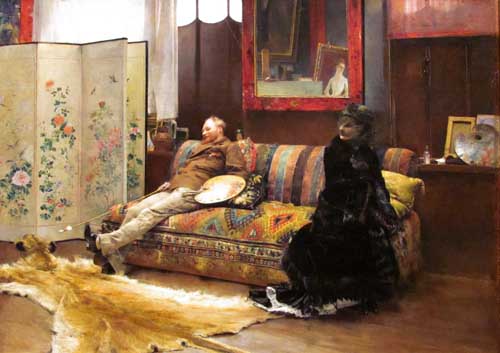
Bouderie (Sulking)

A painting with an intriguing bit of storytelling has surfaced in Sotheby’s auction preview, currently on view in New York.


The scene by Pascal Dagnan-Bouveret (1852-1929) shows Dagnan’s friend, the painter Gustave Courtois slumped on a colorful studio sofa, still holding his brushes and palette as if he’s taking a break from painting.

At the other end of the sofa, a woman in mourning veil sits aloof and dignified. She might be a model keeping her distance, or a patron commissioning a portrait of her deceased husband. Why isn’t she making conversation with the artist? Is she unhappy with the likeness in the portrait he’s painting?


And why is the artist ever so slightly grinning? Dagnan teases but doesn’t give the story away. The obvious thing would have been to show the easel and the portrait. But by concealing, by showing enough and not too much, he invites the human interest of the viewer.

The auction preview continues from 10:00 to 5:00 at Sotheby’s on 72nd and York.