


Tuesday, July 17, 2012
Painting a figure wrapped in plastic
(Video link) This video by Robin Eley shows the process of painting a figure draped in plastic cling wrap.


Berlin museum to sideline old masters
The cultural ministers of Berlin's Gemäldegalerie have generated a storm of criticism from art historians and the public as a result of their decision to place in storage one of Europe's great museum collections of traditional paintings, replacing them with a donated collection of fauvism and surrealism.

The 3,000 heritage works include Giotto, Botticelli, Caravaggio, Canaletto, Lucas Cranach, Rogier van der Weyden and Rembrandt. The plan calls for relocating the old masters into a smaller, temporary space, where only a fraction of the works will be accessible to scholars and the public, and where no funding is yet in place to build a new exhibit space.
The Gemäldegalerie's 72-room museum space will be cleared to make room for an offered gift of twentieth century works. The donor, Heiner Pietzsch, who made his fortune in wholesale synthetics, placed the condition that all the works in his bequest must always be on public view.
Article in the Guardian "Berlin plan for Old Masters to give way to modern art angers historians"
Gemäldegalerie on Wikipedia
Thanks, Christian!

The 3,000 heritage works include Giotto, Botticelli, Caravaggio, Canaletto, Lucas Cranach, Rogier van der Weyden and Rembrandt. The plan calls for relocating the old masters into a smaller, temporary space, where only a fraction of the works will be accessible to scholars and the public, and where no funding is yet in place to build a new exhibit space.
The Gemäldegalerie's 72-room museum space will be cleared to make room for an offered gift of twentieth century works. The donor, Heiner Pietzsch, who made his fortune in wholesale synthetics, placed the condition that all the works in his bequest must always be on public view.
----
Photo from "What to See in Berlin"Article in the Guardian "Berlin plan for Old Masters to give way to modern art angers historians"
Gemäldegalerie on Wikipedia
Thanks, Christian!
Monday, July 16, 2012
Matching dappled light to projecting leaves
On a recent sunny day, I noticed this pattern of light and shadow cast across a road. The shadow looked like a piece of dark paper with holes punched out of it.

The circles of dappled light were about three inches in diameter, and they were all of constant size. However some circles were brighter than others.

I looked up to see what was casting the shadow. It was a maple branch 18 feet above the ground. The branch presented a fairly flat projecting surface with a fixed distance from the ground. This is why the circles were the same size.
Typically a tree or a forest presents a variety projecting of surfaces positioned at many different distances from the ground, so the circles or ellipses vary in size and focus. The farther from the ground, the larger—and blurrier—the circles.
I wondered if I could match up the projecting surface of leaves with the pattern on the ground.

It's a pretty close fit, but doesn't match exactly because they aren't shot at exactly opposite angles. At the bottom of the photo on the right you can see the sharp cast shadow of my arms holding up the camera.
Anyway, it's clear that every opening in the leafy surface, regardless of its size or its ragged shape, has its corresponding circle or composite blob of light on the ground.
The branches aren't thick enough to block the sun from that distance, so they disappear completely in the shadow.
Previously on GJ: Dappled light
More information about natural light effects in my book "Color and Light"
Saturday, July 14, 2012
Classic Art Instruction: The Crowd-sourced List


Ten Top Tips in International Artist
The upcoming issue of International Artist (August/September #86) has the final feature in my 10-part masterclass on atmospheric effects. I share my ten top tips to keep to keep your color on track.

Also in the same issue is a feature on Petar Meseldžija showing how he painted his recent fantasy painting "The Frost Giants," a report on John Howard Sanden's portraits of George and Laura Bush, and a report by Matthew Innis on the recent Art of the Portrait conference.
I'll be kicking off a new series with the magazine in the following issue.
Friday, July 13, 2012
The Burial Vault
Last Sunday, while my wife sang sacred harp music with Bard College students in the meeting hall, I sat outside nearby painting the burial vault.

As the shadows flickered across the stones, I could hear the music and words of a song called "Greenwich" drifting out from the chapel.
Lord, what a thoughtless wretch was I,
To mourn, and murmur, and repine,
To see the wicked placed on high,
In pride and robes of honor shine!
But O their end, their dreadful end.
Thy sanctuary taught me so;
On slipp'ry rocks I see them stand,
And fiery billows roll below.
—Words by Isaac Watts, 1719
Bard's sacred harp (Shapenote singing) club is led by Benjamin Bath and is open to all.
Bartlett Burial Vault.
Sacred Harp music on Wikipedia
See and hear a group singing Greenwich 183 on YouTube
Thursday, July 12, 2012
Visualizing Sound
Sound propagates outward from its source more like a bubble than a wave, according to John Stuart Reid.
 He uses a Cymascope to capture the patterns of sound in a membrane of water, whose behavior is photographed, and, in this case, superimposed over the image of the violinist.
The technique has been used to study the patterns of sound made by birds, elephants, dolphins, and human vowel sounds.
----
Gallery of history of Cymascope images

The technique has been used to study the patterns of sound made by birds, elephants, dolphins, and human vowel sounds.
----
Gallery of history of Cymascope images
Wednesday, July 11, 2012
Concertgoer
Here's a sketch I did of a gentleman who was sitting in front of me at a concert.

I loved the way his tendons showed up on the back of his hand, the way his fingers bent slightly backward, and the way the skin of his cheek wrinkled up as he pushed on it.
Of course he didn't hold this pose for the whole time, but he returned to it a few times through the concert.
Here are the tools I used: Yasutomo Niji Waterbrush
 , Caran D'Ache watercolor pencils
 , Moleskine Watercolor Notebook

Tuesday, July 10, 2012
Part 5: Foliage / Mønsted
It's easy to fall into the tendency to paint foliage in a relatively cursory or generalized way, compared to the way we would paint a figure. If we were to give the same loving artistic attention to a tree or a bunch of leaves that we give to a face or a nude figure, then our foliage painting would take a huge leap forward.


In this foreground detail of the painting above, he observes the character and the color of each leaf, and records how the colors change as the leaves move in and out of shadow.

But a forest is more than the sum of its leaves, or even of its trees. Mønsted improvises a different toolset for the far masses of foliage, generalizing and softening where he needs to.

Improvisation and resourcefulness is vital to painting foliage. The tools and methods that we learn from painting casts or figures in the academy don't really serve us outdoors as we face the changefulness and immateriality of nature.
As we've seen in this series, complete imitation of every leaf in a lush landscape is probably not possible or even desirable, nor perhaps is the other extreme of ultra-softness and generalization. One can be faithful to the character of the plant without copying or imitating every detail. Instead, nature must be re-created or "represented" in paint on the canvas.
Asher B. Durand, in his influential 1855 essays "Letters on Landscape Painting" draws this very distinction between imitation and representation. When painting a tree, he says, “direct imitation is impossible." Instead the artist should strive to “represent this foliage in every essential characteristic, without defining the forms of individual leaves. To do this, some analysis of its structure is necessary.”
There's more to say about structure, but I'll save that for future posts.
More on Mønsted on Lines and Colors
Full text of Letters on Landscape Painting in The American Landscapes of Asher B. Durand
The Artistic Anatomy of Trees (Dover Art Instruction)
More on leaves and foliage in my book Color and Light, which you can get signed here.
Foliage Series
Part 1: Painting Tools
One artist who took such care was Peder Mork Mønsted (Danish 1859-1941). In his long career he painted landscapes of all sorts, and managed to blend painterly handling with conscientious rendering.
In this foreground detail of the painting above, he observes the character and the color of each leaf, and records how the colors change as the leaves move in and out of shadow.
But a forest is more than the sum of its leaves, or even of its trees. Mønsted improvises a different toolset for the far masses of foliage, generalizing and softening where he needs to.
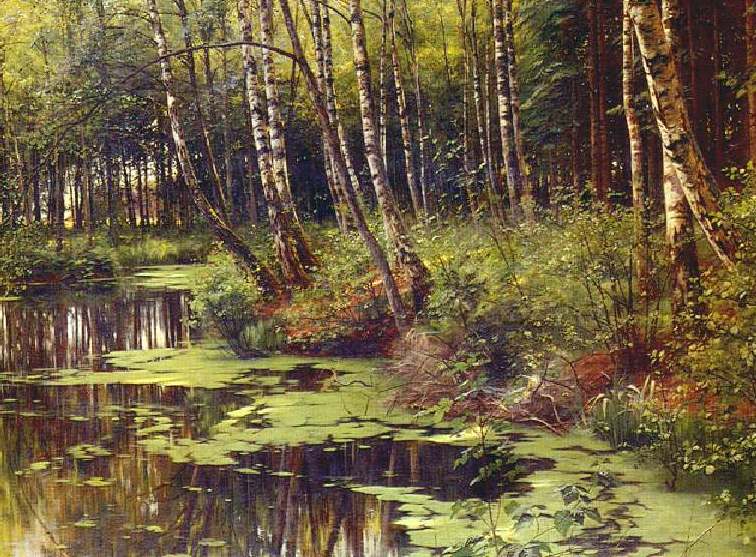
Improvisation and resourcefulness is vital to painting foliage. The tools and methods that we learn from painting casts or figures in the academy don't really serve us outdoors as we face the changefulness and immateriality of nature.
As we've seen in this series, complete imitation of every leaf in a lush landscape is probably not possible or even desirable, nor perhaps is the other extreme of ultra-softness and generalization. One can be faithful to the character of the plant without copying or imitating every detail. Instead, nature must be re-created or "represented" in paint on the canvas.
Asher B. Durand, in his influential 1855 essays "Letters on Landscape Painting" draws this very distinction between imitation and representation. When painting a tree, he says, “direct imitation is impossible." Instead the artist should strive to “represent this foliage in every essential characteristic, without defining the forms of individual leaves. To do this, some analysis of its structure is necessary.”
There's more to say about structure, but I'll save that for future posts.
More on Mønsted on Lines and Colors
Full text of Letters on Landscape Painting in The American Landscapes of Asher B. Durand
The Artistic Anatomy of Trees (Dover Art Instruction)
More on leaves and foliage in my book Color and Light, which you can get signed here.
Foliage Series
Part 1: Painting Tools
Part 2: Every Leaf
Part 3: Super Soft
Part 4: Forest Interiors
Part 5: Monsted
Plus check out the earlier posts on GJ:
Transmitted Light
Transparency of foliage
Painting Snyder Swamp (video)
Part 3: Super Soft
Part 4: Forest Interiors
Part 5: Monsted
Plus check out the earlier posts on GJ:
Transmitted Light
Transparency of foliage
Painting Snyder Swamp (video)
Subscribe to:
Posts (Atom)