


Stephen Silver has made a documentary about Mad magazine caricaturist Mort Drucker. The teaser does its job. I want to see more!
Teaser on YouTube
Thursday, December 9, 2010


Wednesday, December 8, 2010
Offhand Flourishing
Humans are capable of amazing things when a cool mind is connected to nimble fingers. Here are a couple of mind-boggling examples from YouTube:
World championship yo-yo tricks.
Radio control helicopter aerobatics.
In the art of penmanship, the ultimate showcase of skill is called offhand flourishing. This combination of drawing and calligraphy was a natural outgrowth of decorations in pointed pen lettering. It was created at one shot without much in the way of preliminary drawing, which is where we get the figurative sense of the word “offhand.”

(Click to enlarge the picture above, which is from an 1880 penmanship manual called “Real Penwork Compendium of Penmanship.”)
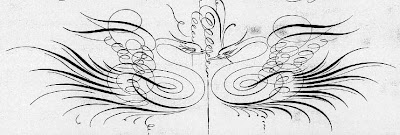
It may not look like anything more than squiggly doodles to the uninitiated, but pictures made from flourishes are incredible difficult. It takes deep practice, good breathing, perfect posture, and a clear mind.
Here’s how master penman W.E. Dennis, in his 1914 book Studies in Pen Art, describes the challenge:
Studies in Pen Art, by W.E. Dennis, available as a free PDF download.
Collection of free PDFs from IAMPETH (International Association of Master Penmen, Engrossers, and Teachers of Handwriting)
World championship yo-yo tricks.
Radio control helicopter aerobatics.
In the art of penmanship, the ultimate showcase of skill is called offhand flourishing. This combination of drawing and calligraphy was a natural outgrowth of decorations in pointed pen lettering. It was created at one shot without much in the way of preliminary drawing, which is where we get the figurative sense of the word “offhand.”

(Click to enlarge the picture above, which is from an 1880 penmanship manual called “Real Penwork Compendium of Penmanship.”)

It may not look like anything more than squiggly doodles to the uninitiated, but pictures made from flourishes are incredible difficult. It takes deep practice, good breathing, perfect posture, and a clear mind.
Here’s how master penman W.E. Dennis, in his 1914 book Studies in Pen Art, describes the challenge:
“It is doubtful if anything in penwork requires more real skill, sureness of stroke, delicacy of touch and absolute freedom of arm and hand than Off-hand Flourishing. Certainly none of the other work in this book offers the technical difficulties found in the flourished designs, the most difficult of all being the two swans facing each other. Lettering is more or less mechanical, but flourishing is quite the opposite. In this work the mind must conceive quickly the arrangement of harmonious, well-balanced curves, and the hand must reproduce them without hesitation. In addition to this, the penman should have in mind some harmonious design, pleasing in effect as a whole.”--------
Studies in Pen Art, by W.E. Dennis, available as a free PDF download.
Collection of free PDFs from IAMPETH (International Association of Master Penmen, Engrossers, and Teachers of Handwriting)
Tuesday, December 7, 2010
Gumball Machine
Let’s face it: laundromats and oil painting don’t mix. But there I was with my paint kit, a beautiful gumball machine in front of me, and three hours to kill.
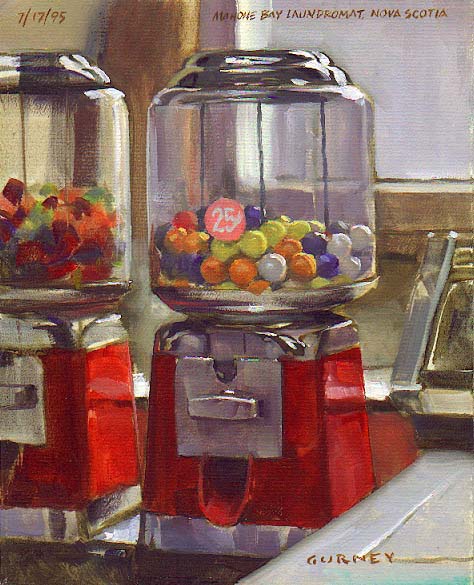
I set up my easel and my folding chair next to a washing machine, which is visible in the right of the painting. I left just enough floorspace for people to squeeze past me with their laundry hampers.
It took a while to draw in all those darned colored gumballs. As I painted them, my worst fear was that someone would actually buy a gumball and mess up the arrangement.
Sure enough, a kid snuck up behind me and jammed a quarter into the slot. He spun the handle before I could say anything. Each time he cranked it, all the gumballs shuffled around inside.
“Hey, my still life!” I protested weakly.
He popped the gumball in his cheek and narrowed his eyes. “What are you doing?” he said, between chews. “You an artist?”
---------
This painting is reproduced full-page in Color and Light: A Guide for the Realist Painter. (in the context of "local color.")
Thanks to Dan Dos Santos of the blog "Muddy Colors" for recommending Color and Light in the Top Ten Art Books of 2010.
By the way, I’ve been filling all your mailed-in orders, and I just want to compliment all of you wives who are giving the book as a gift to your husbands—and vice-versa. That’s really nice of you!
If you mailed in an order and are wondering when it will come, I’ve been turning them around within 24 hours after receiving them. Today I mailed out orders that were postmarked between November 30-Dec.3 and received yesterday.

I set up my easel and my folding chair next to a washing machine, which is visible in the right of the painting. I left just enough floorspace for people to squeeze past me with their laundry hampers.
It took a while to draw in all those darned colored gumballs. As I painted them, my worst fear was that someone would actually buy a gumball and mess up the arrangement.
Sure enough, a kid snuck up behind me and jammed a quarter into the slot. He spun the handle before I could say anything. Each time he cranked it, all the gumballs shuffled around inside.
“Hey, my still life!” I protested weakly.
He popped the gumball in his cheek and narrowed his eyes. “What are you doing?” he said, between chews. “You an artist?”
---------
This painting is reproduced full-page in Color and Light: A Guide for the Realist Painter. (in the context of "local color.")
Thanks to Dan Dos Santos of the blog "Muddy Colors" for recommending Color and Light in the Top Ten Art Books of 2010.
By the way, I’ve been filling all your mailed-in orders, and I just want to compliment all of you wives who are giving the book as a gift to your husbands—and vice-versa. That’s really nice of you!
If you mailed in an order and are wondering when it will come, I’ve been turning them around within 24 hours after receiving them. Today I mailed out orders that were postmarked between November 30-Dec.3 and received yesterday.
Monday, December 6, 2010
Specular and Diffuse Reflection
In specular reflection, light rays bounce off the surface of an object at the same relative angle that they approached it. In diffuse reflection, light rays bounce off in many directions.
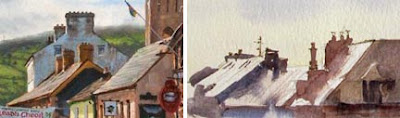
For example, under normal conditions a rooftop has a matte surface which reflects the light diffusely. The rooftops in the painting on the left show diffuse reflection on a dry, sunny day. The sketch on the right shows slate rooftops after a rainstorm. The thin surface of water remaining on the rooftops now reflects the light more specularly.
“Speculum” is Latin for mirror; the rooftops in the second sketch do act more like a mirror, revealing reflections of the dark chimneys.
Many surfaces are a combination of specular and diffuse reflections. When you polish a shoe or an apple, what you’re doing is increasing the relative proportion of specular versus diffuse reflection.
Whether you’re rendering digitally or traditionally, you can think of the specular pattern as a separate layer added on top of the usual form-modeling factors that you would use to render a matte object. In the 3D realm, surface modelers have to consider the normal modeling factors that you would study on a plaster cast plus the specular effects.
---------
More about specular and diffuse reflection on David Briggs' Huevaluechroma.com
Wikipedia on specular reflection
"The Physics Classroom" on the comparison, with diagrams
Previously on GJ: Shadows vs. reflections on water.

For example, under normal conditions a rooftop has a matte surface which reflects the light diffusely. The rooftops in the painting on the left show diffuse reflection on a dry, sunny day. The sketch on the right shows slate rooftops after a rainstorm. The thin surface of water remaining on the rooftops now reflects the light more specularly.
“Speculum” is Latin for mirror; the rooftops in the second sketch do act more like a mirror, revealing reflections of the dark chimneys.
Many surfaces are a combination of specular and diffuse reflections. When you polish a shoe or an apple, what you’re doing is increasing the relative proportion of specular versus diffuse reflection.
Whether you’re rendering digitally or traditionally, you can think of the specular pattern as a separate layer added on top of the usual form-modeling factors that you would use to render a matte object. In the 3D realm, surface modelers have to consider the normal modeling factors that you would study on a plaster cast plus the specular effects.
---------
More about specular and diffuse reflection on David Briggs' Huevaluechroma.com
Wikipedia on specular reflection
"The Physics Classroom" on the comparison, with diagrams
Previously on GJ: Shadows vs. reflections on water.
Sunday, December 5, 2010
Abandoned Icons

These forlorn icons are from the abandoned Six Flags theme park attraction in New Orleans.
--------
From Web Urbanist
Crayon Factory
Who knew that the making of colored crayons could be so beautiful?
Thanks, Roberto
Previously on GJ: How Printing Ink is Made
Thanks, Roberto
Previously on GJ: How Printing Ink is Made
Saturday, December 4, 2010
Elder Mad Man
Some artists of advanced age might feel that they’re too old to really make a mark in their field. The business belongs to the young, they might think.
Consider the career of Norman Mingo (1896-1980), Mad Magazine’s most celebrated cover artist. A veteran of the World War One, he painted his first Mad cover in 1956 at age 60.
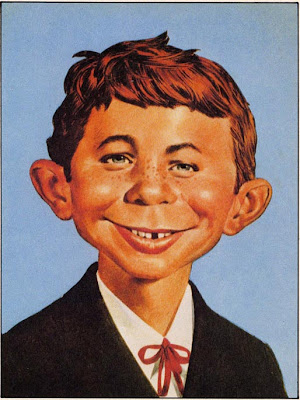
And what a cover! It was the definitive portrait of the cheerful simpleton Alfred E. Neuman. Every Mad artist thereafter has been required to match Mingo’s version, and they agree: no one can top it. The painting sold at auction two years ago for more than 200,000 dollars.
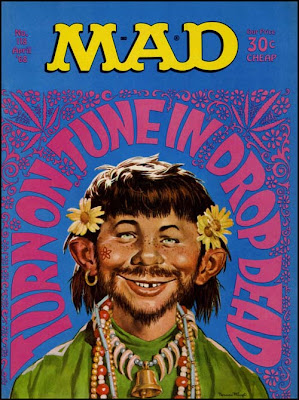
Norman Mingo went on to paint well over a hundred classic covers for Mad, up until his death in 1980. His influence on the current generation of American picturemakers is right up there with Frank Frazetta, Jack Kirby, R. Crumb, Chuck Jones, and Jim Henson.
-------
The book “Mad Art” by Mark Evanier tells the story of Mingo and the other Mad artists.
Norman Mingo on Wikipedia
Consider the career of Norman Mingo (1896-1980), Mad Magazine’s most celebrated cover artist. A veteran of the World War One, he painted his first Mad cover in 1956 at age 60.

And what a cover! It was the definitive portrait of the cheerful simpleton Alfred E. Neuman. Every Mad artist thereafter has been required to match Mingo’s version, and they agree: no one can top it. The painting sold at auction two years ago for more than 200,000 dollars.

Norman Mingo went on to paint well over a hundred classic covers for Mad, up until his death in 1980. His influence on the current generation of American picturemakers is right up there with Frank Frazetta, Jack Kirby, R. Crumb, Chuck Jones, and Jim Henson.
-------
The book “Mad Art” by Mark Evanier tells the story of Mingo and the other Mad artists.
Norman Mingo on Wikipedia
Friday, December 3, 2010
Peeling Paint Letters

Thursday, December 2, 2010
Shrunkenheadman Club
Someone spilled paint on a stool in an art school in San Jose, California.
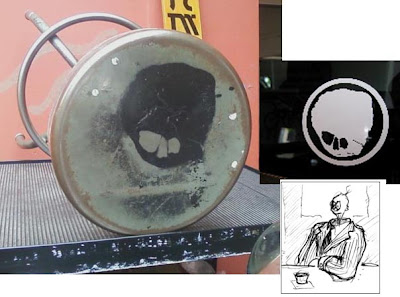
The blob of paint ended up looking like a shrunken head. Student David Gustlin (now a faculty member) looked at that shrunken head shape and sketched the guy that he imagined it belonged to.
A myth was born.
The art students at San Jose State University knew they had the perfect mascot for their campus organization. They called it the Shrunkenheadman Club.
The Shrunkenheadman Club was formed in 1995 to to create a sense of community among students in animation and illustration. The club arranges for figure drawing sessions, visiting lecturers, and an annual costumed draw-off known as “D-Day.”

They sponsored me to give my Color and Light lecture a few weeks ago in October. That’s me and my buddy John Fleskes standing out in front of the school.

The students at SJSU ordered 65 copies of Color and Light, which I signed for them today and put in the mail. To make the books extra special, I made a custom rubber stamp using the club mascot. The stamp is made from craft foam glued to a wood block, and then stamped using a rainbow-colored pigment stamp pad.
If another art school, game company, or movie studio would like to put together an order for 40 or more books, I’ll be glad to come up with something equally customized.
------
Shrunkenheadman history / Official site
Shrunkenheadman program
Ordering signed "Color and Light"books from the Dinotopia Store
Previously on GJ: San Jose State University Art Program.
John Fleskes blog

The blob of paint ended up looking like a shrunken head. Student David Gustlin (now a faculty member) looked at that shrunken head shape and sketched the guy that he imagined it belonged to.
A myth was born.
The art students at San Jose State University knew they had the perfect mascot for their campus organization. They called it the Shrunkenheadman Club.
The Shrunkenheadman Club was formed in 1995 to to create a sense of community among students in animation and illustration. The club arranges for figure drawing sessions, visiting lecturers, and an annual costumed draw-off known as “D-Day.”

They sponsored me to give my Color and Light lecture a few weeks ago in October. That’s me and my buddy John Fleskes standing out in front of the school.

The students at SJSU ordered 65 copies of Color and Light, which I signed for them today and put in the mail. To make the books extra special, I made a custom rubber stamp using the club mascot. The stamp is made from craft foam glued to a wood block, and then stamped using a rainbow-colored pigment stamp pad.
If another art school, game company, or movie studio would like to put together an order for 40 or more books, I’ll be glad to come up with something equally customized.
------
Shrunkenheadman history / Official site
Shrunkenheadman program
Ordering signed "Color and Light"books from the Dinotopia Store
Previously on GJ: San Jose State University Art Program.
John Fleskes blog
Wednesday, December 1, 2010
Mutter and Growl
Eyewitnesses said that when John Singer Sargent painted in watercolor, he “groaned, swore (if no ladies were present), exclaimed, whistled to keep his spirits up, growled in rage when things went wrong, and then shouted in triumph as he completed his work to his satisfaction. It was a noisy performance.”

Another observer noted that he talked to himself: “This is impossible,” Mr. Sargent muttered. “You can’t do it. Why do you try these things? You know it’s hopeless. It can’t be done.”
Then: “Yes, it can, yes, it can, it can be done—my God, I’ve done it.”
--------
From “Art: A New History,” by Paul Johnson, page 521.
Image: "In the Tyrol," 1904, 21 x 13 inches, image courtesy Art Renewal Center.

Another observer noted that he talked to himself: “This is impossible,” Mr. Sargent muttered. “You can’t do it. Why do you try these things? You know it’s hopeless. It can’t be done.”
Then: “Yes, it can, yes, it can, it can be done—my God, I’ve done it.”
--------
From “Art: A New History,” by Paul Johnson, page 521.
Image: "In the Tyrol," 1904, 21 x 13 inches, image courtesy Art Renewal Center.
Subscribe to:
Posts (Atom)