Friday, October 26, 2012

Johns Hopkins Medical Illustration

The medical illustration program at Johns Hopkins University is extremely selective. Of the 50 portfolio applications they receive, they invite only 20 for an interview, and accept only five.
The program was established by pioneering medical illustrator Max Brödel (1870-1941), who developing the carbon dust technique for scientific illustration. Above is one of Brödel's drawings from 1910. The first assignment for the students is to render a human pelvis bone in carbon dust at full size.


Most of the other North American medical illustration programs were founded by Brödel students. In addition to doing medical artwork, many of the graduates do work in other scientific fields. For example the painting above is by John Cody, who is known as the "Audubon of moths."


Tim Phelps, above, is the assistant director of the Johns Hopkins program. In his spare time, he paints hot rods and is the author of Up in Flames: The Art of Flame Painting. On the tour he showed us the workshop of one of the assistant professors, Juan Garcia, M.A., who practices and teaches facial prosthetics.


Dr. Garcia creates custom-made prosthetic substitutes for people who are missing parts of their facial anatomy due to injury or illness. The prosthetics must be lightweight, flexible, and they're often attached by magnets.

Johns Hopkins' Art as Applied to Medicine is a two-year graduate program. Students must take some courses in anatomy, pathology, physiology, and biophysics alongside medical students. As a result, their commitment to science must be as strong as their commitment to art. In addition to illustration, the curriculum includes training in sculpture, digital tools, and animation skills, which are fundamental to succeeding in today's scientific illustration marketplace.

Johns Hopkins Art as Applied to Medicine Department

Thursday, October 25, 2012

Chinese Plein-Air Scenes

In China, the how-to books on oil painting often feature bold, brushy paintings of everyday scenes. Here's a painting of an ordinary hair styling salon. Sorry, I don't know the name of the artist.

These appear to be painted from life, and they have a refreshing directness and simplicity. Judging from the historical books in the art bookshops, the approach is inspired by Fechin, Repin, Menzel, and Zorn.


By the way, the squatting guy above is working a popcorn cannon. Here's one in action (Thanks, SteveC):
----
Thanks, Gary Geraths for the scans
Previously on GJ: Chinese Drawing

Wednesday, October 24, 2012

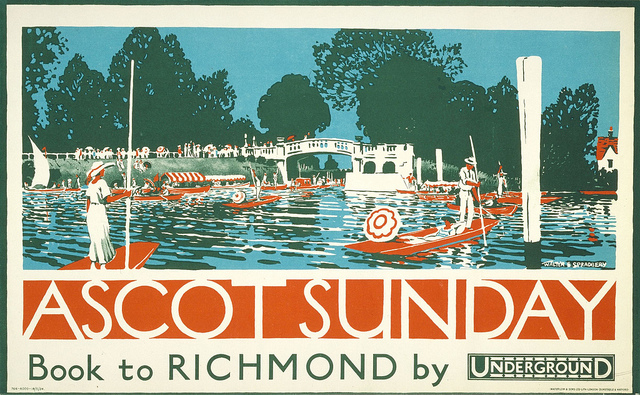
Four-Color Poster Palette

In this 1924 poster for the London Underground, Walter E. Spradbery limited his palette to just four colors: white, cyan, red, and green. 


The resulting poster has a several advantages over an image with a full range of tones and colors. It's cheaper and easier to print, and the simplicity gives it more visual impact from a distance.


Here's a detail of the original painting in opaque water-based colors. Where possible he eliminates outlines around small shapes and lets them blend together.

It's a challenge to design a picture with just four colors. One naturally wants to subdivide, gradate, soften, and outline. But a painting gets its power from the grouping of tones, and this regime forces the artist to group, generalize, and simplify.

Tuesday, October 23, 2012

Raptor Suit

The CGI visual effects for the movie Jurassic Park received a lot of attention, but the animatronics were equally groundbreaking.


(Link to video) In this archive video, one of the designers, John Rosengrant recalls how the people at Stan Winston Studios were able to build raptor suits around him and Mark 'Crash' McCreery.

StanWinstonSchool.com
Previously on GJ: Jurassic Park Set Visit

Monday, October 22, 2012

Baby Doll

On Saturday I was sketching at the corner of West Eager Street and Park Avenue in Baltimore, when I noticed a woman crossing the street toward me, walking her dog.

There was something strange about the dog. At first I thought she had electric lights instead of eyes, because her eyes seemed to be glowing.

She was a Corgi mix, and she moved slowly and stiffly on her short legs. When the dog reached the curb, the owner shortened the leash. The dog leaned forward, touching her nose to the curb, and then she gingerly lifted her paw and climbed the curb. She sniffed around near my chair.

The dog was completely blind with cataracts. The owner was patiently guiding her on her morning walk.

The dog's name was Baby Doll. She was more than twelve years old. She did just fine with her hearing and her sense of smell. She found a crust of bread and started munching it. "Get that out of your mouth, Baby Doll," the owner said.

"She knows her way around my house. But I've got to make sure I don't leave anything out of place, or she'll bump into it."
----
Previously: Old Dog Silver

Sunday, October 21, 2012

CG Wires Interview

The website CG Wires has just posted an interview. Read it here.
CG Wires is a great resource for job listings, tutorials, and other behind the scenes information about gaming, animation, and VFX fields.

Lyman Allyn Exhibit Review


Kristina Dorsey of TheDay.com reviewed the Dinotopia exhibition that's on view at the Lyman Allyn Art Museum in Connecticut. Read the review
----

Sketch / Painting / Study

JeanTraveling asked a question about my commentary on yesterday's painting video:
"You called this a painting at one point and a sketch at another. What is the difference between a sketch and a painting? This is a discussion my husband and I have fairly often:-)"

Jean, it's a matter of semantics, of course, and I'm OK with either term for the one I did yesterday. For me, the distinction between the two terms may be a matter of attitude as much as of finish.

To me, a "sketch" tends to suggests a momentary glance or quick impression, executed freely and intuitively, without much thought to how it lays on the page. Sometimes a sketch is a means to an end, a planning stage or a first effort.

I also use "sketch" as a noun or a verb referring to any picture done purely from observation, regardless of media or level of detail. I like the sound of "I'm going sketching" better than "I'm going plein-air painting." Sometimes I sketch indoors, and "indoor plein-air painting" is a contradiction in terms.

A "painting" might have more consideration behind it, perhaps more thought of composition or overall effect. A painting might demand the use of better materials— a true sketch might be something you could draw on a shopping bag in the heat of the moment.

I like the term "study" too, because it gets me into the frame of mind of patiently observing the world as it is. My goal when I'm working on location is often to try to portray something unfiltered by preconceptions. Not easy! Being patient and open enough to find a fresh motif, and then to try to see beyond artistic conventions, is the most difficult challenge for me in observational work, but it's also the most productive mindset to cultivate.

By the way, I have a hard time distinguishing between the terms "drawing" and "painting," especially when using water-soluble colored pencils, which can be used wet or dry in the same picture. Art historians often group watercolors with drawings, even if they're made entirely with a brush. I suppose that has a lot to do with the way watercolors are stored and displayed in museums.
----
Previously on GJ: Why do we have no word in English for a person who draws?

Saturday, October 20, 2012

Friday, October 19, 2012

American Society of Architectural Illustrators


We're in Baltimore as guests of the conference of ASAI, the American Society of Architectural Illustrators.
It's a fun group, and part of the motive of the gathering is sketching in the host city. Baltimore is a sketcher's paradise. Here's a gouache I did yesterday of the Domino Sugar factory, which looks over the inner harbor.

During an evening boat cruise, Tim Bell, a painter in the American Impressionist tradition, did a demo of oil painting techniques.

One of the evening speakers Aleksander Novak-Zemplinski, an architectural illustrator who grew up in Poland and has become a master of digital techniques.

Here's a sketch of Jon Soules, who was in the audience.