Friday, September 9, 2016

Revolutions and Revivals


Tomorrow the Victoria and Albert Museum will open a new exhibition called "You Say You Want a Revolution? Records and Rebels."

The show will feature album covers, pop art, poster designs, photography, fashion, and film from the watershed period of 1966-1970.
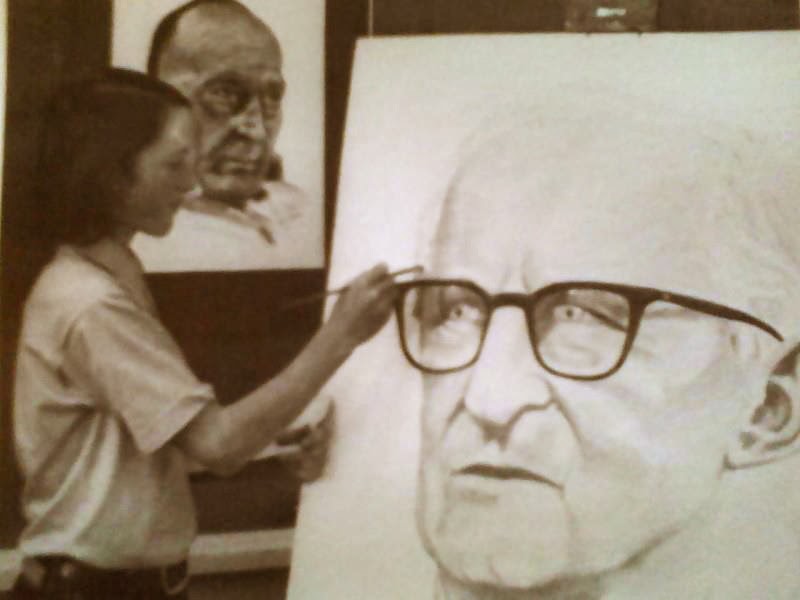
Jim Gurney in eighth grade art class (link to blog post)
Growing up in Palo Alto during that period, and then going to college in Berkeley, I was keenly aware of the album cover art, the Fillmore posters, the outrageous underground comix, and the oversize portraits by Andy Warhol. It all seemed so new and exciting.

But I didn't realize at the time how much those visual innovations owed to revivals of earlier styles. Artists are magnets for visual ideas, and we were inspired by books on Alphonse Mucha, the lettering guides from the Golden Age of Penmanship, and the comics and animation from the 1930s. All these influences took some effort to locate—you had to dig through used bookstores or explore the stacks in libraries—but they were out there.

It may appear that these eras of innovation were merely a rejection of the past, brought about by revolutionary geniuses of the moment such as the Beatles, Andy Warhol, or Bob Dylan. The 1960s did represent a break from the past, but the new ideas grew from the DNA of earlier art forms. In fact all of those great artists—McCartney, Lennon, Warhol, and Dylan—were profound students of earlier styles, and were interested in other art forms outside their main area of expertise, such as film, and animation.

I think we're living in a similar time of revolutionary thought in art and culture, brought about by the access to new ideas via the Internet, but the innovators recognized by future art historians will be those whose roots go deep into the soil of the past, not those who only follow the big names of the present moment.

You Say You Want a Revolution? Records and Rebels."

Thursday, September 8, 2016

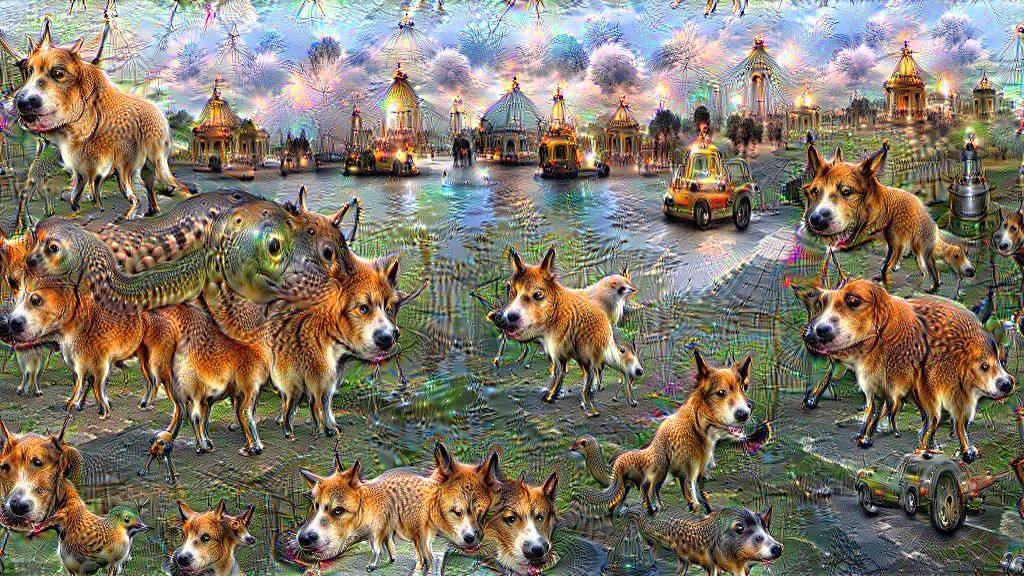
Deep Dreaming Through Neural Networks


A trip to the grocery store turns trippy as everything morphs into a dog. (Link to YouTube).

Such hallucinogenic images are created using artificial neural networks, computers which are set up to resemble the complex web of nerve cells in the brain. 


Google and Facebook have used these systems to recognize and classify objects and to recognize faces, but here they're being used to generate images.

They're able to mimic the human tendency for pareidolia and apophenia—the recognition of patterns in what we see, and in particular our hard-wired penchant for seeing faces faces in things.

As the computer recognizes faces, dogs, or other traits in the target image, it re-renders it to bring out that enhancement. The system can thus reinforce the kind of visualization we do when we're daydreaming. As Google wrote in a blog post: “This creates a feedback loop: if a cloud looks a little bit like a bird, the network will make it look more like a bird.”

Via Glitterbat — Google Deep Dreams Dolls
What we're seeing so far definitely goes beyond the Photoshop filter look. The images strikes me as a weird combination of humorous, compelling, obsessive, hideous, and disturbing. 

But the style of the images doesn't exactly resemble a the way my human brain generates novel images. It's definitely a computer's way of dreaming. 

But what we're seeing so far is just the tip of the iceberg, and in our lifetimes we'll be surprised by completely different styles of images, some that resemble what we think of as humanlike, and others completely novel.

Wednesday, September 7, 2016

Casein Six Pack

Here are a few casein paintings created with a super-limited palette of just six colors.

I call this set my "Six Pack": Titanium white, ivory black, Venetian red, yellow ochre, cobalt blue, and raw umber.


The emphasis in this painting is on the warm sky and the cool shadows on the near side. I didn't use black on this one. The darks are made with cobalt blue, Venetian red and raw umber.

Darks often have more character if they're made up of loose mixtures of warm and cool colors.


The main reason for the black is for painting in grisaille. There's no better way to learn about a new painting medium than to paint a still life using nothing but black and white.

Because the Six Pack doesn't have high-chroma reds and yellows, it automatically gives you a slightly faded, old world feeling, like the color of memories.


It also doesn't let you mix strong greens, which can be a good thing. Instead, it forces you to interpret the scene in terms of simple warm/cool oppositions.

You can see this focus on warm vs. cool in the work of classic British landscapists like J.M.W Turner, David Roberts, and Richard Parkes Bonington.


Here's a video showing how I work out the sky and background first, then the smaller verticals, and finally the delicate wires, using a graphite pencil over the dry paint.

The Jack Richeson company, who makes the only artist-grade casein I know of, liked my Six Pack idea, and they asked if they could offer it as a set.


Gurney's Casein 6 Pack:
Titanium white, ivory black, Venetian red, yellow ochre, cobalt blue, and raw umber.

Gurney's Casein 6 Pack with Brush Set
Amazon offers the six-color set with a portable set of synthetic brushes in a travel holder.

I also suggested a wider assortment of colors if you want to start off with a fuller gamut.

Gurney's Casein Explorers Pack contains: titanium white, ivory black, alizarin crimson, cadmium red scarlet, cad yellow light, cad yellow medium, cerulean blue, ultramarine blue deep, chrome oxide green, burnt sienna, raw sienna, raw umber.

This set is non-overlapping except for the commonly used colors white, black and raw umber. That way you can start with either one and expand to the other.

Tuesday, September 6, 2016

Sargent and Caricature

When John Singer Sargent painted a portrait, he exaggerated the proportions and features to make his subject look more elegant and distinctive.

At left is a detail of Sargent's 1902 portrait of Lord Ribblesdale (Thomas Lister, 4th Baron Ribblesdale) alongside some photos of the subject in similar poses.


Sargent made many subtle accentuations. The head is smaller relative to the figure, making the figure look taller and more regal. Within the face, he made the outer folds over the eyes turn downward more dramatically. 

Some of the differences in the folds and lines of the face may be explained by the aging of the subject, but Sargent changed the bone structure and proportions, too. He narrowed the jaw and lengthened the nose. These are all deviations away from the normal, standard face. 

To be clear, the painting was done from life, not from photos, but the photo at center, taken in 1884, may have provided a starting point for Sargent's interpretation.

A contemporary cartoonist in Punch emphasized the absurd aspects of Sargent's interpretation. The note says "Regrets...Or Why did I Speculate on Such a Neck Tie? —J.S. Sargent."

Sargent was as much a caricaturist as a copyist, and that's what makes his portraits so memorable. 

At the links below, you can see other painting-to-photo comparisons.

Monday, September 5, 2016

Origins of Bugs Bunny


This video takes examines Bugs Bunny—his origins and what makes him so enduring. (Link to YouTube). Thanks, Mel.

Revisiting the Cartoon Guy


Remember the Cartoon Guy? His name is Mark Mains, and he was one of the caricaturists at the county fair. I stopped in again to see him again and sketch his portrait.
-----
Previous posts:
Cartoon Guy (2008)
Sketching the Cartoon Guy (2011)

Sunday, September 4, 2016

At the Blue Benn Diner

Here's a patron at the Blue Benn Diner in Bennington, Vermont, watercolor over pencil, 4 x 4 inches. 

Saturday, September 3, 2016

Online Collection of Antique Children's Books


University of Florida has placed its extensive collection of antique children's books online.


It's a good source for old fashioned styles of lettering, illustration, and design.

Baldwin Library of Historic Children's Literature
(Thanks, Janet)

Friday, September 2, 2016

Brushstroke Tips in IA 111

It all started with a question from Sean Walsh on my Instagram page. Look for the new article in the next issue of International Artist Magazine, #111.

Thursday, September 1, 2016

Lucas Museum Hoping For a Home in S.F.

The proposed Lucas Museum of Narrative Art may be coming to the San Francisco area after all.

If you haven't heard of it, the LMNA promises to be a public museum collection featuring illustration art, comics, animation, and movie related artwork, topics usually overlooked in most art museums. 

N.C. Wyeth, The Storybook
The collection is based on the original paintings by the likes of Rockwell, Parrish, Wyeth, Rackham, Crumb, and Moebius assembled by George Lucas over the last 40 years. According to the Museum's president, Don Bacigalupi:
“The most popular arena for storytelling in visual form has been things like film and illustration and comics and animation. ... Instead of us getting into that debate about what is art and what isn’t art, the museum really doesn’t pay attention to that capital “A” Art, and instead looks for this through line, this continuity in whatever form, whatever context, whatever medium ... for this very basic human impulse: to tell stories.”
Despite the false starts in locating the museum in the Presidio in San Francisco, or in Chicago's lakeside, the latest proposal centers on Treasure Island, which is located in the San Francisco Bay. According to the San Francisco Chronicle, they're also in talks with officials in Los Angeles.
------
Read more: "The Art of Storytelling: An exclusive first look at the collection of the Lucas Museum of Narrative Art" by Charles Desmarais. Thanks, Chuck Pyle!
----