Saturday, February 24, 2018

Quotes from Caspar David Friedrich

German Romantic artist Caspar David Friedrich (1774-1840) painted landscapes infused with spirit and feeling. What was in his mind as he painted them?

Caspar David Friedrich The Sea of Ice
"The divine is everywhere, even in a grain of sand."


Friedrich says: "The artist should not only paint what he sees before him, but also what he sees in himself. If, however, he sees nothing within him, then he should also refrain from painting what he sees before him."


"Every truthful work of art must express a definite feeling, must move the spirit of the spectator either to joy or to sadness…rather than try to unite all sensations, as thought mixed together with a stirring stick."


"You call me a misanthrope because I avoid society. You err; I love society. Yet in order not to hate people, I must avoid their company."


"I must stay alone and know that I am alone to contemplate and feel nature in full; I have to surrender myself to what encircles me, I have to merge with my clouds and rocks in order to be what I am. Solitude is indispensable for my dialogue with nature."
Read about Caspar David Friedrich's life on Wikipedia

Friday, February 23, 2018

Twilight in Bonabba

Bonabba is one of Dinotopia's pod villages. Its biomimetic architecture is based on plant forms. 


The human dwellings are raised off the ground on central stalks. You can climb into them via the ladder.

"Twilight in Bonabba" 
I imagined Bonabba at the magic hour of twilight. There's mist in the air, the humans and dinosaurs are settling in for the evening, and the lights in the pods are coming on. The image appears as an establishing shot in my book Dinotopia: The World Beneath, 

I've just been updating the store on my website. Thanks to a warehouse find, I've got some art prints of "Twilight in Bonabba" available now.

Two big inspirations for this curved-space architecture are:
Roger and Martyn Dean, who discuss it in their book Magnetic Storm, and Antonio Gaudí, whose work is well represented in Gaudí: The Complete Buildings

Thursday, February 22, 2018

Repin portraits vs. color photos of the same model

Color photograph of Andreyev
Leonid Andreyev was a Russian writer who experimented with early color photography, taking selfies between 1910 and 1914. 

These are true color photos using the Autochrome method, decades before Eastman Kodak's process.

Oil painting of Leonid Andreyev by Ilya Repin
Andreyev was also a friend of the great artist Ilya Repin, who painted several portraits of him. 


So we have the rare treat of being able to compare color photographs of one of Repin's models with some painted portraits. 

They're not in the same poses, not taken at the same time, and Repin didn't use these photos as reference.

But it's remarkable to see how Repin stayed true to the essential character of the sitter, clarified the structure of his face, and presented him in an interesting way.
----
Book: Photographs by a Russian Writer Leonid Andreyev: An Undiscovered Portrait of Pre-Revolutionary Russia
Leonid Andreyev - his Autochromes, and two portraits by Repin
Previously: How Sargent Interpreted Carolus-Duran

Wednesday, February 21, 2018

Sight-Size or Comparative Measurements?

Patrick Room from Vienna asks:


"When you go outside to do a sketch, how do you scale down the view so that it fits into your sketchbook? Do you establish an anchor point and connect all the measurements to this point, or do you place your sketchbook far enough away and then measure the subject with your outstretched arm?"

Patrick, that's a good question. Ideally I set up my easel so that the view is sight-size, and I place the easel as close as possible to my line of sight. On a few occasions I have experimented with a sight-size grid viewer to assist with very complex subjects.

But frequently the subject is too far away for sight-size to be possible. In that case I use comparative measurements. I establish a unit of measurement in my view of the subject using a pencil held at arm's length. Then I look for other examples where that unit appears.

You can see this approach in action in my YouTube video "Street Painting in Indiana."

Tuesday, February 20, 2018

Animal Linocuts by Norbertine Bresslern-Roth

Norbertine Bresslern-Roth (1891-1978) was an Austrian printmaker who specialized in animal subjects.


Her preferred medium was the linoleum block print, which suited her strong sense of design.

She studied at the animal painting academy of Hans von Hayek, where students painted landscapes and animals on farms near Dachau. 


She was inspired by a trip to Africa, and later by trips to the zoo. Most of her African compositions are based on her deep knowledge of animal anatomy, with poses that could never be taken directly from photography. 


She often used the linoleum reduction process, where the same plate is used several times for progressively darker ink runs. With each color run, more and more of the block is cut away. 


Even for a simple subject, this process requires careful planning, and since you destroy the plate, you can't go back and print more.


Her birds, fish, and insect subjects, show striking color combinations. Her art is well known to lino-cut artists, but not as well known as it should be to painters and other artists.
 -----
Wikipedia (in German) Norbertine Bresslern-Roth 

Monday, February 19, 2018

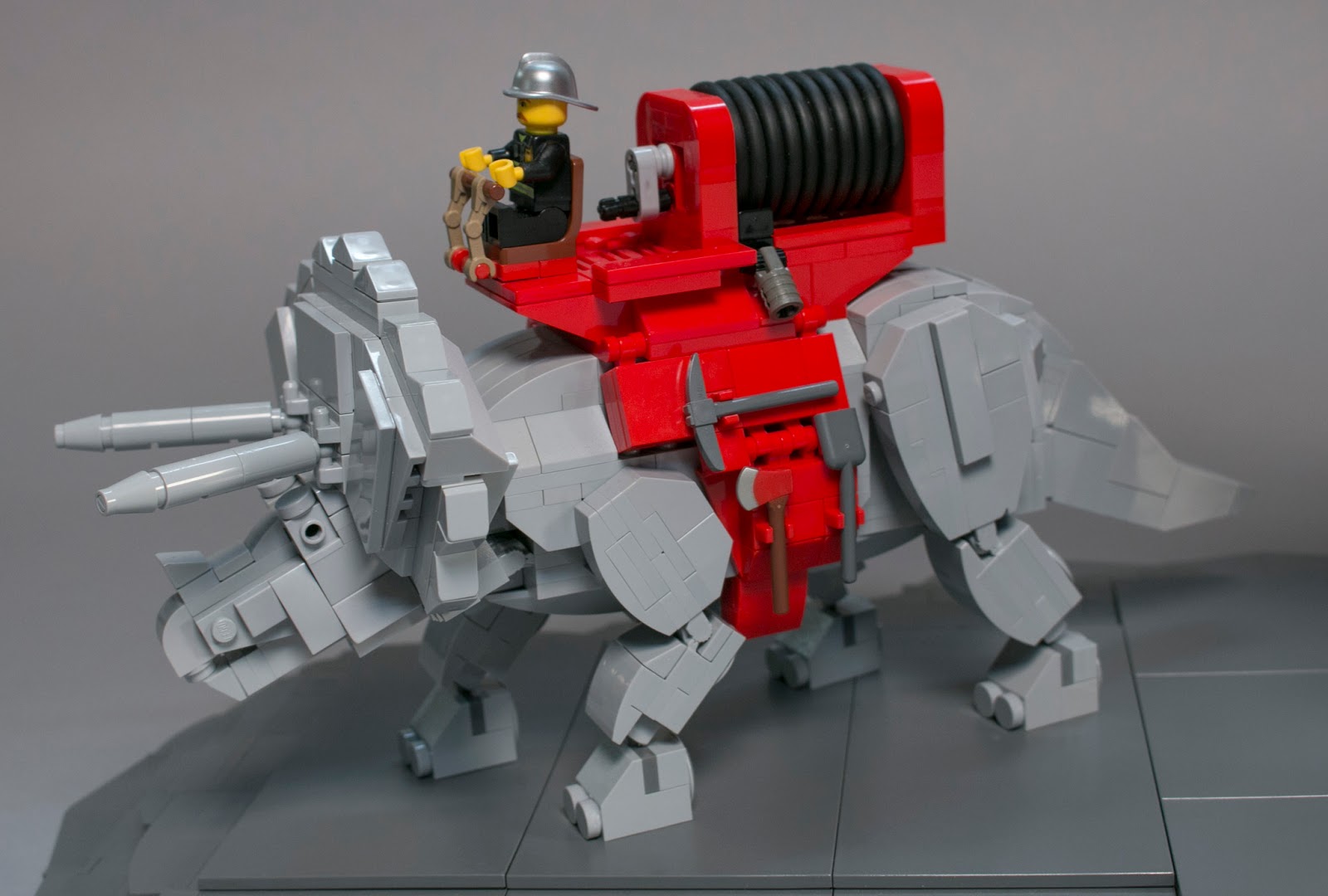
Building Dinotopia in Lego

Seattle area builder Shawn Snyder recreated the saurian-themed architecture of Dinotopia in Lego bricks.


The gold trimmed details of the pediment use dinosaur-shaped motifs, and pterosaur finials hover over the towers.


The dinosaur firefighting rig was based on a page spread from Dinotopia: Journey To Chandara.


The firefighter has his tools mounted on the side of his Triceratops saddle, with the hose reel right behind him.


More Lego creations on the site Brothers Brick 
Thanks, Michael Lynch

Sunday, February 18, 2018

'Still Going Strong'

J.C. Leyendecker, "The Open Road," 21 x 37 in.
This intense fellow, with his goggles, cap, and gloves, would have seemed amusingly old-fashioned when Leyendecker painted this ad for Amoco around 1942.

The shapes are lovingly crafted, from micro to macro. Note how the red necktie and the fringe on the scarf flap back in the wind, but the mustache juts forward. The little light spots between strokes add sparkle.
More info about the original painting

Saturday, February 17, 2018

Anna Boberg's Painting Rig

Swedish artist Anna Boberg (1864-1935) was a self-taught innovator, and she developed an unusual design for a plein-air easel.

Anna Boberg
The painting was held in a frame that attached to a waist band and propped up against her right leg.


In addition to her winter landscapes, Boberg was known for her writing and her Art-Nouveau ceramics.
-----
Anna Boberg on Wikipedia
Thanks Ricky Mujica and Gregory Dunham

Friday, February 16, 2018

Google Removes "View Image" Button

Google removed the "View Image" button from its image search results, with the goal of forcing users to visit the website if they want to copy an image file.


Google made the change because of a licensing deal with Getty Images. The change is frustrating to people who want to freely copy images (and many uses are copyright-free), but it's probably better for artists and photographers who want to control their copyrighted images. By going to the website, users will be more likely to see the usage requirements first.

There's a workaround, though. You can right-click the image when it comes up in results, and then select "View Image in a New Tab." Or you can select "Copy Image Address" to get the URL of the image. Paste that URL into a new tab and it takes you to the same place that "View Image" used to.

Another solution for getting better image searches is to use another search engine, such as DuckDuckGo, which gives you more usable image search results and doesn't track your search history for advertisers.
----
More on "The Verge"

Thursday, February 15, 2018

Ed Vebell's Nuremberg Sketches

Westport illustrator Ed Vebell died last week at age 96. One of his most remarkable experiences was sketching at the 'War Criminals Trials' in Nuremberg in 1945.
Field Marshall Goering by Ed Vebell, 1945
His job was to record the proceedings of the trial and document the key players. From his position in the press gallery, he could see the defendants, starting with Hermann Göring. 

"Göring still seemed to be in charge," Vebell remembers. "He gave the feeling he was still running the show. He had his uniform on, but he had lost a lot of weight." He looked sunken in, reminding Vebell of a collapsed parachute. 

Vebell’s Nuremberg portraits of Nazis
Rudolf Hess (top) and Wilhelm Keitel. 
Vebell sketched with a fountain pen, which allows no second thoughts or corrections. Since he didn't have any water, he achieved gray tones by using his spit to dissolve the water-soluble ink.

In his written notes, he described their demeanor, with its mixture of a rigid military bearing and a sense of hollowness.

He sketched while looking through a pair of binoculars because he was a little too far to get a clear portrait likeness. 

He pressed the binoculars against his glasses, holding them in position, and then flipped his eyes up and down to switch from the view to the sketch pad. 


In this 2013 interview, he recalls the experience. At 9:00 in the video, there's some archival footage of a Russian artist who also documented the trials, with a more caricatured approach. 

-------
Learn more