Wednesday, August 8, 2018

New Video: Painting Animals from Life


(Link to YouTube)
Many of you asked for a video that shows an entire painting from start to finish. This video delivers on that request two times over, with each gouache painting taking about 30 minutes.

One painting shows a Belgian draft horse getting washed on the day before the big parade. It's a complex, dynamic subject. Neither the horses nor the people hold still for more than a few moments. That makes the painting process challenging for me to do, but fun for you to watch, full of twists and turns. The other painting shows my son's husky mix named Smooth as he rests by the window. The intended audience is not only the animal lover, but also the general painter, from beginning to experienced.

69 minutes Widescreen, MP4 video. 
Digital download:

DVD
DVD at Amazon

REVIEWS
“James’ techniques are not only insightful but his knowledge of the animals’ structure and his love of his subjects shine through his whole painting process. A thoroughly enjoyable presentation.”
—Gary Geraths, Professor of Art, Otis College of Art and Design

“It’s amazing to watch him get right in there and start drawing with his brush. After that, the looseness of his blocking is wonderful because he knows where it’s going and he’s not afraid to just let the process play itself out.” 
—Aaron Blaise, co-director of Disney’s Brother Bear and founder of CreatureArtTeacher.com

“Animals are beautiful and a delight to see captured in art, but it can be oh-so-hard to do, as they just won’t hold still or follow direction as a model would. As an animation artist, I'm all too familiar with the challenge of capturing a moment in time. The design of the production opens the viewer up to a profound and deep understanding as to how each piece was created.” 
—Chuck Grieb, Professor of Entertainment Art & Animation, Cal State Fullerton

“It's magic to watch his paintings develop from big, loose shapes to finished pieces, and there's much to be learned from his thoughtful narration, which includes anecdotes about his models as well as lessons in color, anatomy and perspective.” 
—Shari Blaukopf, teacher and urban sketcher

“I found that when I'm teaching workshops, the artists are mostly transparent watercolorists and confused about using opaque mediums, and drawing first, then filling in the color. Your video shows them that the important part is laying in tones and values and getting your perspective and composition correct right away and then you can do as much detail as you want.” 
—Morton E. Solberg

“For starters, as artist and educator, James Gurney is a superb storyteller with the ability to delight, inform and entertain all the while setting you back on your heels with wicked skill sets.” 
—Donald Colley

“James is not only a master of life sketching but he’s an excellent teacher. In this video he breaks down his process into manageable parts while clearly expressing his approach to problem solving.” —Jeff Hein

Tuesday, August 7, 2018

'Painting Animals from Life' releases tomorrow


(Link to Facebook video)
Here's a video teaser for tomorrow’s release of “Painting Animals from Life.”


Shari Blaukopf says: "It's magic to watch his paintings develop from big, loose shapes to finished pieces, and there's much to be learned from his thoughtful narration which includes anecdotes about his models as well as lessons in color, anatomy and perspective.”
----
69 minutes Widescreen, MP4 video. 

Digital download

DVD

Landseer's Dog Studies


Edwin Landseer (English, 1802-1873) was an animal specialist who frequently drew and painted from life. He drew all the time: in books, on letters, even on checks.


He was the son of an artist and a child prodigy, mentored by a variety of artists and exhibiting in the Royal Academy before he was 20.


His knowledge of anatomy was profound as a result of his studies of ecorché specimens. He had an ongoing arrangement with his local zoo to dissect their animals after they died.


An early biography tells this anecdote:
"At a Court Ball at which the King of Portugal and Landseer were present, his Majesty expressed a wish to be introduced to the illustrious painter.
'Oh! Mr. Landseer,' said the King in a foreigner's English, 'I am delighted to make your acquaintance. I am so fond of beasts.'"


One time he was a guest at the Redleaf estate. His host, a faithful churchgoer, expected all his guests to accompany him on Sunday. Landseer declined to accompany the host and other guests to church, choosing to paint instead....


"...Looking out the window, he straightaway saw a spaniel catch a rabbit, and he proceeded to paint the scene from memory. When the family returned from church, they saw the finished painting, accompanied by a note: "Painted by E. Landseer in two hours and a half. Redleaf, August 1831."


Despite his success and his prodigious ability, Landseer was prone to depression and drinking. 

The Old Shepherd's Chief Mourner by Edwin Landseer
In his last years, he was vexed by failing eyesight, forced to rely on inadequate glasses right when PreRaphaelitism was all the rage. A fall from a horse evidently led to brain injury. After his death, houses and shops lowered their blinds, his bronze lions at Trafalgar Square were draped with wreaths, and he was buried in Saint Paul's.
 ----
Previously on GJ
Wikipedia: Edwin Landseer
Books: 
Sir Edwin Landseer by Richard Ormond
Free book on Archive.org: Sir Edwin Landseer by James A. Manson, 1902

"Painting Animals from Life" digital download

DVD
DVD at Amazon (Releases Aug. 10)

Monday, August 6, 2018

Teaser 1: Painting a Husky Mix


Here's a little preview of the new video on "Painting Animals from Life." (Link to Facebook video)

69 minutes Widescreen, MP4 video. 
Digital download

DVD

Animal Body Silhouettes

Let's start with basics. An art instruction book from 1862 says "a horse should not be mistaken for a cow, or a pig for a sheep."
Simplified outlines for a horse, cow, sheep, dog, and goat, Charles Weigall, 1862
He presents basic outline shapes for each type of familiar domesticated animal. They are constructed from the same three body parts: the shoulder, the rib mass, and the pelvic area. The cow holds its head lower than the horse, and it's much more bony and angular in the pelvis area.

The dog is the only meat-eater in this group, and his rib cage is consequently smaller and the waist thinner. He needs less gut to digest his food, so his frame is much lighter and faster than the goat or the sheep.


Weigall recommended sketching at the Zoological Gardens, where he said "every liberality is shewn to artists." I also like to sketch at county fairs, dog shows, and farms, warming up by drawing those simple silhouettes.

For my upcoming video on painting animals from life, which releases this coming Wednesday, I decided to heed a request that many of you have made: to follow a painting all the way from start to finish, so that you can see every step. In this video, I do this with both a dog and a horse.

Jeff Hein, who paints only from life, says: “James Gurney never ceases to amaze me. I’ve painted animals from life and it is hard. James is not only a master of life sketching but he’s an excellent teacher. In this video he breaks down his process into manageable parts while clearly expressing his approach to problem solving. I finished the video feeling like I might be able to channel James in my next painting attempt. Ok, that’s not likely, but I’m confident I learned a lot nonetheless. I highly recommend this video to any artist of any skill level.”
----
A Guide to Animal Drawing for the Use of Landscape Painters by Charles Weigall, 1862


"Painting Animals from Life" 69 minutes Widescreen, MP4 video. 
Digital download from:

DVD

Sunday, August 5, 2018

Old Woman Reading

Old Woman Reading, 1959, by Boris Ivanovich Kopylov 
(also listed online as Boris Ivanovich Mayorov) (1931-1991) 
I love the honesty and compassion of this portrait. The subject feels like a beloved relative overcoming her physical frailty with inner strength.

The pose and the reflected lighting seem natural, as if the artist discovered the arrangement. The tones and shapes are simple, and the shadows are unified. The treatment of the face, hands and hair are realized with care and subtlety, but there's no more detail in the rest of the picture than there needs to be.

Tomorrow we start Live Animal Week.

Saturday, August 4, 2018

Realistic Graphics via Voxel Cone Tracing


Creating photo-real graphics in real time on a normal computer is difficult because it requires calculating light transport, or the infinite potential pathways of light rays that interact with the subject at hand.

By using a technique called voxel cone tracing, a remarkable level of naturalism is possible within fast computational times, which makes it applicable to video game graphics.
--
Watch the YouTube video by Two Minute Papers

Friday, August 3, 2018

Animal Painting Video Releases in 5 Days

The next painting tutorial video is called "Animal Painting from Life." It releases on Wednesday of next week.


Many of you asked for a video that shows an entire painting from start to finish. This video delivers on that request two times over, with a painting of a horse and of a dog. Each painting takes about 30 minutes.


You'll be able to see what I'm seeing and hear what I'm thinking, starting with the first lines of the drawing. 

Even if you don't sketch live animals, you'll learn a lot about painting methods that you can apply to any subject. 


One painting shows a Belgian draft horse getting washed on the day before the big parade. It's a complex, dynamic subject. Neither the horses nor the people hold still for more than a few moments. That makes the painting process challenging to do, but fun to watch, full of twists and turns.


The other painting shows my son's husky mix named Smooth as he rests by the window. This gouache portrait also develops all the way from start to finish. 

Along with painting tips, the voiceover is peppered insights about dog behavior and psychology.


Gary Geraths, Professor of Art at Otis College, says:  “James' techniques are not only insightful but his knowledge of the animals’ structure and his love of his subjects shines through his whole painting process. A thoroughly enjoyable presentation.”

Chuck Grieb, Professor of Entertainment Art & Animation, Cal State Fullerton, says: “Animals are beautiful and a delight to see captured in art, but it can be oh-so-hard to do, as they just won’t hold still or follow direction as a model would. As an animation artist, I'm all too familiar with the challenge of capturing a moment in time. The design of the production opens the viewer up to a profound and deep understanding as to how each piece was created.”
------
"Painting Animals from Life"
69 minutes Widescreen, MP4 video. 

Digital download

DVD

Art Materials:
Pentalic watercolor sketchbook
Travel brush set
Water-soluble colored pencil
Water cup
Homemade easel
Tripod
Gouache 
Holbein (gouache):
M. Graham (gouache)
Winsor & Newton (gouache)
Shinhan Pass (watercolor/gouache hybrid) 

Thursday, August 2, 2018

Anders Zorn in Algiers


In 1887, Anders Zorn painted a man and a boy on a balcony in Algiers.


The painting is a sensitive study in warm and cool colors. You can see from the "bead line" over the head below how he returned with a big wash of blue over the main figure to deepen the color of the sky.


Bonhams auction house tells how the painting came to be:

"In the New Year 1887, Anders Zorn and his wife Emma (née Lamm), travelled from Sweden to North Africa to spend the winter in Algiers. There were strong European influences in Algiers at this time, even a small circle of Swedes including the physician and author Axel Munthe. Zorn met up with his fellow artist Robert Thegerström and together they rented a 'Moorish' house with a roof terrace and inner courtyard in the old town, the Casbah, where they could paint figure studies using hired models. Zorn writes, '[We] rented for ourselves an Arabian house far up, where we could paint, and took on a servant, an Arab, who got models for us, which was otherwise quite difficult work.'


"The main reason for the trip to Algiers was that Zorn had a commission from the Swedish King Oscar II to paint something from the Golden Horn. The subject that he chose was 'the Arab women who came to a priest down in the harbour to be blessed. Then they usually went down some stairs to the water and removed the veil from their faces as long as they knew no-one was looking. I chose to paint this scene and made studies in the harbour with Algiers in the background and then painted the figures on our roof.'

"In a letter from Algiers, dated 17th March 1887, Emma Zorn writes to her mother, 'Today Anders finished the large picture. It is lovely and in my opinion one of the best things he has done.' The watercolour From Algiers Harbour is nowadays to be seen at the museum, Prince Eugen's Waldemarsudde in Stockholm.

"In the present watercolour Zorn's interest in the strong and characteristic North African light is combined with his interest in exotic models and the use of traditional dress. A man and boy are sitting and standing in intense sunlight on what might be the roof terrace of the house rented by Zorn, looking out over the sea. The dark face of the man creates a strong contrast to his white dress. The colour scale keeps to light blue, grey and white, just as it does in many other of Zorn's pictures from Algiers. The scene invites an interpretation of Orientalism; however Zorn has also presented an everyday picture of life in the North African city.
----
Book: Anders Zorn: Sweden's Master Painter 

Wednesday, August 1, 2018

"Paint a Parking Lot Challenge" Results

In last month's Paint a Parking Lot Challenge I asked you to paint a car park on location using whatever medium or colors you want.

We had over 44 inspiring responses from artists around the world, ranging from seasoned professionals to people just starting out on the adventure of painting. You braved heat, moonlight, rain, passersby, wild animals (well, a fox), bugs, and wind, plus cars that wouldn't stay put.

It was really hard to select the winners. I was impressed with everyone's effort, and grateful to all who participated. In this post I want to spotlight a few of the results that I thought made the most of the opportunity.

The painting by Steve Hughes, a Professor of Illustration, really stood out, so I would like to give him the Grand Prize. I love the care he gave to the excavator, and the cool colors behind it that made the yellow and black stand out. 

He says: "This is the parking lot near the Ore Dock in Marquette, MI. June 28–July 2 (rained several days in the middle of this span)."


He continues: "I think this machine has been parked here for more than a month. So, I was able to take a few days to finalize this one. Working in gouache and Moleskine sketchbook." 

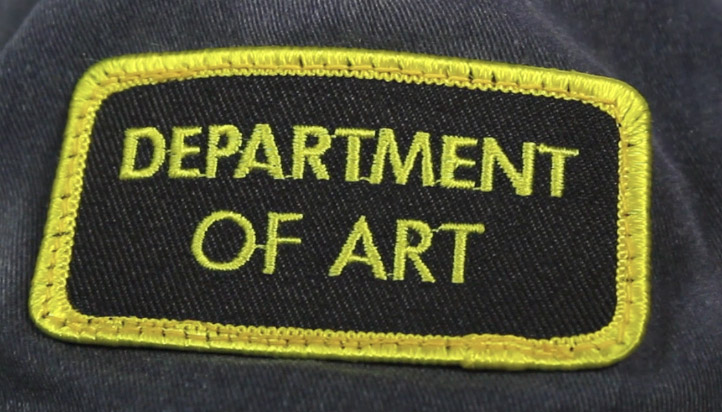
Steve receives a "Department of Art Patch," and a choice of three video downloads or DVDs.
-----


Next winner is Wendy Line. I like the way she captured the shadow under the parking porch, with the varied colors of the cars. 

She says: "This is a parking lot at the Port of Fremantle in Western Australia, painted in gouache. The building behind is the oldest original port shed, built in 1903 and one of seven that still line the harbour."


Wendy continues: "Some of these sheds are used as retail venues while others are empty and awaiting renovation. As a working port with many heritage buildings, Fremantle is a popular place to visit. I'm filling up sketchbooks with the local sights but usually avoid cars, so this was a good exercise." 

Wendy and all the next winners will receive a Department of Art Patch and choice of one video download.
-----


The next one is an abandoned photo booth at the corner of a parking lot by Joshua Davis (5x7 gouache on crescent panel).

The image brings back memories to me of stopping at these places. I love the desolation of this casualty of changing technology.


He says: "I really liked the mint green paint job... I took some liberties with the background."
-----


This one by Al Granberg really is a portrait of a parking lot, cracks, litter, shadows, and all. He says:
"My parking lot selection is one of the several parking lots on the grounds of the closed Shakespeare Theatre in Stratford, Connecticut. It’s close by and I go there often to sketch the magnificent old trees and historic buildings on the scenic grounds. The large parking lots, once busy, are now empty and neglected, except for the locals who park their cars in the shade to enjoy the scenery and solitude."

"I thought the trash-filled steel drum on the crumbling asphalt peninsula would provide a bit of interest to my composition and so that is where I set up my easel."


"Painting an expanse of featureless asphalt, forced me to focus on whatever color and textures I could depict. The shadows helped to add shapes and patterns that break up the gray, as did the network of cracks. As I worked, I thought of work of Robert Vickrey, who specialized in painting magnificent egg temperas of asphalt and cobblestone streets and parking lots. The finished painting is 8 x10, painted with casein on illustration board."
-----


Next up is Meredith Moles, who painted the Motel 6, Fort Bragg, CA. using Acryla Gouache on panel. I love the pure ordinariness of the motel lot and her story of her encounters:

"This is one of two paintings I did on vacation this week. It was the first time I’ve finished a painting on site! The other painting was done at a Botanical Gardens, where the passers-by were rather stand-offish, most seeming not to want to bother me. But at the Motel 6, people were interested and chatty and really delightful. I talked about painting and heard about travels, grandchildren, cars, and what it’s like to have a pet pot-bellied pig. (The pig, who must have weighed 200 lbs, was getting a break from her hotel room and enjoying a walk in the parking lot!)"


"Like others, I found it challenging that cars were coming and going, and decided to give myself a break by parking my own car in a key spot in the painting. The red was a good addition, I think. I was also grateful for the grey skies so there were fewer moving shadows, and in any event I love the moody, foggy Northern California coastal atmosphere."
-----

One of the standouts using pure watercolor was by Tony Coniglio, who says:
 "The painting is done with a Van Gogh pocket watercolor set, in my #PerfectSketchbook .
Kept it loose which is something new to me to do , mostly try to put a lot of detail in my work, but this was fun to do."


"This is the parking lot next to The Mutual of Omaha. Facing another parking lot of a popular local German and specialty beer pub."
-----


And finally I'd like to give a prize to Max Rebo from Germany, who did a fine painting of a store he remembered from childhood, and he made a video about it. (Link to YouTube).

Have a look at the Facebook Event page where all the entries are posted. My compliments to everyone who joined in, and hats off to those of you who bravely painted outside for the first time, or painted in gouache for the first time.

So Max, Tony, Meredith, Al, Joshua, Wendy, and Steve, please contact me to let me know which video you want and which mailing address to send your official "Department of Art" patch.
-----
Original blog post about the Parking Lot Challenge.
Facebook page for the Parking Lot Challenge.