Sunday, March 10, 2019

Sorolla's Method

 Joaquín Sorolla, Afternoon Sun
How did Joaquín Sorolla produce paintings of such dynamically challenging subjects: kids, boats, oxen, wind, and waves?

Sorolla Washerwomen (sketch), about 7.5 x 10 inches
A 1911 article on Joaquín Sorolla describes his method.


"Sorolla's habit is to observe nature very carefully, to see all that is going on at the beach, sketch attitudes and movements, sometimes very strange ones, then select his models and make careful drawings. This careful drawing never seems to disappear."

Photo of Sorolla painting. Note the rope stabilizing the top of the
canvas and the heavy weight hanging from the easel
"He takes his paraphernalia to the beach, poses his models as nearly like his sketch as possible, but never allowing the stiffness of the model to interfere with the elastic drawing he has made, and then paints the sea and the sky, the sliding water and the beautiful shadows as he there sees them."

Juaquín Sorolla, Before Bathing
"The work is a commingling of careful thought and study with lightning-like impressions. Thus we see beautiful attitudes, beautifully drawn and the most brilliant vagaries united."

The article describes a painting of boys swimming, and says: "The artist took down six boys to the water. Three of these he set to swimming, and when they were tired they wrapped themselves in blankets while the other three went at work, and so on alternating throughout the day. Although he paints with extraordinary swiftness, the picture of life size boys requires time."

"It is no easy matter to work on the sea beach, especially when the size of the canvas is four or five feet. Of course the wind always blows and a canvas is a kite. Not alone could it be easily carried off by the wind, but the linen itself is liable to tremble and flap because of the windy gusts."

"Fortunately for him Sorolla is rich enough to secure every contrivance, and to take with him a sufficient number of attendants, to manage all the details, to anchor down his easel and to fly to his assistance in case of need. He frequently stretches his canvas on a big drawing board, and, it is not uncommon to find places in the pictures where he has planted thumb tacks through the canvas to keep it perfectly still."
----
Read More
• Online article on JSTOR: Sorolla the Spanish Painter, His Art, by James William Pattison, Fine Arts Journal, 1911.
• Previously blog posts on GurneyJourney: Sorolla Painting on the Beach and Photos of Sorolla Painting
• Upcoming exhibition: "Joaquín Sorolla: Spanish Master of Light" opens 10 August 2019 at the National Gallery of Ireland.
• Book: Sorolla: The Masterworks

Saturday, March 9, 2019

How Do You Stay Relevant in the Freelance Life?


An art student named Corey asked two questions:

1. As an illustrator who has been relevant for a long time and still is relevant today, you have seen how the industry has changed. What advice can you offer so that we will always be a way to maintain our value as illustrators in this ever changing industry?

I don't know if I'm relevant or just a living fossil!

Fortunately, the Universe of Art has many planets. I just choose to live on the one dedicated to imaginative realism and physical media, because there will always be a demand for those.

Here are a few thoughts to keep in mind. As with any other creative endeavor, visual art is competitive. You have to produce among the best work in your category. That means making the extra effort, studying and sketching, improving your weak points, whether it be lighting or gesture or form or perspective, or landscape.

No one arrives at a bountiful career and just settles into the harvest. The survivors are always improving and learning.

Economic realities change. Anyone who has been around a long time has had to re-engineer their business model a few times. This is true whether you work as a comic artist, an illustrator, a film designer, or a gallery painter.

Computer technology has driven a lot of changes in the last three decades, with new business models springing up around social media, crowdsourcing, and digital distribution.

Taste changes too. There will always be an appetite for novelty. You can be a classicist, but you still have to come up with something no one has ever seen before.

If your work is original and if it draws deeply both from your imagination and from the world around you, your work will continue to have relevance. Take your inspiration first from your own experience. If you want to get fired up by the art of others, look at artists of the past or from other cultures, not your close contemporaries.

Tap in to the thing that you loved about art when you were a teenager. Stay alert to new opportunities, new clients, new ways of reaching your audience, and experiment to see what works and what doesn't.


2. Most of us will at some point will become freelance artists and I know that is how you started as well. What tips can you give that you have learned to help you find and establish connections with clients?

To find clients, go to conventions, send around postcards, and maintain a good website and Instagram account. Once you get trusted with an assignment, hit it out of the park and do everything you can to make your client happy.

I regard any kind of freelance art as a form of collaboration. For example, if you're painting a paperback cover, you'll need to work closely with the art director, and your job is to bring the writer's vision to life for the reader.

If you're concept artist, you are visualizing a director's ideas. You're not just painting pretty pictures. When I do paleoart illustrations for science magazines, I'm mindful of enlisting the input of the editor, art director, and scientific consultant at various stages of the process.

As with any other dealings you have with other humans, communication is the key. Your job is to make a great picture, of course, but your task is also to lower the blood pressure of the art buyer, and to help your client win.

One thing I like to do is to produce behind-the-scenes video content for the social media feed of my magazine client. They can't afford to hire a videographer and they're hungry for content. If you can provide that, you'll be doing them a favor and yourself a favor, and you'll make yourself much more valuable to them.

Above all, be reliable and deliver on time. As Neil Gaiman once said, you need to: 1) Be really good at what you do, 2) Deliver on time, and 3) Be pleasant to work with. If you can accomplish two out of three of those qualities consistently, you might be able to make a living, but it's a good idea to be able to deliver on all three.

Friday, March 8, 2019

Art Advice from Anna Airy

Anna Airy, Verdure and Decay, watercolour
In a recent post I featured Anna Airy, who documented the factories in World War I.

She also wrote an instructional book called "Making a Start in Art."
Here are some excerpts:


Eye level
"You will find, by holding up your pencil or brush horizontally on a level with your eyes and extending it forward to arm's length, a mental horizontal line across your view. The boundaries of your picture having been decided by framing it with your hands, translate that mental observation into an actual light pencil line right across your paper, the eye level, and mark it E.L."

Don't touch wet watercolour
"Do not touch wet watercolour—wait. However bad it looks when wet, it will not look so bad dry and you will get over the trouble more easily."

Half-closing the eyes
"It is very helpful to half-close your eyes every now and then when working; look through the lashes; this partially shuts out for the moment masses of detail that may be worrying you. This is not done with the idea that the detail may be left out to avoid trouble, but to let you see how subservient is that intricate detail to the picture seen as a whole."

Keeping things in proportion
"Do not be led away into making a lot of little measurements, each of which is in all probability a little wrong (and error multiplies): run your eye over your subject as a whole and take note of the proportion of big things to one another, remembering that the greater is bound to contain the less, so that if you get your few big proportions roughly correct, all the smaller objects will fall into their places without much difficulty."

Should we ignore detail?
"Never say, 'Oh! I don't see detail' and 'The detail doesn't matter.'"

How to paint a background around a complicated shape in watercolour
"Take a good brushful of the background colour and go carefully round your difficult flower petals first, leaving a real wet track. It will not dry in a hurry; if you wanted it to you would have to wait a long time! Then start your background wash at the top as you have done in previous examples, and continue it down until it meets the already wet colour round the flowers. When the washes meet you will have more wet colour than you want round the flower petals; take the squeezed-out brush, as before, and very lightly remove some: the remaining wet colour will probably settle itself quite comfortably. You must be neat-handed and careful! Or you can remove the extra moisture with a little corner of blotting paper, like taking off ink blots. Or you may effect the whole process by turning the work upside down."


Assorted thoughts
• "Our business is to be the eyes and the brain for other sorts of people."
• "Key your picture from its highest light, which we will assume to be, as it so often really is, the sky.
• "Don't look at the thing you're painting, look just beside it." (Attributed to James J. Shannon)
-----
Book on Amazon: Making a Start in Art
Previously: Anna Airy's Industrial Art


Thursday, March 7, 2019

Sketching at Boring Meetings

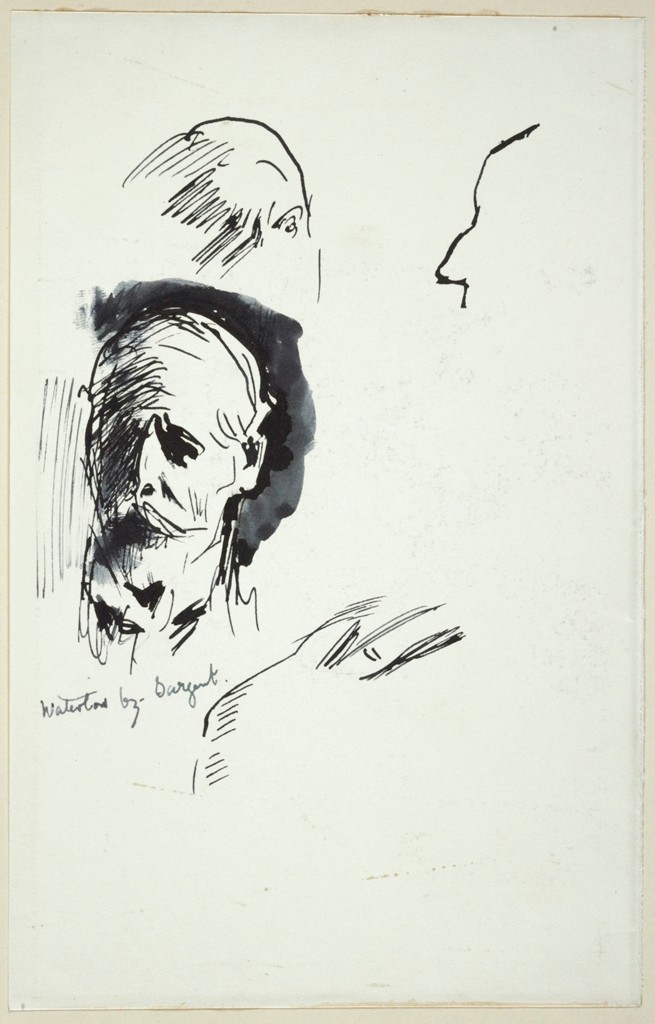
John Singer Sargent (1856-1925) didn't like to speak up at meetings, so he reached for a pen and some paper instead.

J. S. Sargent, Sketch of Sir David Murray (1849-1933)
and John Seymour Lucas (1849-1923)
Martin Birnbaum, in his recollections about John Singer Sargent, said: "When he felt bored during some of the meetings of the Royal Academy which he was obliged to attend, he would pass the time making sketches of his fellow members, and Sir David Murray collected and preserved a volume of those hasty impressions."


Sargent's pen immediately sought out the essential lines and planes of the face.

Portrait Sketch of Sir Ernest
Albert Waterlow, R. A. (1850 - 1919)
Sometimes he seemed to be looking for a quick tonal statement. 

Caricature Portrait of Mrs. George Mosenthal
Other times he went for a humorous or highly reductive caricature, probably from memory. He even playfully experimented with tessellation and symmetrical ink blots.

Sargent's quick sketches show how he could bring a variety of visual tools to play in stating the essence of a person. Edwin Blashfield called him a "master of masters" and "a mind with a quite outstanding visual outlook." (Source
----

Wednesday, March 6, 2019

T. rex Teaser #2

In a shallow stretch of a freshwater stream, an adult Tyrannosaurus rex introduces three juveniles to the water and supervises them while they bathe.


I develop the scenario after watching YouTube videos showing the bathing behaviors of ostriches, emus, and cassowaries, plus a lot of kinds of birds. First they squat down into the water, then stretch upward and shake, followed by self-preening. The juveniles still have their light coloration and haven't yet molted into their adult layers of feathers.


The feathers are based on the fact that all members of the tyrannosaur group which have been found with detailed fossils (such as Dilong and Yutyrannus) show feathers. Among my scientific consultants was tyrannosaur expert Steve Brusatte, who said: "I am particularly really moved by the one of the adult and juveniles bathing in the stream. It brings these predators to life in a way that hunt scenes don't--it makes them seem more like normal animals, not monsters."

This oil illustration is coming up in the April issue of Ranger Rick magazine. (Link to video)

Tuesday, March 5, 2019

Sirens and Water Nymphs

Greek mythology presents a number of female water spirits, such as sirens, nymphs, and mermaids. 

Arthur Prince Spear (1879-1959)
In an era when the undersea world was still unexplored and wrapped in mystery, artists portrayed the female nude in settings that were evocative and romantic.

Oceanides by Gustave Doré
The siren was a dangerous but enchanting femme fatale whose beautiful song lured mariners to their deaths.  But other female water spirits were regarded as helpful to sailors.

Hugo Hoppener, Water Nymphs
According to Wikipedia, water nymphs or "Naiads were associated with fresh water, as the Oceanids were with saltwater and the Nereids specifically with the Mediterranean." 

Henrietta Rae, Hylas and the Water Nymphs
"The ancient Greeks thought of the world's waters as all one system, which percolated in from the sea in deep cavernous spaces within the earth." So, to the Greeks, the fresh-water and salt-water nymphs overlapped.

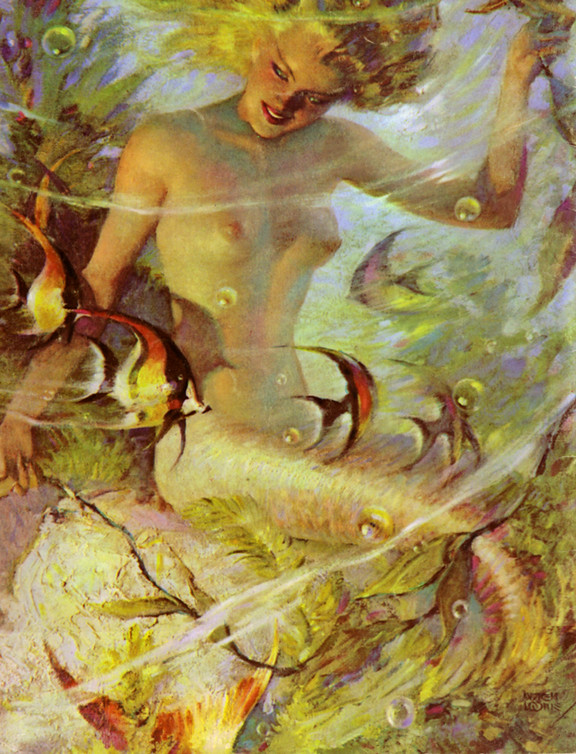
Andrew Loomis, mermaid
The general public in the 20th century is less familiar with the details of Greek mythology, so artists  can't count on people knowing the myths that were taken for granted in centuries past. 
-----
You can find other paintings of female water spirits in the work of John William WaterhouseHerbert Draper, and Howard Pyle, who I've talked about before.

Monday, March 4, 2019

Painting the Winter Forest

Winter Forest, gouache, 5 x 8 inches
I hiked into the snowy forest to paint this little gouache study.


In the video is a little glimpse behind the scenes (Link to YT Video).
-------
Follow me on Instagram

Sunday, March 3, 2019

New Book Recommendations


I've been enjoying these new books, and I thought they might interest you, too.


192 pages, 10 x 12 inches, hardback. Publisher: Yale University Press
The catalog that accompanies the current exhibition in Milwaukee includes over a hundred color reproductions of the French academic master's work, including many detailed, full-bleed closeups that let you survey the paint surface. The exhibition of nearly 50 major paintings covers his whole career, from his early historically inspired works to his later paintings of Italian children and angels. The text by Tanya Paul, Stanton Thomas, and four others focuses on Bouguereau's popularity, his standing with critics, and what drove American collectors to prize his works. Unlike the catalog from the 1984 exhibition, the text doesn't really look into his teaching principles and painting methods.

End of the Megafauna: The Fate of the World's Hugest, Fiercest, and Strangest Animals
256 pages, 8.3 x 10.3 inches
Dinosaurs get a lot of attention, but the large mammals and birds that flourished in the last few million years were just as amazing. There were 9-foot-tall flightless birds, gorilla-size lemurs, and massive sloths. Except for a few familiar survivors like elephants, giraffes, bison and moose, these megafauna or giant animals are all extinct. Until recently, it was assumed that they were all killed off by human hunters, but the actual story may be more complex. The author is Ross MacPhee, a paleomammalogist from the American Museum of Natural History, who has conducted over 50 expeditions to nearly every corner of the globe. He explores all the competing extinction theories and explains how we've learned about paleoenvironments and phylogenetics. The book is amply illustrated with new paintings by Peter Schouten, along with photos and diagrams.
-----

The Rise and Fall of the Dinosaurs: A New History of a Lost World
416 pages, 8.9 x 6.2 inches 
Steve Brusatte is a young American paleontologist who has been involved with many key new discoveries in this current golden age of dinosaur science. He starts his account with the rise of the dinosaurs as unimpressive small creatures living at the fringes of Triassic environments that were dominated by other, bigger creatures. He then tells what happened as dinosaurs came to dominate world ecosystems, culminating with famous types like the Tyrannosaurus rex (one of Brusatte's specialties). He ends his story by examining various extinction theories that explain how all but the birds were wiped out. Woven through this well-written scientific account are his personal stories of discovery and collaboration with other scientists. This book will appeal not just to dinosaur fanatics but to any general reader.
--------

352 pages, 10.5 x 12 inches This unique picture book features over 300 images of animals taken from many different cultures and from eras ranging from the ancient world to the present. The images tell the story of animals and our response to them, and will prove stimulating and inspiring to any visually driven person. The book's promo copy gives a sense of the scope: "From the first cave paintings, extraordinary medieval bestiaries and exquisite scientific illustration, to iconic paintings, contemporary artworks and the incredible technological advancements that will shape our futures together, the huge range of works reflects the beauty and variety of animals themselves - including butterflies, hummingbirds, bats, frogs, tigers, dogs, jellyfish, spiders and elephants, to name a few."
-----


Illustrator, writer, and concept artist Simon Stålenhag has produced three stunning volumes of visual science fiction, and they're all inspiring and well executed. The first two, Tales from the Loop and Things from the Flood, describe an alternate 1980s universe where big research firms have built mysterious giant robots and underground facilities that for the most part aren't working anymore. Things start to get weird as some teenage kids begin exploring them. Stålenhag's most recent book, The Electric State, tells a separate story set in the USA, about a woman and her companion robot crossing post-apocalyptic landscapes trying to solve a mystery. For the most part the illustrations are set in mysterious twilight or fog.
----

How to Read Water: Clues and Patterns from Puddles to the Sea
Author Tristan Gooley is a world explorer, pilot, and sailor. Throughout his explorations he has made  many fascinating observations about the behavior of water. His book is divided into chapters such as "rivers and streams," "the color of water," "reading waves," and "water at night." He concentrates on both commonplace and exotic observations. The book is full of well-written explanations that deepen your appreciation of the earth's universal material. The book resembles the kind of observations you might have read in my own book, Color and Light, or the classic in the field of backyard science, M. Minnaert's The Nature of Light and Colour in the Open Air.

Saturday, March 2, 2019

A Typewriter Drawn in Scratchboard

In the July, 1938 issue, Art Instruction Magazine published this fine example of scratchboard art.


Scratchboard is a form of pen and ink drawing executed on a clay-coated surface. Black lines and areas are drawn with pen and brush, and then white lines are scratched away with special tools that fit into nib holders.

Scratchboard was used extensively for product illustration because it reproduces better in print than halftone photos do. Scratchboard comes in black and white. This example would have been done on white board.


Art Instruction said: "Scratchboard is particularly well suited to subjects which, like the typewriter, call for rendering in dark tones. Relatively small areas need to be scraped and there is great economy of effort in producing the desired effect. That is of course but one reason for its use. When skillfully handled it has a peculiar charm associated with wood engravings."

Art Instruction magazine later changed its name to American Artist. It was founded by Ernest Watson and Arthur Guptill, who wrote some classic drawing books in the mid-20th century.
Pen and ink drawings—and scratchboard drawings in particular—unfortunately just don't look as good on a computer screen as they do on a printed page, and maybe that's why we don't see as much great pen work these days. 

Friday, March 1, 2019

Reimagining Rembrandt's Painting Procedure

To honor the 350th anniversary of Rembrandt's death, a team of scientist, historians, conservators, and artists have created what they believe is an authentic reconstruction of Rembrandt's procedure for painting a portrait.


#1 Preparation and Sketch (Link to video #1)
In the first 10-minute video, an artist prepares the canvas and draws the guidelines. The voiceover, in Dutch, is supposed to be Rembrandt teaching a student.


#2 Materials and Underpainting (Link to video #2)
The procedure continues with more about the materials and the early stages of establishing the light and dark. Experts from the Rijksmuseum say they based this procedure on the study of 60 self-portraits.


#3 Light and Dead Color (Link to Video #3)
The third installment goes deeper into the interplay between light and dark. The greyed-down tonal statement, called "dead color" ("Doodverf" in Dutch) is made to be glazed with warm transparent layers to bring it to life.


Behind the Scenes: How they created Rembrandt's voice (Link to video)
The voiceover reconstructs Rembrandt's sound and style, based his writings and his facial metrics. For this back-construction, they worked with forensic speech analysts from the FBI and Carnegie Mellon.

I would like to commend the officials at the Rijksmuseum for funding this effort to better understand Rembrandt's painting procedure. It's part of a trend where museums are engaging with living artists to reconstruct the painting procedures of artists from the past.
---
Thanks, Christoph Heuer