Saturday, September 10, 2022

Using AI to Guess How a Painting Was Made

Scientists have developed machine-learning system that analyzes existing paintings and reconstructs how they might have been painted.


The authors say:
"The system, which the team calls “Timecraft,” was trained on more than 200 existing time-lapse videos that people posted online of both digital and watercolor paintings. From there, the team created a convolutional neural network that can look at a new painting that it’s never seen before, and figure out the most likely way it was created."

The study is a couple years old now, and with more extensive training data and more computer power, the results would now be a lot higher resolution and more accurate.

Friday, September 9, 2022

Quick Sketch of a Resting Dog

Smooth and I wait at a picnic table outside the Culinary Institute's Egg Café while the rest of my gang goes in and gets supper.


Here he is in watercolor, colored pencils, fountain pen and white gel pen.

I sometimes go straight to watercolor+  because it’s the fastest technique, and you need FAST when you’re sketching live animals.


Thursday, September 8, 2022

Obamas' White House Portrait


The Obama Foundation produced this behind-the-scenes video of Robert McCurdy and Sharon Sprung painting the official White House portraits of Barack and Michelle Obama. (Link to YouTube)

Mr. Obama's portrait shows him in a dark suit against a white background.


The emptiness of the background removes him from context and focuses the viewer on his expression and posture, because there's nothing else to look at. 

White backgrounds can suggest many things: the contemporary gallery wall, the unwritten page, the mysterious, luminous void. What a white background doesn't suggest is wealth, heritage, power, status, or cultural milieu—all the usual trappings of official portraiture of a former head of state. 

Maybe such associations were impossible in the case of Mr. Obama, and the artist made the best choice, I don't know. 

The idea of the white background isn't new. Photographer Richard Avedon presented many of his subjects against a white seamless. In Avedon's case it often had a leveling effect, cutting through normal distinctions of status or power and making everyone equal. It could even have a clinical flavor that made the viewer examine the way the subject presented himself or herself. 

When director Alfred Hitchcock made the praying gesture against a field of pure white, one wonders why he presents himself that way, and how sincere he is.


When painter James Bama used the white background for his portraits of Western characters, he invited us to study the details of their face and costume, and from those clues to wonder about the character of their working life.


Wednesday, September 7, 2022

Grid Illusion


The photo above is in black and white. But it looks like it's in color because there's a subtle grid laid over it. 

The phenomenon is called the 'color assimilation grid illusion'. [Source] Thanks, Massimo 

Tuesday, September 6, 2022

Sketches for Dinosaur Parade

I did a lot of sketches before painting "Dinosaur Parade."

I interpreted the scene in a variety of techniques: red chalk & charcoal, pencil & wash, markers, and oil.


What would the scene look like from high up on a balcony, or from a child's perspective, looking up?
There are probably 100 more like these, all drawn purely from the imagination.


Once I decided on the composition, I located maquettes, models,
costumes, and reference photos to help me visualize the complete scene.

The painting appears in Dinotopia: A Land Apart from Time.


Monday, September 5, 2022

Puppet Dog "Smooch"

 Smooch thinks he's Smooth's little brother.


But Smooth isn't so sure. I think he doesn't pass the smell test.

Sunday, September 4, 2022

Image-to-Image Style Transfer

Suppose you made this rough sketch and wanted to finish it in a photo-real or painterly style.


Twitter user @TomLikesRobots is a digital artist who did just that, using the new image generation tool called Stable Diffusion (#stablediffusion), the open-source model which has a powerful feature called Image to Image (#img2img). 


He uploaded the sketch and told the system to render it as "A black and white photo of a young woman, studio lighting, realistic, Ilford HP5 400." The hair style is a little different, and the ear is weird, but the basic pose and lighting is pretty close to the sketch.

Tom says: "Overall, composition is controlled by the sketch and the details are controlled by the prompt. 
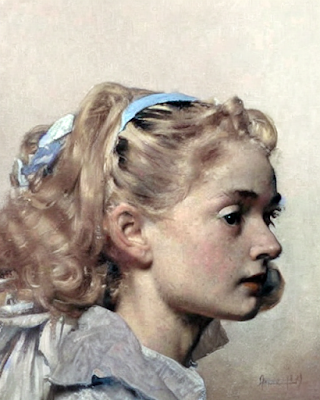


This time he told it he wanted it to make the sketch look like "A portrait of a young woman by Norman Rockwell." 

It looks like a painting, but not much like Rockwell—more like a Victorian artist like Charles S. Lidderdale. On close scrutiny it doesn't hold up too well: the blue ribbon and the costume don't make sense, and her left eye has too many eyelashes.


Here's the sketch rendered in the style of Gustav Klimt. It's got a lot of drawing problems that Klimt never would have allowed, but it is somewhat reminiscent of his style.


And here's the sketch as painted by Vincent Van Gogh. Again, we can pick it apart, but it's in the ballpark.

.
And finally Alfonse Mucha. He is one of the hardest to emulate. It used soft internal transitions and clear outline.

The system was also able to translate the sketch into the features of famous celebrities:

Selena Gomez

Scarlett Johansson

Nicole Kidman

Emma Stone

All of them have big problems with the hair, but they're recognizable, and let's admit the tech is in its infancy and will only get better.

If you're an artist, you might find all this a little scary, threatening, or astounding. I do too! I feel like we've been introduced to a magical genie who can bring whatever we wish into existence.

Some have responded by calling for laws to ban the technology from creating images in the styles of living, working artists. What if someone created a print for sale that was supposedly painted by you or me?

I think we have to be careful how we respond to this apparent threat. Let's keep in mind that the technology is transformative, meaning it doesn't copy/paste images. It creates something new. And artistic styles can't be—and shouldn't be—copyrightable. These tools are here to stay. They're only going to get more advanced, and they're open-source. Also the people who are developing it are artists, too. 

I'm wary of laws or AI bots that restrict the growth of this new art form, or that drive the prompts underground. Instead of involving politicians and lawyers and AI bots, we should encourage a culture of mutual respect and fair play. Perhaps we should encourage generative artists to share their prompts when they use a living artist's name, and never to mislead their audience into thinking the work was actually painted by that artist. Basically, people should give credit where credit is due.

How do you think we should regulate or guide this new art industry?

Saturday, September 3, 2022

"Same Energy"—A Visual Search Engine

Same Energy is a free website that describes itself a "visual search engine."

On the home page you're presented with a wide assortment of images laid out in a tiled array. When you click on the image of your choice, it will find more images with the "same energy." 


The interface is fun for artists to use because it doesn't use words. It employs machine learning software to recognize similar looking images from a huge array that it finds on the web.


You can use it to research photography styles, art subjects, interior decoration concepts or fashion trends.

Friday, September 2, 2022

Painting in the Rain in International Artist Magazine #147


RAIN is the plein-air painter’s best friend — and worst enemy.


I included some of my favorite stories about painting in the rain in the upcoming issue (#147) of International Artist Magazine.

Thursday, September 1, 2022

Andrew Wyeth's Images of Death

Andrew Wyeth, Spring, 1978, tempera, 24 x 48

Andrew Wyeth was always fascinated by the subject of mortality.

Andrew Wyeth, Dr. Syn, 1981, tempera on panel (21.5" x 19")

Before his own death in 2009, he painted several visions of skeletons, funerals, and gravesites.

Andrew Wyeth, Drawing from Funeral Group

He worked on preliminary sketches for a composition of himself lying in a coffin, surrounded by the people who were important to him, such as his wife Betsy, and his models Helga and Anna Kuerner.

This "Funeral Group" of sketches offers a tantalizing hint at a composition that he never completed. "I might die before it's done," he said. "Maybe you'll only have a pile of loose ideas." 

Andrew Wyeth, Snow Hill, tempera on panel, 48 x 72 inches, 1989

The Funeral Group sketches, along with a few selected finished works on the subject of death and life, are included in an exhibition currently on view at Colby College Museum of Art in Maine. The exhibition will be up through October 16, 2022.

--

Wikipedia on Andrew Wyeth

Museum catalog: Andrew Wyeth--Life and Death.