


 Sometimes I search far and wide for an exotic or "artistic" motif to paint. But I end up having the most fun painting a humdrum, ordinary subject that was sitting next to me all along.
Friday, May 7, 2010
Wheelbarrow
Sometimes I search far and wide for an exotic or "artistic" motif to paint. But I end up having the most fun painting a humdrum, ordinary subject that was sitting next to me all along.


Thursday, May 6, 2010
Color Bleeding
Color bleeding is a term used in the computer graphics industry to describe the way the color of an illuminated surface influences the surfaces around it.
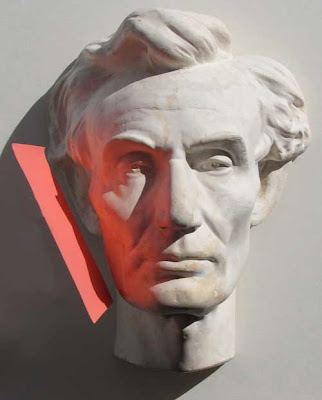 Traditional painters usually refer to the effect as “reflected light,” and you can see it in this photo of an Abe Lincoln bust with a colored card in direct sunlight.
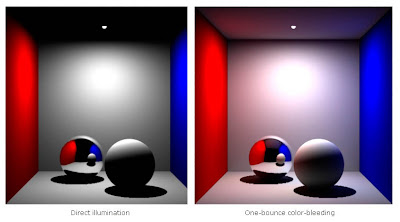 Here is an example of a digital scene with simple direct illumination (left), and then again with color bleeding (right).
Note how the white ball in the right image is tinged with blue on one side and red on the other. The same colored spillover appears on the ceiling and the back wall.
 The phenomenon is a hot subject in CG rendering right now because new techniques are emerging to accomplish it. The technique called ray-tracing conveys the effect very convincingly, but it takes a lot of computer rendering time.
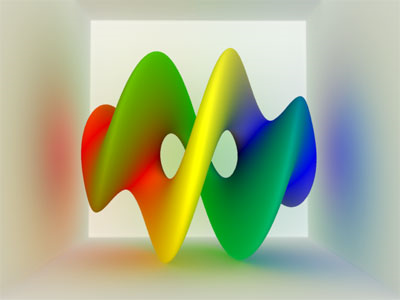 A new technique, using a “point cloud,” to generate the effect, can be accomplished with a fraction of the rendering time.
The recent Pixar movie “Up” used this technique to great effect in the sequence where the house is floating through the upper atmosphere.
Here’s a good overview by a lighting expert from "Up" on CG Society (Part 1 and Part 2), explaining its use in “Up”
I’m indebted to Jason Hill of Blizzard for sharing his knowledge with me.
 Traditional painters usually refer to the effect as “reflected light,” and you can see it in this photo of an Abe Lincoln bust with a colored card in direct sunlight.
  Here is an example of a digital scene with simple direct illumination (left), and then again with color bleeding (right).
 Note how the white ball in the right image is tinged with blue on one side and red on the other. The same colored spillover appears on the ceiling and the back wall.
 The phenomenon is a hot subject in CG rendering right now because new techniques are emerging to accomplish it. The technique called ray-tracing conveys the effect very convincingly, but it takes a lot of computer rendering time.
 A new technique, using a “point cloud,” to generate the effect, can be accomplished with a fraction of the rendering time.
The recent Pixar movie “Up” used this technique to great effect in the sequence where the house is floating through the upper atmosphere.
Here’s a good overview by a lighting expert from "Up" on CG Society (Part 1 and Part 2), explaining its use in “Up”
I’m indebted to Jason Hill of Blizzard for sharing his knowledge with me.
Wednesday, May 5, 2010
Natural Science Exhibition
Last Friday we visited the Focus on Nature exhibition at the New York State Museum in Albany.
 This exhibit happens every two years, and brings together the work of over 70 natural science artists from 13 countries.
The artwork shows plants, insects, mammals, and amphibians, and is primarily executed in watercolor, colored pencil, and digital.
 It was fun to meet the other artists, and we went upstairs in the museum to see the collection of jury award winning paintings from previous years.
Focus on Nature website
Follow the link to download the PDF of the catalog (23MB) with samples of artists's work and statements.
 This exhibit happens every two years, and brings together the work of over 70 natural science artists from 13 countries.
 The artwork shows plants, insects, mammals, and amphibians, and is primarily executed in watercolor, colored pencil, and digital.
 It was fun to meet the other artists, and we went upstairs in the museum to see the collection of jury award winning paintings from previous years.
Focus on Nature website
Follow the link to download the PDF of the catalog (23MB) with samples of artists's work and statements.
Tuesday, May 4, 2010
Sign Painters
Malcolm Murray produced this 12-minute documentary about the artists who paint large exterior ads on the sides of buildings in New York City.
Thanks, Adrien!
Thanks, Adrien!
Ball Balancing
Note to science fiction concept artists: if you’re not already designing robots and vehicles that cruise around on top of a single ball, do it. The future is already here.
YouTube: "A Robot That Balances on a Ball"
Via Best of YouTube.
YouTube: "A Robot That Balances on a Ball"
Via Best of YouTube.
Monday, May 3, 2010
Gorilla No-Threat Glasses

Inspired by a post on this blog, The Dutch Rotterdam Zoo offered some goofy but safe glasses for gorilla viewing.
"Earlier this month at the Dutch Rotterdam Zoo, an eleven year old male gorilla named Bokito escaped and ran rampant through the Zoo’s food court, injuring a woman when he bit and dragged her some distance. Now, health insurance company FBTO is distributing eye-contact disguising glasses that allow zoo visitors to stare all they like, a behavior that is threatening to most of the great apes."
More at Geekosystem
Previously on GJ: Gorilla Portraits
Working Small, Working Big
When we see artwork reproduced in books, it’s sometimes hard to get a sense of scale, which has a big effect on the making of the art.
 Here is Lawrence Alma-Tadema working at his easel in the 1890s. Tadema frequently created finished paintings that were no more than 5 inches on their short side.
Dean Cornwell, by contrast, had to be hoisted up on ropes to paint his murals for the Los Angeles Library, which he completed in 1932. His foot was bandaged, having been hurt in an accident. He had to move to England to be trained in the art of mural painting, and to find suitable mural space.
 The painting he is working on was called “Earth: Gold in the Ground,” one of eight subjects on California history, each measuring 12 feet wide by 19 feet high.
The library commission paid barely enough to pay his expenses. He had to borrow money from his life insurance policy to afford his children’s college education.
 Here is Lawrence Alma-Tadema working at his easel in the 1890s. Tadema frequently created finished paintings that were no more than 5 inches on their short side.
Dean Cornwell, by contrast, had to be hoisted up on ropes to paint his murals for the Los Angeles Library, which he completed in 1932. His foot was bandaged, having been hurt in an accident. He had to move to England to be trained in the art of mural painting, and to find suitable mural space.
 The painting he is working on was called “Earth: Gold in the Ground,” one of eight subjects on California history, each measuring 12 feet wide by 19 feet high.
The library commission paid barely enough to pay his expenses. He had to borrow money from his life insurance policy to afford his children’s college education.
Sunday, May 2, 2010
Sketch Posture
If you’re sketching without an easel or a drawing table, you have to hold your work at the most convenient angle.
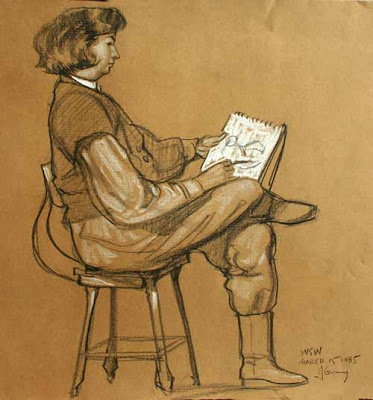 This fellow artist at a sketch group shows an excellent posture for observational sketching from a seated position. She’s comfortably holding the book with her left hand while resting it on her crossed leg.
By holding the book at about 60 degrees, the book remains perpendicular to her viewing angle. This eliminates any danger of distortion caused by looking at the work foreshortened.
By holding the work as high as possible, close to her line of sight, she doesn’t have to tax her memory any more than necessary as she transfers her observation to her drawing.
In fact she doesn’t have to bob her head at all, an advantage when you’re drawing candid poses in public and you don’t want to draw attention to yourself.
Artists who hunch over a work laying flat in their laps make the job unnecessarily more difficult than it needs to be.¬
 This fellow artist at a sketch group shows an excellent posture for observational sketching from a seated position. She’s comfortably holding the book with her left hand while resting it on her crossed leg.
By holding the book at about 60 degrees, the book remains perpendicular to her viewing angle. This eliminates any danger of distortion caused by looking at the work foreshortened.
By holding the work as high as possible, close to her line of sight, she doesn’t have to tax her memory any more than necessary as she transfers her observation to her drawing.
In fact she doesn’t have to bob her head at all, an advantage when you’re drawing candid poses in public and you don’t want to draw attention to yourself.
Artists who hunch over a work laying flat in their laps make the job unnecessarily more difficult than it needs to be.¬
Friday, April 30, 2010
Cell Tower
Most people regard cell towers as a blight on the landscape, but I’m weirdly attracted to them. They’re beautiful in their own strange way, delicate and mysterious. I don’t understand how they work. I can’t tell whether they’re listening or speaking.
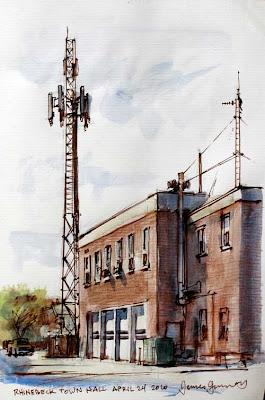 Fifty years from now, cell towers will no longer be in use. Most of them will be torn down or converted to other uses. They’ll be a rare sight. Only older people will use cell phones or iPads.
The kids with their "implantcoms" will laugh at the old-timers who still use handhelds. Cell towers will be like sailing ships or neon signs. Artists will paint them in their nostalgic landscapes, and they’ll talk about how beautiful they are.
 Fifty years from now, cell towers will no longer be in use. Most of them will be torn down or converted to other uses. They’ll be a rare sight. Only older people will use cell phones or iPads.
 The kids with their "implantcoms" will laugh at the old-timers who still use handhelds. Cell towers will be like sailing ships or neon signs. Artists will paint them in their nostalgic landscapes, and they’ll talk about how beautiful they are.
Thursday, April 29, 2010
Lovell, Photos, and Maquettes
Lovell used photo reference when he had to, as with this photo of a member of the 173rd Army Airborne Brigade in Vietnam, for his painting “The Chaplain in Southeast Asia.”
 The connection between the photo reference and the painting was made by blog reader Gene Snyder, who noticed the resemblance while photographing over 9,000 art images in the Army's art collection over the course of several years.
But Lovell also used other, more traditional means of getting figure and animal reference. He preferred to work from drawings made from posed models in the old master tradition. He also frequently did mirror studies, posing himself in a mirror to take the action of the pose.

 Lovell also made maquettes of animals and ships, which can be difficult to visualize otherwise.
The study of the clay model was made in charcoal and pastel 11x14 on Kraft paper.
The painting is called Camels in Texas, 1971, commissioned by the Petroleum Museum in Midlands Texas.
-------
Thanks, Joe and Gene S.
Previous Post: Lovell's Soldier (where he uses mirror drawings)
 The connection between the photo reference and the painting was made by blog reader Gene Snyder, who noticed the resemblance while photographing over 9,000 art images in the Army's art collection over the course of several years.
But Lovell also used other, more traditional means of getting figure and animal reference. He preferred to work from drawings made from posed models in the old master tradition. He also frequently did mirror studies, posing himself in a mirror to take the action of the pose.

 Lovell also made maquettes of animals and ships, which can be difficult to visualize otherwise.
The study of the clay model was made in charcoal and pastel 11x14 on Kraft paper.
The painting is called Camels in Texas, 1971, commissioned by the Petroleum Museum in Midlands Texas.
-------
Thanks, Joe and Gene S.
Previous Post: Lovell's Soldier (where he uses mirror drawings)
Subscribe to:
Posts (Atom)