Tuesday, January 20, 2015

Dinotopia Podcast, Episode 11

Episode 11 of the Dinotopia Podcast was released today, but sorry, it is no longer available online.

Levka Gambo shows Will a map of the caverns below Dinotopia, where is father is exploring.

Then a sky galley arrives and takes them on a wild ride.

The Podcast Series
This acoustic adventure was produced by Tom Lopez of the ZBS Foundation, with an original music track by composer Tim Clark.

The final episode, #12 arrives in a week. Each 10-minute episode will only be live online for one week, and then it will disappear.

If you'd like to purchase the full two-hour Dinotopia podcast right now and hear all twelve episodes back to back in a feature-length production, check out Dinotopia at ZBS Foundation website for the MP3 download.
----
You can also order the original book from my web store and I'll sign it for you.  It's a great New Year's gift for the imaginative person in your life. (Ships via Media Mail within 24 hours of your order. US orders only for the book, please). The Dinotopia book is also available from Amazon.
----
There will be an exhibit of Dinotopia originals at the Stamford Museum and Nature Center in Connecticut from February 14 - May 25, 2015. I'll be giving an illustrated lecture there on Sunday, March 1, 2015 at 1:00.

Monday, January 19, 2015

Oregon Ducks fans reject mascot redesign

The University of Oregon decided that their cute duck mascot named "Puddles" (left) needed to be redesigned to look more cool and athletic.

Gone were the googly eyes and the pot belly. The new duck was more muscular, with reptilian scales and a streamlined head that resembled a biker's helmet. The official name of the rebranded character was "Mandrake," but everyone called him "Roboduck."

But Roboduck didn't charm the fans. He scared kids, and people started pushing him around. So they retired Roboduck and quietly went back to Puddles.
-----
Wall Street Journal: "Fans Found University of Oregon’s Muscular Mascot a Lame Duck."

Sunday, January 18, 2015

Stylistic Evolution

Early and late work by artists who went through a Modernist style shift.

Klimt
Gustav Klimt, Sitzendes junges Mädchen 1894
Gustav Klimt, The Kiss, 1908-1909
-----
Mondrian
Piet Mondrian, Fen Near Saasveld 1907
Piet Mondrian, Composition II in Red, Blue, and Yellow, 1930
-----
Kupka


FrantiÅ¡ek Kupka, Papal Ceremony, 1904.
František Kupka, Katedrála, 1912-1913
-----
Alfred Maurer
Alfred Maurer (1868-1932) (Thanks, Kevin Ferrara)
-----
Disney
Walt Disney Studios, Snow White, 1937
Walt Disney Studios, Toot, Whistle, Plunk, and Boom, 1953
-----
Tenggren
Gustaf Tenggren, Juan and Juanita, 1926
Gustaf Tenggren Arabian Nights
-----
de Kooning
Willem de Kooning

Willem de Kooning
-----
Richter

Gerhard Richter (thanks, Ricky Mujica)

Gerhard Richter (thanks, Ricky Mujica)

Saturday, January 17, 2015

Studio Tips

A couple of GurneyJourney blog readers shared some helpful studio tips:


Doug Goodale says: "I recently built a lightweight sketch easel according to your specs and added some Velcro strips so it could hold a 1/4 sheet of watercolour paper. I had a plastic palette, so glued some rare earth magnets on the mixing surface to affix it to the easel."

Lawrence Roibal says: "Having had the privilege of being in the presence of the great Steve Assael painting from life, I witnessed how he utilizes the theory of the parallel palette without the expense. He would just fashion a makeshift palette right on his painting surface or utilize a clamp, and a simple masonite palette."
----
Thanks, Doug and Larry

Friday, January 16, 2015

How to Video Your Art: Microphones / Recorders


Four recommended microphones / recorders: MXL TempoZoom H1Zoom H2n, a Lavalier Microphone
The current issue of International Artist magazine published Part 2 of my series on How to Video Your Art. In this post, I want to discuss how to get good audio.

Audio is the most common flaw in art videos. It’s usually caused by trying to record a voice with an onboard camera microphone that’s too far away from the person who is speaking. It’s fairly easy and cheap to overcome this problem. Good audio will do more to make your videos appear professional than anything else.

When I’m making an outdoor video, I like to record a few introductory comments on location before I start the painting. Later, I record a voiceover in the studio over the final edit. In the voiceover, I speak in present tense, as if it's happening now. This makes the voiceover blend in with the field-recorded voice audio.

Hearing the voiceover is as important as seeing the paint strokes, because it allows viewers to get inside your mind as you’re making painting decisions. Doing the voiceover after the fact makes the painting process much easier for me because I don't have to talk while I'm painting, and it makes the editing much easier, too.

In the photo above are four recommended microphones / recorders.

MXL Tempo Microphone
This microphone is specialized for voice and for studio settings. It has a USB connector that plugs into the computer. It makes recording voiceover in post production much easier because you can record directly into the editing timeline and do as many retakes as you want. It's a bit bulky and fragile to take on location, and it takes a while to set up, but it gets excellent sound quality. You can also use it for music performance, podcasts, Skype, etc. 

Zoom H1 Recorder
This small portable digital recorder captures high-quality digital audio to supplement the audio captured by the cameras. It records in stereo in WAV or MP3 files, and has a lo-cut filter. You can select either manual level control or automatic gain control. It's small enough to fit in a pocket or carry on a belt. It’s also useful for recording audio clips from interview subjects. Wind noise is a persistent menace when recording audio outdoors, The best defense is a furry microphone cover called a deadcat windscreen. These windscreens are available commercially, or you can knit your own from novelty yarn.

Zoom H2n Handy Recorder
For around $159.00, less than the price of the two previous items, you can get one device that works as both a USB-microphone and a recorder. Through a USB cable, you can attach it to the computer and use it as a voiceover mic. As a recorder, it has far more features, and an easier set of controls than the Zoom H1. The five microphone elements can be selected in four different field patterns to get a surround effect, a mid-side field or a conventional stereo effect. The manual gain setting uses an old fashioned wheel, rather than a push-button interface, which makes it much easier to use. It runs on two AA batteries (I use rechargeable NimH) and records onto an SD card for many hours of audio.

Audio-Technica Lavalier Microphone
If your video camera has an input for an external microphone, you can use a lavalier microphone. The small mic clips to your shirt beneath your chin. It captures very good audio, especially with the Canon VIXIA camcorders that I use (more in the post Camera Guide). At less than $30.00, wired lav mics cost far less than the wireless models, and they’re less prone to electronic interference. When you don’t need the lav mic for voice, you can clip it to the canvas or sketchbook to capture the contact noise of the pencil or the brush.

Editing tips
• WORKFLOW: 1. Visual edit, 2. Color correction, 3. Background audio, 4. Foley if necessary, 5. Voiceover, 6. Titles and Transitions
• Whenever possible, conceive of the piece as a 3-act story: Articulate goals, grapple with challenges, and figure out solutions.
• Use authentic sounds instead of music under time lapse. Use music only at the beginning and end if necessary for mood. Don't use music as an acoustic floor throughout.
• Edit to match the speed of viewer's mind, not real time.
• If you change speed in a shot, tell the viewer that you're doing it in VO.

Online resources
• Check out my painting tutorials on Sellfy
• You can also get my videos on Gumroad
• Link for all my videos on DVD at Kunaki.
• You can also get my DVDs at Amazon
• Longer post on GJ: How to Video Your Art (goes into more detail about gear)
• Helpful filmmaking tutorials on the older uploads from Indy Mogul (YouTube channel)
• Also some good tutorials on Film Riot and Frugal Filmmaker
------

Thursday, January 15, 2015

Knitted Beards on Babies


It keeps their faces warm. And gives them an air of authority.
----
From Ravelry, by Ashlee Prisbrey, Megan Graddy and Kylie Marie Brown.

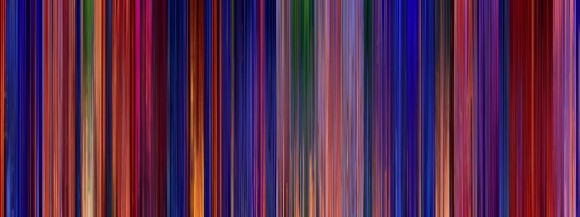
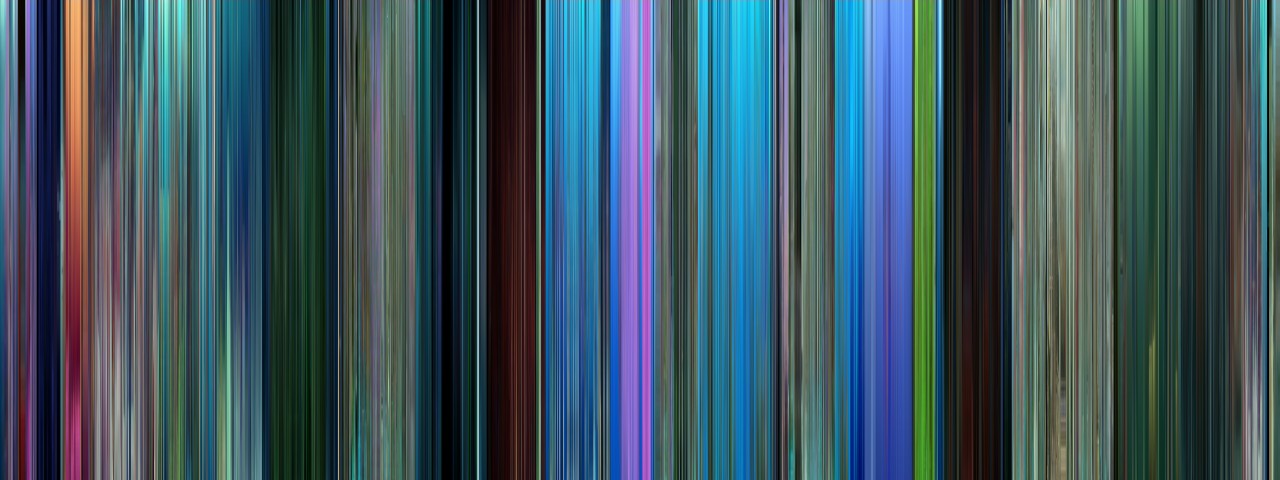
MovieBarCode


The blog MovieBarCode compresses the colors of an entire film into a single line.


At a glance, you can see how the film travels from one color to another as it moves from scene to scene. Animated films are especially deliberate about color scripting. The Disney animated film Aladdin has a lot of red and purple


Pixar's Finding Nemo alternates highly saturated colors with neutrals. There are three blue open-ocean sequences in the middle section of the film, framed by very dark passages.

Blue Sky's Ice Age varies in saturation, hue, and value from sequence to sequence.

MovieBarCode on Tumblr  (You can search a particular film in the alphabetical index)
MovieBarCode Generator 
More examples on CartoonBrew
Previously Color Scripting

Wednesday, January 14, 2015

Manfred Schatz — Wildlife in Action


Manfred Schatz (1925-2004) was a wildlife artist who captured the energy and movement of living animals.

He developed a distinctive motion-blur effect in his oil paintings, using large brushes to soften edges in the direction of movement. The wings of these flying ducks are nearly lost, and the water is suggested with a few deft strokes.

Manfred Schatz, From the Shadows 
Manfred Schatz was born in 1925 in Stettin, Germany, and attended the Academy of Arts in Berlin before the age of 18. He was unable to escape the war and was drafted in the German army, fighting on the Russian front. 

He was taken prisoner in Russia and spent more than four years in a prison camp. He suffered from exhaustion, tuberculosis, and near starvation. After he was set free, he recuperated at a hunting preserve with his brother, a game warden. 

There he fell in love with nature and with observing the movement of animals. Though it may appear he was influenced by studying photographic effects, he primarily relied on his knowledge, memory, and imagination to convey fleeting impressions of the human observer.
  
According to one biographer, he was "unhindered by the use of technical equipment like cameras, which Schatz believed would only impede his true viewing of wild creatures." He started exhibiting in 1953, and by the 1960s, his work began to win international awards.

He said that his greatest influences were Anders Zorn and Bruno Liljefors. 

You can find the work of Manfred Schatz in some public collections, including the Genesee Country Museum in Mumford, New York, the Leigh Yawkey Woodson Art Museum in Wausau, Wisconsin, and the National Museum of Wildlife Art in Jackson, Wyoming.
-----
Book on Amazon: The Moving Art of Manfred Schatz
Prints by Manfred Schatz at National Wildlife Galleries and Art Barbarians Gallery
Previously on GurneyJourney: Motion Blur

Tuesday, January 13, 2015

Dinotopia Podcast Episode 10

Episode 10 of the Dinotopia Podcast was webcast today, but the file was only up for a week. Check out a more recent post to hear the latest episode.

After his father Arthur left to explore the system of caverns underground, Will Denison picks up the journal to describe his ascent into the mountains.


He and Sylvia meet Levka Gambo in the Tentpole of the Sky. 

I built this whole segment of the story around this painting, "Tentpole of the Sky," which I painted in 1989, before I came up with the idea of a dinosaur utopia.

The Podcast Series
This acoustic adventure was produced by Tom Lopez of the ZBS Foundation, with an original music track by composer Tim Clark.

Episode 11 arrives in a week. Each 10-minute episode will only be live online for one week, and then it will disappear.

If you'd like to purchase the full two-hour Dinotopia podcast right now and hear all twelve episodes back to back in a feature-length production, check out Dinotopia at ZBS Foundation website for the MP3 download.
----
You can also order the original book from my web store and I'll sign it for you.  It's a great New Year's gift for the imaginative person in your life. (Ships via Media Mail within 24 hours of your order. US orders only for the book, please). The Dinotopia book is also available from Amazon.
----
There will be an exhibit of Dinotopia originals at the Stamford Museum and Nature Center in Connecticut from February 14 - May 25, 2015. I'll be giving an illustrated lecture there on Sunday, March 1, 2015 at 1:00 (Note that the date is different from what we first announced.)

Monday, January 12, 2015

Digital tool for analyzing color gamuts

Joost van Dongen, lead programmer and co-founder of Ronimo Games, wrote me to say that my book Color and Light inspired him to create a digital tool for analyzing color schemes.


When he developed the geometric racing game Proun (screenshots above), he was thinking about restricted color schemes, but his new tool let him see exactly what parts of the color spectrum were occupied by the colors he chose.

The blacked out areas of his diagrams represent the parts of the entire range of colors that are not included in a given color scheme.

He also used the tool to analyze screenshots from Awesomenauts (below), a game that his art team developed.

Looking at the gamut maps, he says: "the colour scheme is all over the place. It really is an explosion of colour, as is fitting for the over-the-top Eighties themes of Awesomenauts. Nevertheless you can see that even in the top image the colour scheme ignores large parts of the colour wheel, so even there the colour usage is limited."

He used the tool to analyze the color gamuts on other games, including Uncharted 3, Star Control II, and Far Cry 4, above. The first is a narrow complementary gamut, the second uses high chroma primaries without neutrals, and the third is clustered around a fairly muted gamut near the gray center of the spectrum. 

On his blog post, he shares a link to download the tool for free so that you can try it yourself. Thanks for sharing, Joost.
-----