Showing posts sorted by relevance for query fidelia bridges. Sort by date Show all posts

Thursday, May 28, 2015

Fidelia Bridges

Fidelity Bridges, Milkweeds, 1876. Watercolor and gouache on paper

Fidelia Bridges (1834 - 1923) was known for her meticulous botanical studies, many of which were painted outdoors in nature.

Both of her parents died when she was in her teens. She never married, but had a small circle of friends, including Mark Twain, for whom she served for a time as a governess of his daughters. 

She lived by herself in a home in Canaan, Connecticut, overlooking a stream and a flower garden filled with birds and butterflies. A writer of the time described her this way:

"She soon became a familiar village figure, tall, elegant, beautiful even in her sixties, her hair swept back, her attire always formal, even when sketching in the fields or riding her bicycle through town. Her life was quiet and un-ostentatious, her friends unmarried ladies of refinement and of literary and artistic task who she joined for woodland picnics and afternoon teas."

Fidelia Bridges, Calla Lily, 1875
She was inspired by reading John Ruskin's Modern Painters, which preached truth to nature. She found her way to study under William Trost Richards, who became a lifelong mentor. Her early studies in watercolor and gouache, such as this one of a calla lily, show a patient and observant eye. 

Bridges was one of only seven women who became members of the American Watercolor Society in the 19th century. She worked for the Prang company in her later career, and her work was often reproduced on greeting cards.
-----

Thursday, September 7, 2023

Fidelia's Backgrounds

 Fidelia Bridges (1834-1923) started her career using oil paint, but then switched over to watercolor and gouache. Her chromolithograph prints made her the most popular woman artist of her era.


What I've been looking at is how she set up her backgrounds to allow the viewer to focus on the foreground botanical detail. Here there's a very simple but subtle gradient that gets lighter and warmer toward the bottom.


Although she loved painting botanical studies, she rarely painted her subjects against a white background. Generally she used either toned paper or paper that had been pre-toned by her with a watercolor wash.

A simple blue-to-amber gradient suggests sky-to-high-grass.


Sometimes she gives a little more information in those backgrounds, suggesting here the arching forms of wheat stalks. 


According to Katherine Manthorne, author of an excellent new biography on Bridges, "She telescopes the space, painting the background in soft focus so that it appears an indeterminate distance away, while the plant forms in the foreground seem to jump off the page."


She may have gotten the idea from the influential English critic John Ruskin, who wrote: "If we look at any foreground object so as to receive a distinct impression of it, the distance and middle distance becomes all disorder and mystery. And therefore, if in any painting our foreground is anything, our distance must be nothing and vice versa."
---
Read more:
Ruskin quote from Modern Painters, quoted in The New Path
Wikipedia on Fidelia Bridges
Monograph Fidelia Bridges: Nature into Art by Katherine Manthorne

Tuesday, May 3, 2016

The Chromolithographs of Fidelia Bridges

Fidelia Bridges (1834-1923) was one of the few commercially successful female artists of the late 19th and early 20th centuries. She was a student of William Trost Richards, who encouraged her to paint detailed views of nature. 


Her sensibilities resonated with the newly emerging technology of color printing, called chromolithography, published in the form of album cards and greeting cards by Louis Prang. 

Album cards were treasured color images intended to be glued into a scrap book.


Bridges was influenced by Pre-Raphaelite art and Japanese prints. Often the scenes included a foreground bush or tree with a couple of birds, with a landscape view visible beyond.


These prints were immensely popular, and made her famous and well compensated, though some people in the day complained of the prints being overly saturated with color.


There's a chapter on chromolithography and the art of the late 19th century in the book The Artist's Garden: American Impressionism and the Garden Movement
----
Previous posts

Tuesday, August 8, 2023

Fidelia Bridges Exhibit in Wisconsin

An exhibition now at the Leigh Yawkey Woodson Art Museum portrays the life and career of botanical watercolorist Fidelia Bridges (1834-1923). 

The museum website says: "Despite inauspicious beginnings as an orphan growing up in Massachusetts, she became one of the preeminent women artists of her time and was the first woman member of the seminal American Watercolor Society. As an artist, she developed an elegant and exacting style, most often portraying birds and botanicals."
The exhibition Fidelia Bridges: The Artful Sketch will be at at the Woodson Art Museum in Wausau, Wisconsin through August 27, 2023, and admission is free.

Sunday, April 14, 2019

Catalog Review: American Pre-Raphaelites

Today the National Gallery in Washington opens the exhibition "American Pre-Raphaelites: Radical Realists."

John William Hill, Bird's Nest and Dog Roses, 1867
watercolor, gouache, and graphite
The exhibit examines a group of American artists that were inspired by the English critic John Ruskin. Ruskin advocated that young artists should go to Nature ‘rejecting nothing, selecting nothing, and scorning nothing.’ 

Thomas Charles Farrer, Mount Tom, 1865, oil on canvas,
The show includes more than 90 works of art, including oil paintings, watercolors, and drawings, some never before exhibited. One of the American leaders of the movement was English expatriate Thomas Charles Farrer, who was instrumental in spreading Ruskin's philosophy of close observation of nature.

Oddly enough, the curators left out Asher B. Durand from the selection of exhibited artists. He was a central figure in advocating truth-to-nature philosophies and practices, at least as much as Ruskin was. Although Durand didn't mention Ruskin by name in his Letters on Landscape Painting, he exemplified many of Ruskin's philosophies in his careful studies of trees and landscapes, and he gave Ruskin's ideas his own American slant. Durand exhibited these studies to a rising generation of landscape painters at the National Academy of Design in New York, where he was president from 1845-1861. Contrary to the impression left by the catalog essay, which quotes critics accusing Durand of belonging to a "past age and a dead system," in fact he remained an influential advocate of close observation, celebrated and beloved by younger artists until his death in 1886.

Henry Roderick Newman, Study of Elms, 1866, watercolor, 17 x 19 in.
The catalog begins with seven essays examining roots of the truth-to-nature philosophies, the role of photography in their work, their interest in still life painting, and the iconography of American Pre-Raphaelites.

Charles Herbert Moore, Hudson River, Above Catskill
One of the authors devotes twenty pages to the idea that some of the landscape paintings contain veiled references to the Civil War, Abolitionism, and other hidden political agendas. For example, the boat pulled up on shore in Charles Herbert Moore's painting Hudson River, Above Catskill is described as a "wrecked or stranded boat emblematic of a foundered ship of state and the associated fears for and even a loss of faith in the American corporate enterprise during and following the Civil War."

While some artists were certainly painting landscapes with political overtones during this period, I'm a bit skeptical of some of these interpretations. In the case of the Moore landscape above, maybe the boat was there because someone just beached his rowboat above the high tide line (the Hudson River above Catskill is tidal).

William Trost Richards Corner of the Woods,
1864, graphite, 23 x 17.5 in.
I wish the catalog's editors had devoted less page space to political theories (why not publish those online?) and instead tell the factual and humorous stories of the artists. What logistical challenges did they face, and what practical methods did they use? There are a lot of vivid, first-hand accounts in letters and journals to draw upon. I also wish the editors would consult practicing painters and conservators to give themselves more of a grounding in the concerns the actual artists faced.

Or better yet, cut back on the text and devote more pages to reproductions of artwork.

John William Hill, Apple Blossoms, watercolor, 1874, 9 x 15.5 in.
Despite those quibbles, the 312-page catalog is worth the cost ($65 list, $42 on Amazon) for the 210 color illustrations. There are high quality reproductions of all the works in the show, plus several closeups.

Fidelia Bridges, Study of Ferns, oil on board, 10 x 12 in.
I was especially impressed with the 11 works by William Trost Richards and the six samples by Fidelia Bridges. The back of the book includes an exhibition checklist, a timeline, artist biographies, notes, and index.
----
Catalog: The American Pre-Raphaelites: Radical Realists on Amazon
Exhibition: American Pre-Raphaelites: Radical Realists will be up through July 21, 2019.


Tuesday, May 24, 2016

Weed Painting Challenge


“A weed is but an unloved flower.” ― Ella Wheeler Wilcox

It's time for the next GurneyJourney painting challenge. Let's paint some weeds.

Ivan Shishkin, Aegopodium, Pargolovo (study) 1884, 35x59 cm
Fidelia Bridges, Thistle and Landscape
How does the challenge work?
We've done this before with gas stations, graveyards, and outdoor markets (Links take you to results). 

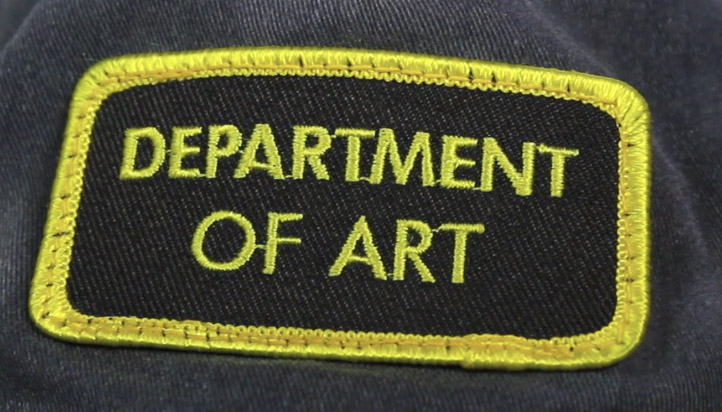
This time we'll paint some weeds on location. Everyone can upload their examples to this special Facebook event page. I'll choose a Grand Prize winner and five Finalists. Each receive a coveted "Department of Art" embroidered patch, and the Grand Prize winner will also receive a free tutorial download.

I hesitate to call it a "contest" because there's no entry fee and the spirit is more about cooperation, community, and camaraderie than competition. We're all at different levels of skill and experience, but we're all out there braving the elements and trying out new painting ideas.

Ivan Shishkin Grasses
How do you define a weed?
• By "weed" I mean any naturally growing herbaceous plant. For example: wildflowers, cattails, vines, lily pads, grasses, dandelions, ferns, mushrooms—really any natural plants. 

• That excludes anything planted, cultivated, or tended by humans, such as nursery or garden flowers or food crops.

• Nothing too big: no woody plants and no trees. 

Ivan Shishkin A Woman Under an Umbrella
• Must be painted outdoors with the weeds in situ. The weeds can't be cut and brought indoors or painted from photos. 

• The scene can include a landscape background, but the emphasis should be on the foreground with the plant carefully observed, with some botanical detail. 

• You can put a piece of white or black board behind a weed if you want to isolate it against a simple flat background. But I'm not looking for botanical studies so much as weeds in natural (or man-made) settings.

• OK to include some trash, insects, signs or other things you find around the weeds.

William Scott The Butterflies' Haunt--
Dandelion Clocks and Thistles
What media are OK?
• All painting media accepted, such as oil, watercolor, acrylic, gouache, acryla-gouache, alkyd, casein, or water-soluble colored pencils. 

• No limits on palette of colors.

Deadline
• You can enter as soon as you finish the piece, but no later than the deadline: Friday, June 24, 2016 at midnight New York time. Winners will be announced on Sunday, June 26.


William Henry Hunt Birds Nest and Primroses
Fidelia Bridges
Thistle in a Field
Submission Guidelines
• Free to enter

• It must be a new painting done for this challenge. In addition to a scan of the final painting, your entry must include a photo (or video) of your painting in progress in front of the motif. 

• Please include somewhere in the title or description the name of the weed, either a common name or Latin name.

• Upload the images to this Facebook Event Page. If you don't have a Facebook account, please ask a friend with an account to help you. Please include in the FB post a mention of what medium you used, and if you want, a word about your inspiration or design strategy, or an anecdote about your painting experience.

• In addition to the Facebook event page, you can use the hashtag #weedpaintingchallenge on Instagram or Twitter to see what other people are doing. 

• If you end up doing more than one entry, please delete your weaker entry so that we end up with just one entry per person.

Aaron Draper Shattuck Leaf Study with Swallowtail
Prizes
I'll pick one Grand Prize and five Finalists. All six entries will be published on GurneyJourney, and all six will receive an exclusive "Department of Art" embroidered patch. In addition, the Grand Prize winner receives a video (DVD or download) of their choice. Everybody who participates will have their work on the Facebook page, too.

EDIT: Winners of the Weed Painting Challenge
-----
Check out the previous results for gas stations, graveyards, and outdoor markets.
Own the 72-minute feature "Gouache in the Wild"
• HD MP4 Download at Gumroad $14.95
• or HD MP4 Download at Sellfy (for Paypal customers) $14.95
• DVD at Purchase at Kunaki.com (NTSC video) $24.50
GurneyJourney YouTube channel
My Public Facebook page
GurneyJourney on Pinterest
JamesGurney Art on Instagram
@GurneyJourney on Twitter

Saturday, May 13, 2017

American Watercolor Exhibit in Philadelphia


Jeanette and I visited Philadelphia yesterday to check out the blockbuster exhibit "American Watercolor in the Age of Homer and Sargent," which closes tomorrow.

The exhibition focuses on the period between 1860 and 1925. During that time water media flourished, attracting collectors and critics. Some of the finest realist painters lent their talents to the medium during that era.

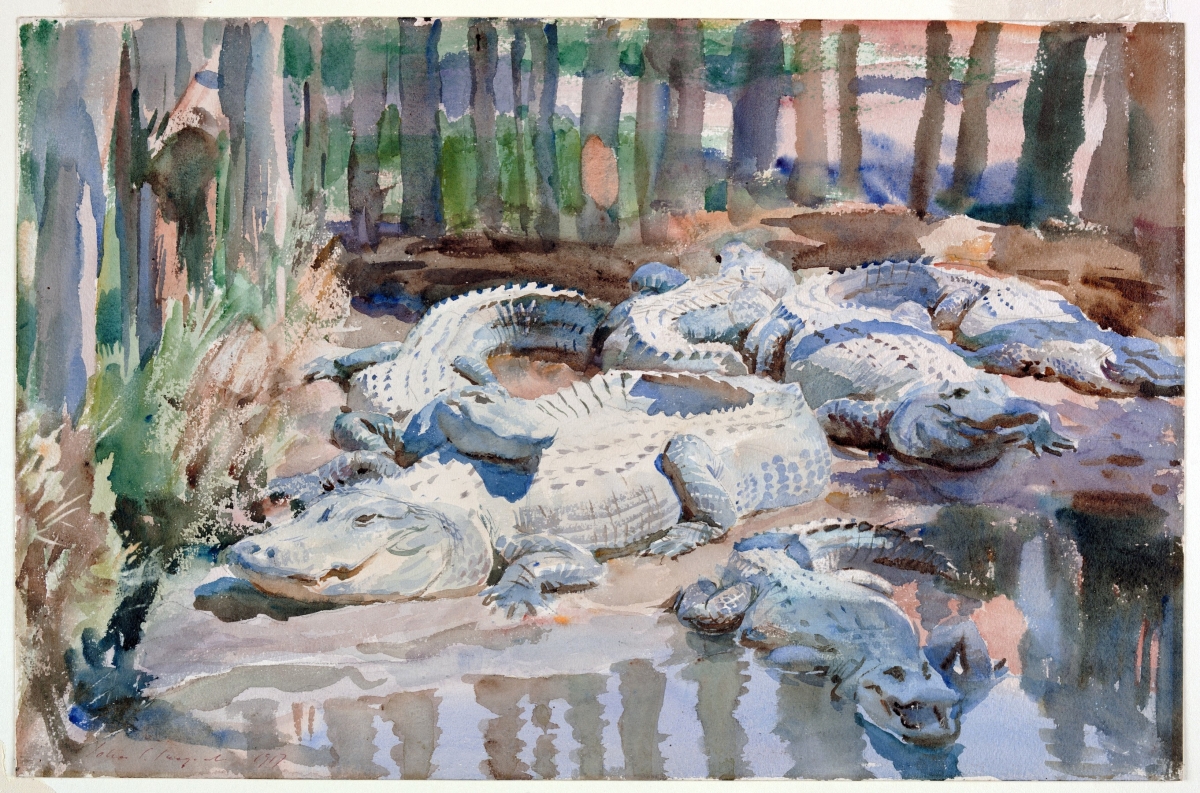
Sargent, Muddy Alligators, 1917 Watercolor over graphite, with masking out and scraping, on wove paper
13 9⁄16 x 20 7⁄8 inches (34.4 x 53 cm) Worcester Art Museum, Worcester, Massachusetts.
There are familiar classics such as Sargent's Muddy Alligators. This plein-air painting would have been a challenging task, given the fact that alligators will hold still only so long, and their movements are sudden and unpredictable. His pencil underdrawing quickly defines the main shapes, but most of the execution is done rapidly with the brush.

The show (and the book) features some of the best works by William Trost Richards, Henry Farny, Thomas Moran, Fidelia Bridges, Jessie Wilcox Smith, and Elizabeth Shippen Green.


Edwin Austin Abbey (1852–1911) An Old Song, 1885 Watercolor and opaque watercolor over graphite on paper
28 x 48 inches (71.1 x 121.9 cm) Yale University Art Gallery, New Haven. Edwin Austin Abbey Memorial Collection.


One room of the exhibit is set up as a "watercolor salon," reconstructing the way the works would have been shown in the late 19th century. Large framed paintings were accompanied by potted palms and urns. 

Instead of captions, the works in this room are identified by numbers and described in a booklet with black and white illustrations that simulate the engraved style of the day.  

Childe Hassam (1859–1935) Boulevard at Night, Paris, 1889 Watercolor on paper
8 x 12 inches (20.3 x 30.5 cm) Private collection
The curators, led by Kathleen Foster, did an imaginative job of organizing the paintings into thematic topics. Each room has a different organizing principle, such as: "Ruskin, Turner, and the English Tradition, 1855–1865, Figure Painting in the 1870s: Homer and Eakins, Impressionism from Munich and Rome, and Landscape Painting after 1880: Tonalism."

One of the rooms pitted Homer against Sargent with side-by-side paintings of similar subjects. The curators played a tongue-in-cheek "Who was better?" game. It is impossible to settle such a contest, of course. But it's a fun jumping-off point for discussion. 

And it gets museum-goers away from the darn recorded audio tour that dulls their brains, turns them into zombies, and makes the rooms quiet zones where even soft discussion is frowned upon. I watched people using those ear wands, and while they listened to the audio prompts, they only spent 1-2 seconds on average looking at the actual art. The rest of the time they either gazed blankly at the caption or stared into space.

I'd love to see curators work harder to get their museum guests talking with each other and really engaging with the art, rather than being mute and passive. 


Winslow Homer's palette

The final room does that! It has a fascinating presentation by conservator Becca Pollak about the materials and tools that the artists actually used. I'll talk more about this topic in future posts.

It's a massive show that was decades in the making, with about 170 paintings that are rarely exhibited because they're so sensitive to light. The show was very crowded but everyone was polite and good-spirited about it. It took us about four hours to get through it all and see everything. 

This is the last weekend. It closes Sunday, but at least the museum will be open until 7:00 pm today and tomorrow. It's a very popular show. If you go, be ready for crowds, and know that you can't go back for a second viewing. Get your tickets online to be sure you get a spot. There are 12-hour metered parking spaces on the streets a few blocks away.

The catalog is very thick and comprehensive, with fascinating essays and considerable new scholarship. It's probably worth purchasing for that reason, but inevitably the art reproductionss are on the small side and they just can't do justice to the color and detail of the original artwork.

Museum website: American Watercolor in the Age of Homer and Sargent.
Catalog on Amazon: American Watercolor in the Age of Homer and Sargent

Saturday, June 27, 2015

Some of My Favorite Gouache Masters

Over the years, gouache has attracted some brilliant painters. Here are some virtuosi:

Menzel, The Interior of the Jacobskirche at Innsbruck, 1872, 15 3/4 × 10 5/16 in.

Adolph Menzel (1815-1905) This long-lived German artist made important contributions in oil, pencil, watercolor, and engraving, but it was said of him that he expressed his greatest truths in gouache.

Wm. Trost Richards Moonlit Landscape, 1862, gouache, 6 7/8 x 13 3/8 in.
William Trost Richards  (1833-1905) American landscape painter who often painted small works on tone paper. He was equally competent in oil.


Thomas Moran (1837-1926) Moran painted in oil in his studio work, but brought gouache on location to the American West with some of the first survey teams.

Leaves watercolor and gouache 8 5/8" x 6 3/4"
Fidelia Bridges (1834 - 1923) American student of Trost Richards, who painted sensitively observed close-ups of plants.


Albert Beck Wenzell (1864-1917) Belle Epoque illustrator of society life who often worked in black and white.


Stepan Kolesnikov  (d. 1955) Russian painter of solid peasants and spindly trees.


Eugène Galien-Laloue (1854-1941) French boulevard painter during la Belle Époque. He painted scenes of bustling streets at twilight. They may have been painted by formula, but it was an impressive formula!


Albert Brenet (1903-2005), a French illustrator specializing in trains and ships.
Coby Whitmore, 1950, For the story Heartbreak by A. Barke
Coby Whitmore (1913-1988) Mid-century style-setting illustrator, always innovative with his compositions.


Harry Anderson (1906-1996) known on this blog for his magazine illustrations of women and children, he painted in tempera—here's one of his plein-air landscapes.

Freshwater Pond Life, ca. 1970. 12 ½ x 28 ½ inches
Ned M. Seidler (d.2007) was one of the natural history illustrators for National Geographic and the U.S. Postal Service in the 1970s, often compressing a whole ecosystem into a single picture.


Art Fitzpatrick and Van Kaufman. Known as "Fitz and Van" this team painted car ads for Detroit, with consummate control over craft.


Carl Evers (1907-2000) German-born artist specializing in ships and water.

Leynnwood ‘Memphis Belle’, a Boeing B-17F.
Jack Leynnwood (1921-1999) painted many of the best covers for the Revell plastic models. He painted both in gouache and casein.


Ralph McQuarrie (1929-2012) concept artist for the original Star Wars series.


Syd Mead (born 1933) The combination of Ridley Scott's dystopian vision and Mead's sense of believable detail made the art for Blade Runner some of the finest concept art of all time.

I know I've left out a lot of others, but go ahead and mention them in the comments. Thanks, Charley Parker, Armand Cabrera, and all the others on Facebook who reminded me of some names I had forgotten.