Friday, November 12, 2010

The Angel Academy of Art

The three great domes of Florence were shining in the morning light yesterday.


On the left of the picture is Jay Blums and on the right is Martinho Isidro Correia. Both instructors are originally from Canada. We're standing in the Angel Academy of Art, one of the world’s leading centers for academic training.


The school was founded by Michael John Angel, known as “Il Maestro” by his students. Mr. Angel was a student of portrait painter and muralist Pietro Annigoni (1910-1988).


The school consists of two buildings near the center of Florence, where 60 students from 29 countries follow a focused curriculum. The method is based on traditional realistic painting methods that Mr. Angel has painstakingly researched.

Students begin by carefully copying plates from Charles Bargue’s 19th-century drawing course. Then they proceed to portraying the plaster cast under artificial light, using "sight-size" procedures, first in charcoal, and then in oil.

They graduate to working from still life subjects and to drawing and painting the living figure.

The entire regimen has taken as little as two years for a few very precocious students. More typically it takes three or four years. A single oil or charcoal can take several months. People move to succeeding steps in the curriculum depending purely on their readiness.
-------------
Angel Academy of Art
Michael John Angel
Cast drawing at left is by Dorian Iten
Charles Bargue Painting Course (Book from Amazon)
Pietro Annigoni on Wikipedia
Wikipedia on the Atelier Method & Sight-Size Drawing
Related GurneyJourney posts:
    Academy of Realist Art, Toronto
    Grand Central Academy, New York
   En Loge (Prix de Rome) Competition

Wednesday, November 10, 2010

The Marais

Around the city of Bourges, France, is a vast system of marshes and canals called the Marais. The low land has been reclaimed as allotments for gardeners, who grow swiss chard and lettuce.


Footpaths follow the canals, punctuated with pollarded willows . Pensioners walk their dogs or ride along on bicycles, greeting each other as they pass. The air is hazy, and fragrant with the smell of burning leaves.

Last Judgment

One of the stained-glass windows of the cathedral of Bourges shows scenes the Last Judgment.


Here, the souls are thrown into the mouth of the Leviathan. The scene is conjured with all the vividness of the 13th century imagination.

Guest-blogger Jeanette

This sketch was done in ballpoint pen with watercolor wash. I sat next to Jim, and my picture begins just to the left of where his sketch ends. Trying to get the half-timbering (pan-de-bois) correct was insanely time-consuming.

As we sat there on our folding stools, people from Bourges kept walking by us, saying encouraging things in French. At least I assume it was encouraging from their facial expressions, as I don’t speak much French.

It’s amazing how Jim and I can sketch the same subject at the same time and come up with entirely different results. Almost invariably, mine is breezy and cheerful, and Jim’s is carefully drawn, with moody lighting. I see everything in line, Jim sees form and light first.

Tuesday, November 9, 2010

Tao of Painting People


Don’t paint a figure; Paint a person.
Don’t paint a head; Paint an individual.
Be accurate, but see beyond the surface.
Beware of pictures that are correct but lifeless.


The face is the window to the soul.
All of humanity’s greatness and frailty can be found in a single pair of eyes.


---------
Portraits by Peder Krøyer (1851-1909). Thanks to Tim Adkins for the close-up.
Krøyer on Wikipedia

Map Crunch


What do other countries in the world really look like? Standard tourist photos don’t give you genuine slices of life.


The website “MapCrunch.com” allows you to view random images from the vast Google street view archives. You can select from 18 different countries around the world and choose whether you want country roads or not. The examples above are from Spain, Hong Kong, Mexico, and Missouri (USA).

This would be a fun motif-generator for the tiny landscape painting exercise in yesterday’s post. Press the button and paint the scene in 10 minutes or less!

MapCrunch.com
GurneyJourney: Tiny Landscapes
Thanks, Toby Neve

Unveiling at the Jules Verne Museum

Yesterday I had the privilege of attending the unveiling of two paintings that are now part of the permanent collection at the Jules Verne Museum in Nantes, France.


Upper left: The paintings on the wall of the museum near the entrance; the dedication ceremony yesterday; the Jules Verne medal presented to me by Jean-Louis Jossic, the cultural minister of Nantes; and standing near the fountain in the Place Royale, where the painting is set.

According to the article in today's Ouest-France:

"Le musée acquiert deux illustrations de l'auteur de Dinotopia: l'une, Décollage nocturne, a servi pour l'affice du festival des Utopiales 2009, tandis qu'une autre représenet le musée installé sur son rocher."
------
Ouest France: "Deux oeuvres de James Gurney au musée Jules Verne"
Musée Jules Verne
Utopiales Festival 2009

Previous GJ Posts:
Floating Jules Verne Museum
Utopiales Painting, Part 7: Final Painting
Part 6: Washin
Part 5: Pencil Drawing
Part 4: Lighting
Part 3: Maquette
Part 2: Researching Insect Flight
Part 1: Initial Sketches

Muddy Colors Blog

The new blog called "Muddy Colors" brings together an all-star line-up of illustrators and designers with daily insights into the thinking behind the art of contemporary fantastic art.

In the last five posts:
Dan Dos Santos reflects on digital versus traditional and violence in covers.
Arnie Fenner describes how movie posters and paperback covers got him fired up about art.
Greg Manchess shows how he painted a cover with clockwork fairies.
Jon Foster explains how he uses thumbnails to find the best image.
Dan Dos Santos shows the various sketches on a job and the thinking behind them.

Monday, November 8, 2010

Tiny Landscape Nuts and Bolts

This is an answer to the questions from Petr and Vicki from the previous post (by the way, I appreciate all the kind comments, and the haiku, Dan!)


Anyway, the tiny landscapes were done with a mixture of watercolor and water-soluble colored pencils. I usually start with a quick lay-in using a brown Caran-d'Ache pencil. The watercolor is a Schmincke half-pan set.

Then I painted the sky with a flat watercolor travel brush. The brush is the gold metallic thing just to the right of the rows of paints. It divides into two pieces, with the handle acting as a cover and protector for the brush tip when stored. I also used a Niji water brush for softening some areas.

Then I painted the other big shapes of the landscape with watercolor, and added detail and foliage texture with the colored pencil. The notes are written with the blue Waterman Phileas fountain pen (filled with brown ink) that's just visible above the Moleskine watercolor book.

The rag is a scrap of cotton flannel, and the cup is a Nalgene plastic jar.

Sorry, the Mac iBox (upper right) is a prototype only, and is not for sale.
----------
Previously on GJ: How to refill a fountain pen.

Tiny Landscapes

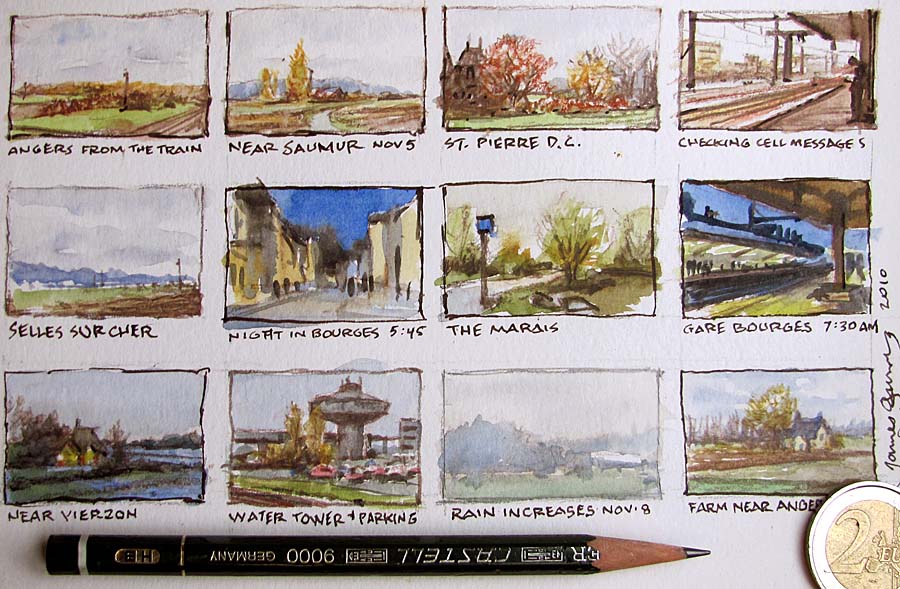
Traveling often gives you time in 15 minute intervals. This morning, for example, I found myself on the train platform in Bourges from 7:25 until 7:39 AM.


But that’s enough time for a painting the size of a postage stamp. I got out my Moleskine watercolor book and the other little tools that I keep in the side pouch of the computer case.


There’s the painting on the far right of the second row (click to enlarge). A few minutes later the TGV train passed farms near Vierzon, where the lights of the houses still glowed. The landscapes—and the weather—changed moment to moment.

This is a really fun way to work if you want to tackle new subjects, or to try a new medium, or to explore new compositional ideas.