Monday, June 6, 2011

"Spectrum Fantastic Art Live" event announced

Spectrum has announced its first ever convention to celebrate fantastic art. It will take place nearly a year from now, May 18-20, 2012 in Kansas City, Missouri, USA.

Called "Spectrum Fantastic Art Live," it will bring together artists and art appreciators from the fields of science fiction and fantasy art, plus comics, concept art and other related visual pop culture. The event is the dream of Arnie and Cathy Fenner, who have published the Spectrum annuals of contemporary fantastic art.

Spectrum 16 (the book)
Spectrum 17
Spectrum Fantastic Art Live

1931 Morgan three-wheeler

On Saturday we went sketching at the Old Rhinebeck Aerodrome. In one of the sheds out back, they’ve got a 1931 Morgan barrelback three-wheeler.


Three-wheeled vehicles were classified as a motorcycles in Britain, so owners could avoid road taxes. The Morgan was low to the ground and weighed only about 850 pounds. With its crank-start water-cooled Matchless V-twin engine, it could go up to 80 miles per hour.

According to Jay Leno, who owns one, 80 mph in a Morgan is like 180 in any other car. Check out Leno’s video, which is a lot of fun.

Jay Leno's Garage Video
Old Rhinebeck Aerodrome

Sunday, June 5, 2011

Lucas imprisoned while an imposter made the prequels.

Here's a funny mock-trailer that explains what happened to the Star Wars universe during the last twenty years: George Lucas was kidnapped while an imposter ran around making lame prequels. Never fear: Lucas escapes and rallies his old pals to take back the empire.


Slick Gigolo Via BoingBoing
Direct link to YouTube video

Disney explains his multiplane camera

The multiplane camera was an ingenious device invented by the Disney studios to create the illusion of depth in their animation backgrounds.


In this archive video, master pitchman Walt explains how they came up with the idea, and how it helped create the immersive forest shots in Bambi.

Via Best of YouTube 
Direct link to YT video
The ILLUSION OF LIFE: DISNEY ANIMATION

Saturday, June 4, 2011

Early Poortvliet

The Dutch artist Rien Poortvliet (1932-1995) is best know for "Gnomes" and many other illustrated books. But before he did those works on his own, he was a prolific book and advertising illustrator.

Blog reader Christoph Hueur went to the Rien Poortvliet museum and was allowed to take some pictures from Poortvliet's early illustrated books. You can survey his image collection here: http://web.me.com/heuerdesign/Gefunden/album_poortvliet_pim_frits_en_ida.html

Thanks, Christoph! http://www.christophheuer.com/
Rien Poortvliet on Wikipedia
Gnomes by Wil Huygen and Rien Poortvliet
Noah's Ark by Rien
Dogs by Rien

Friday, June 3, 2011

Ten Tips for Drawing Glasses

Here are my top ten suggestions for how to draw glasses.

1. Downplay or eliminate the reflections on the lenses.


2. Reduce the cast shadows or caustic effects below the lenses on the cheek, and the shadows beneath the temple pieces. In this watercolor-pencil drawing of my friend Paul, I only put a small accent underneath the frames to show where they touch the cheek.

3. De-emphasize the nosepads, too. In general, these details don’t add to the impression of character; they’re just accidental effects.

4. If you have a dark background, the far lens can be suggested with just a curving white line. If you’re working in ink, you have to carefully draw around that shape.


5. As you start the drawing, lightly indicate the glasses, but otherwise ignore them. Try to draw the face without the glasses at first. Erase them with your mind as your draw.

6. Once the face and eyes are constructed, then “put on the glasses.”

7. Big or dark frames often cast shadows over the whole eye area, so the modeling on the eyes may need to be a bit darker than they would be without glasses.

8. Sometimes you may want to capture the optical effects of glasses. Glasses distort the size of the eyes, and they usually shift the contour of the cheek. Reading glasses make the eyes bigger and move the cheek contour outward. Distance glasses for nearsighted people make the eyes appear smaller and move the cheek contour inward.


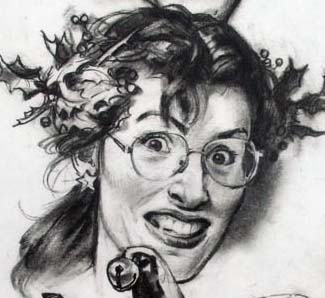
9. For cartoony character effects, you may want to eliminate the eyes altogether inside the glasses frames, leaving a smudge or a foggy patch, which gives a “clueless” look. For this “goofy” sketch of Jeanette, I drew her glasses crooked.

10. Just a small hint of the glasses gives the full impression of them.

I’d love to hear your thoughts, experiences, or advice!

Interview on Archosaur Musings


Dave Hone of the paleoblog "Archosaur Musings" has just posted an interview with me.

Thursday, June 2, 2011

How to make a rustic stump planter

What can you do with a tree stump? Grind it up? Chisel it out? Put a statue on it?


Instead, you can make a nifty natural planter using the base section of the tree itself, fill it with flowers, and let the bugs rot out the stump from beneath.

1. Materials list: Chainsaw, ear protection, goggles, gloves, stick of charcoal, pliers, picture frame cable, splitting maul, dirt and flowers. I also used a hammer and few trim nails. Cost of gas, cable, and nails: less than a dollar.


2. After the tree is cut down, save the bottom section of the trunk, the piece just above the stump. The town crew took down the tree because it was diseased, and they let me keep all the wood (Thanks, guys!).


3. Level the top with a chainsaw. Usually it has a step left over from the felling cut.


4. Cut a slot into the bark a fraction of an inch deep around the section, about three inches below the top and three inches above the bottom. The cable will set in this slot later. If you don’t have a chainsaw, you can use a regular saw.


5. With the charcoal, mark the log into six sections. Draw a hexagon about three or four inches in from the side. It doesn’t have to be perfect.


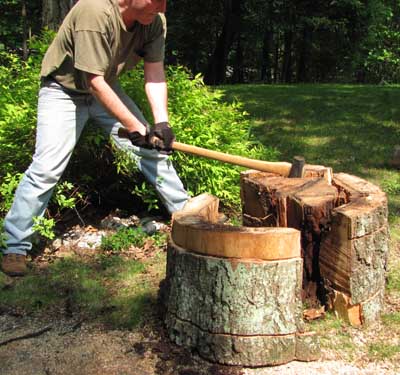
6. This tree was an oak, which splits nicely on straight grain. With the splitting maul, chop the log into sections along the lines you drew. No big deal if you miss your marks (I did). You could also do these cuts with the chainsaw if you’re careful.


7. Chop out the inner part of each section with the splitter. This will take pretty good aim with the splitter. Note that I accidentally knocked a section of bark loose.


8. Assemble the pieces back together on the stump base. It will fit nicely and look really natural.


9. If a piece of bark falls off, you can tack it back on with trim nails.


10 Run a loop of sturdy picture hanging wire or weatherproof rope around the slot on the outside edge. I cranked it tight by tying a bowline on one end and two half hitches on another. Maybe there’s a better kind of knot to use.


11. The planter is like a rustic barrel which perfect fits over the stump. Fill it with planting mix and plant with flowers.

Lecture June 9: “Plein Air Pioneers”

On Thursday, June 9, I’ll be presenting an illustrated lecture about the history and modern practice of plein air painting. I'll reveal the grisly secret of how artists carried around paint before they invented metal paint tubes.

The event is in Poughkeepsie, New York at the Mill Street Loft at 45 Pershing Avenue. Reception at 5:30, and talk at 6:00. Book signing afterward.


More at the Mill Street Loft website.
Related book: The Painted Sketch by Eleanor Harvey

Wednesday, June 1, 2011

Reflectivity and viewing angle

Smooth surfaces are more reflective when you look at them at shallow angles.


You can see this subtle phenomenon best by looking at cars in an open parking lot. Note how the foreshortened plane on the left is highly specular, or mirrorlike, reflecting the scene beyond with a wide range of values.

The back window and tailgate do not reflect the sky or the surrounding cars as brightly.

In previous posts, we’ve seen a related phenomenon with smooth water surfaces, which also become more reflective at grazing angles of incidence. In the case of a transparent fluid surface like water, light that is not reflected is refracted beneath the surface.

A smooth solid surface like a painted car or a pool ball or an apple is generally a blend of specular and diffuse reflection.

But even surfaces that we think of as diffuse reflectors, such as ordinary paper, can be remarkably specular at shallow angles. Hold up a piece of paper at an extremely shallow angle to your eye, so that you’re sighting right along the surface of the paper. If you have bold light and dark lines above that surface (such as the mullions on a window), the paper will behave almost like a mirror, reflecting a fairly clear image of the scene beyond. (Good party trick.)
-------
Thanks, Kevin Bjorke, for telling me about this.  

More on such things in "Color and Light: A Guide for the Realist Painter"

Related previous posts on GJ:
Escher’s Three Worlds
Color in Mountain Streams
Transparency of Water
Specular and Diffuse Reflection