"It’s hard to imagine painting without cadmium. The brilliant, lightfast pigment was discovered around 1820 and started appearing in artist’s red, yellow, and orange paints in the 1840s — just in time for Impressionist founder Claude Monet’s arrival in the world. They’re what gave us Monet’s haystacks, Van Gogh’s sunflowers, and Matisse’s red-drenched studio. The European Chemical Agency (ECHA) began considering a ban on cadmium after the Swedish Chemicals Agency submitted a 197-page document calling for one in December 2013. Cadmium pigment is made with cadmium sulphide, a toxic heavy metal. It is not technically classified as hazardous by REACH, the EU body that advises the commission on chemicals, and it makes up only .1 percent of paints. Nonetheless, the report argued that artists were polluting the environment by rinsing their cadmium-soaked brushes in the sink. The cadmium would find its way into sewage sludge that is spread on agricultural land and wind up polluting crops, and so increase the risk of cancer and other illnesses."
Thursday, April 11, 2019
Cadmium Pigment Escapes E.U. Ban
Wednesday, April 10, 2019
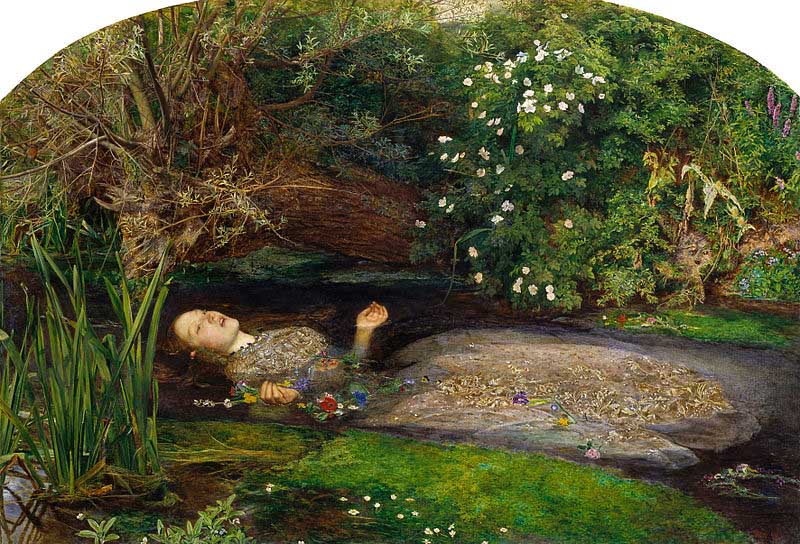
Painting the Background for Ophelia
In the summer of 1851, Pre-Raphaelite painters John Everett Millais and William Holman Hunt traveled to the Elwell River in England, each in hopes of painting the background for an ambitious picture that they had planned in their heads.
Millais wanted to paint Hamlet's Ophelia drowning in a stream, and his plan was to paint the background first.
Following the advice of critic John Ruskin to capture every detail faithfully—“rejecting nothing—selecting nothing”—Millais dutifully recorded the "flowering rush, river daisy, forget-me-not, willow herb, meadowsweet, and the wonderful tangle of brier bush with its multitude of dog roses in bud and bloom."
According to a 1923 biography: 'They were up by six o’clock and at their selected spots by eight o’clock, where they painted until evening, returning to their lodgings about seven o’clock; Hunt had to walk four miles and Millais two to their respective painting places.
'In a letter to Mr. Combe, Millais gives an interesting description of the trials and difficulties of the time : “I sit tailor-fashion under an umbrella throwing a shadow scarcely larger than a halfpenny for eleven hours, with a child’s mug within reach to satisfy my thirst from the running stream beside me. I am threatened with a notice to appear before the magistrate for trespassing in a field and destroying the hay; likewise by the admission of a bull in the same field after the said hay be cut; I am also in danger of being blown by the wind into the water and becoming intimate with the feelings of Ophelia when that lady sank to a muddy death, together with her (less likely) total disappearance through the wrath of the flies. There are two swans who not a little add to my misery by persisting in watching me from the exact spot I wish to paint, occasionally destroying every water-weed within their reach.’’'

'Their lodgings were far from comfortable; their hunger had to be appeased with an unvarying diet of chops, until Millais writes that he has taken such “an aversion to sheep that I feel my very feet revolt at the proximity of woollen socks.”'
The process of painting the background on location took more than two months.
-----
Quotes from 'John Everett Millais: Master Painters of the World' by Arthur Fish, 1923
Labels:
Academic Painters,
Plein Air Painting
Tuesday, April 9, 2019
Eye tracking and film
Where do our eyes look when we watch a movie? Eye-tracking technology can record in real time how the observer's eyes land on important features, and then jump to new points of interest.
Scientists can take the data from the visual experience of many individuals and compile it into heat maps showing where most observers actually look. That information can suggest the cognitive activity driving the eye movements, and it can help editors understand what information people are taking away from the moving pictures.
Researchers used this technology on three films: the war movie "Saving Private Ryan" and two Pixar movies, "Up" and "Monsters, Inc."
The researchers' concluded that the eyes and the mouth were especially important for delivering narrative information:
| Image from Pixar. Overlay by Avni Pepe |
Researchers used this technology on three films: the war movie "Saving Private Ryan" and two Pixar movies, "Up" and "Monsters, Inc."
The researchers' concluded that the eyes and the mouth were especially important for delivering narrative information:
1. "Hot spots emerge around the character’s mouths, as if our viewers are conditioned to look for identification through the way a film’s central characters 'speak', and are searching for narrative clarification through dialogue exchanges that actually never emerge."
2. "Objects and motifs that actively move the story along and define character mood are picked out of the mise-en-scène and gazed at even when the scene is fluid and action is taking place across the filmic space."
3. "Our eyes seem to be active in finding emotive objects even when they are found in a busy scene. There is a caveat here of course: the 'extra' attention to significant objects may well have been because the scenes were free of dialogue."
4. "When the sound is off, viewers actually migrate slightly away from the character’s mouths to focus on their eyes, and to objects that are pregnant with narrative information."
5. "The viewer is searching for non-verbal signs to confirm what might be taking place and because the eyes, culturally speaking, are where “truth” is to be revealed."-----
Read the whole article at The Conversation
Monday, April 8, 2019
Book Review: Working with Color
A new book by urban sketcher and watercolorist Shari Blaukopf explores the practical possibilities of color.

Working with Color: Techniques for Using Watercolor and Color Media on the Go is a vibrant collection of painter's wisdom, served up with colorful artwork and friendly and encouraging captions.

The book is the latest in the Urban Sketching Handbook series. It's printed in a small (5 x 8 inch) flexible covered book of 112 pages that almost looks like a sketchbook, and there's at least one color reproduction on almost every page.
Shari builds on her experience as a workshop leader to structure the book. She covers painting and drawing tools, pigments and color mixing, color & value, limited color, color relationships, and neutral colors.
She includes a few charts and diagrams to clarify points made in the brief text.
In addition to her own work, she also includes artwork by friends and colleagues, such as Mike Kowalski and Donald Colley.
Other volumes in the Urban Sketching Handbook series include:
• Working with Color: Techniques for Using Watercolor and Color Media on the Go
• Understanding Perspective: Easy Techniques for Mastering Perspective Drawing on Location
• People and Motion: Tips and Techniques for Drawing on Location
• Architecture and Cityscapes: Tips and Techniques for Drawing on Location
Shari also has a Basic Watercolor Brush Set
Shari Blaukopf's website

Working with Color: Techniques for Using Watercolor and Color Media on the Go is a vibrant collection of painter's wisdom, served up with colorful artwork and friendly and encouraging captions.

Shari builds on her experience as a workshop leader to structure the book. She covers painting and drawing tools, pigments and color mixing, color & value, limited color, color relationships, and neutral colors.
She includes a few charts and diagrams to clarify points made in the brief text.
![]() |
| Watercolor by Mike Kowalki |
• Working with Color: Techniques for Using Watercolor and Color Media on the Go
• Understanding Perspective: Easy Techniques for Mastering Perspective Drawing on Location
• People and Motion: Tips and Techniques for Drawing on Location
• Architecture and Cityscapes: Tips and Techniques for Drawing on Location
Shari also has a Basic Watercolor Brush Set
Shari Blaukopf's website
Labels:
Book reviews,
Watercolor Painting
Sunday, April 7, 2019
Sitting for a Sargent Charcoal Portrait
In his book "John Singer Sargent: A Conversation Piece", Martin Birnbaum describes his lively conversation with Sargent while the artist drew a charcoal portrait of him. To start out, they compared notes about Adolph Menzel, William Blake, and Winslow Homer. And they joked around. Sargent said how he didn't like "ba-NA-nas."
They chattered on and on, but Sargent was already at work. Birnbaum continues: "While talking, Sargent had been drawing rapidly, examining my features closely, at a distance of only three or four feet. Watching him at work, I was reminded of Paul Manship's little daughter Pauline, who on seeing Sargent make a pencil drawing of the sculptor, ran to Mrs. Manship and exclaimed, 'Mamma, Mr. Sargent is making a picture of father just like you would write a letter.' That exactly described his fluency and authority.
"Suddenly he stopped talking and showed me the charcoal drawing. He did not seem satisfied with it, — 'not very flattering, — a trifle unnatural, and rather Mephistophelian,' he commented. I, on the contrary, thought it was unduly youthful and complimentary and it showed that I had tried, without success, to look serious on this unique occasion. The scrutiny of the artist at such close range was more than I could stand, and I think he enjoyed catching my vain endeavor to be solemn.
"He liked always a friend or two to be in to break the spell of a settled gloom in my countenance by their prattle...as Sargent likes animated, sympathetic, beautiful, talkative friends to do, in order to correct by their presence too lugubrious expressions."
------
Previously: What it was like to sit for Sargent
John Singer Sargent: A Conversation Piece
![]() |
| John Singer Sargent (1856-1925), Portrait of Ernest Schelling 1910, Charcoal on paper. 24 3/8 x 18 3/4 inches (620 x 475 mm) |
"Suddenly he stopped talking and showed me the charcoal drawing. He did not seem satisfied with it, — 'not very flattering, — a trifle unnatural, and rather Mephistophelian,' he commented. I, on the contrary, thought it was unduly youthful and complimentary and it showed that I had tried, without success, to look serious on this unique occasion. The scrutiny of the artist at such close range was more than I could stand, and I think he enjoyed catching my vain endeavor to be solemn.
![]() |
| John Singer Sargent, Portrait of Quincy Adams Shaw, Jr. |
------
Previously: What it was like to sit for Sargent
John Singer Sargent: A Conversation Piece
Labels:
Portraits
Saturday, April 6, 2019
Muscled Skeleton Animated by Computer Intelligence
A computer graphics team from Seoul National University has developed a virtual skeleton with 346 rope-like muscles. It is animated by a method called deep reinforcement learning, so it moves according to its own learning process, not by human intervention.
As the character walks, dances, lifts weights, and runs, the muscles light up. It's fascinating to see which muscles come into play in a given movement. If the muscles are overstressed, the character collapses.
When one of the feet is replaced by a prosthesis, the character adapts its style of movement accordingly. If the character suffers an injury, the resulting movements simulate what you would expect from a human patient experiencing the same condition. In many ways the movements don't resemble human movements, though. For example, it doesn't protect its face when it falls.
----
Scientific paper: Scalable Muscle-actuated Human Simulation and Control
Friday, April 5, 2019
Advice for a Beginning Plein Air Painter

1. Use just a few colors.
If you're trying to paint for the first time, use just black and white at first to familiarize yourself with the properties of the medium. When you're ready for color, use three colors and white. (Lately I've been using ultramarine blue, yellow ochre, and cadmium red.) After you've explored the possibilities of that group for a while, try another small group of colors.
It will free up your non-painting hand and get the work close to your line of sight. It could be a really simple sketch easel (Facebook group "Sketch Easel Builders") on a tripod, or a commercial watercolor easel. This improves your accuracy and keeps you from having to hold the book in your off hand. By the way, my wife disagrees with me on this. She says don't use an easel at first because it attracts attention to you, which you probably don't want. Bring a chair or stool instead.
3. Pick a simple subject.
It could be something in the foreground, such as a rock, a bucket, a fire hydrant, or a snow pile. Try to paint it as accurately as you can in the time available. As you develop your skills more, you can try trickier effects like water reflections, atmospheric perspective, or live animals.
Pick a spot that doesn't have too many people wandering by. If they do, welcome their curiosity, but shift the conversation topic to something about them. Keep in mind that they're probably not judging you, and if anything they admire you for what you're doing. Check out the previous posts on Curious Spectators: The Problem and Top Ten Ways to Deal with Curious Spectators.
----
What advice would you offer? Am I forgetting something?
Wednesday, April 3, 2019
Sorolla's Little Plein-Air Studies
The Sorolla Museum in Spain is hosting an exhibition of the master's tiny oil studies. The show is called "Hunting Impressions: Sorolla in Small Format."
![]() |
| Pepita García del Castillo, 1889, Oil on board, 13.7 x 8.6 cm (5.4 x 3.4 inches) |
The curators say: "Sorolla takes elements from the Italian school of the Macchiaioli, whom he had known during his period of scholarship in Rome (1885-1888). They placed great importance on the natural quality of small wooden panels, and they used the wood grain as an expressive element."
![]() |
| Joaquín, María and Elena Sorolla García, 1897, Oil on board, 7.5 x 12 cm (x 4.75 x 3 inches) |
Curators say: "In this color note, Sorolla focuses on the silhouettes of the children with their straw hats that are cut out on the bluish sea, surrounded by a sandy bottom suggested only through the color of the support. With a reduced palette of colors, in which the blues predominate, Sorolla models the bodies and portrays wave movement by means of short, thick brushstrokes."
![]() |
| Among the pines, 1900, Oil on canvas, 22 x 29 cm |
"The composition is marked by the trunks of the trees that organize the different planes of the scene, as well as the red of the woman's dress, which attracts the viewer's gaze. In these color notes, rather than in his larger, definitive works, you can see how Sorolla progressively introduces color in the treatment of shadows, which he considered as an element of modernity."
----
Hunting impressions: Sorolla in small format at Museo Sorolla will be on view through September 29, 2019.
Thanks, Manuel Barranco.
Tuesday, April 2, 2019
Painting Fine Details with Big Brushes
It's possible to paint details that are much smaller than the brush itself. The subject is a snow pile in a parking lot.
![]() |
| Snow Pile "Everest", gouache, 5 x 8 inches. |
Using relatively big brushes can add verve and speed to your paintings. My goal when I'm painting fast is to convey as much truthful information as I can in the time available.
(Link to video on YouTube) In this video, I show how you can capture a lot of detail with relatively big brushes.
If you're experimenting with a new medium, it's helpful to do an abstract painting exercise, and try out wet and dry passages, drybrush, gradations, etc. I did this with a flat brush.
Labels:
Gouache
Monday, April 1, 2019
Subscribe to:
Posts (Atom)