Saturday, May 13, 2023

A Face is Easier to Recognize When It's Moving

Over the last few decades, researchers have learned a great deal about how we recognize faces. Using neuro-imaging techniques, scientists have pinpointed the regions and pathways in our visual systems that help us recognize people we know or celebrities we've seen on the screen.

Recently a group of authors in The Frontiers of Psychology made the following observation: "Most of what we know about face processing was investigated using static face images as stimuli. Therefore, an important question arises: to what extent does our understanding of static face processing generalize to face processing in real-life contexts in which faces are mostly moving?"

The scientists classify facial movement in two categories: static movement (head turning or nodding) and elastic movement (speaking, changing expressions).

Where babies look in a face changes depending if the person is moving or static and how old the baby is.

The paper summarizes findings in other scientific studies, for example:

1. Faces are much easier to recognize when presented in a video. If you play the video backwards, recognition performance drops off drastically.

2. Smiling faces are easier to recognize.

3. Babies begin developing neural strategies for processing movement as early as three or four months old, and the first year of life is crucial for developing these skills.

---

Read the free paper online: On the facilitative effects of face motion on face recognition and its development by Naiqi G. Xiao et al.


Thursday, May 11, 2023

Repin's Portrait of Murashko

Ilya Repin (1844–1930) Portrait of Mykola Murashko ,1882, Oil on canvas, 48.5 x h58.5 cm

Mykola Ivanovych Murashko was a Ukrainian painter, devoted art teacher, art critic and art historian who belonged to the Russian movement of Peredvizhniki or Itinerants. He was also the founder and the first director of his own private drawing school in Kyiv which was supported by many well-known artists, notably Ilya Repin, a friend from the Academy.

Mykola Murashko (1844-1909) on Wikipedia

Wednesday, May 10, 2023

Way back in the theater

Sometimes I get a seat close to the performer, and other times I have to sit way back.


When that happens, I try to capture a lot faces made from dots and dashes. Maybe they’re more expressive that way.


I'm on my way to the Portrait Society Seminar.


Tuesday, May 9, 2023

'Conscious and Precise Observation'


Hills in Settignano by Telemaco Signorini (1835-1901)

Telemaco Signorini, one of the principle members of the Macchiaioli, said: "Do you know what in our view is great art? It is not what historical culture or imaginative talent demand from the artist but a conscious and precise observation of the infinite forms and character of the countryside surrounding us.


Monday, May 8, 2023

Whitcomb's Tips on Idealizing Women


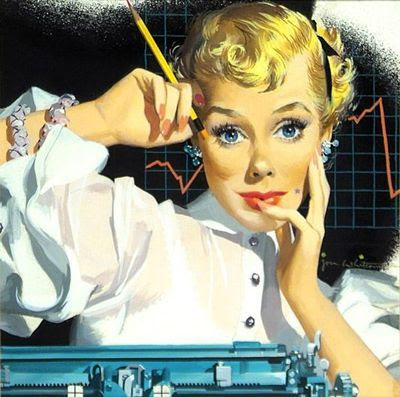
Golden Age illustrator Jon Whitcomb explained what elements he would change to idealize a woman's face, explaining "what makes a pretty girl pretty." 

1. Eyes are sometimes moved further apart. This device helps make a face look younger.

2. The eyebrows are raised.

3. The irises of the eyes are enlarged very slightly.

4. Shadows from lighting are edited for simplicity and sometimes left out altogether.

5. Mouths are usually made a little fuller, especially the lower lip.

6. Superfluous lines, like laugh lines and wrinkles, and irregularities of the jaw and nose are ignored.

"The width of the face is narrowed slightly, since in life, your two eyes see a face that is a composite of the image from both. Eyes are roughly three inches apart, so that your left eye sees a little more of the left cheek, your right eye a little more of the right. Your visual impression is that of a thinner face."

---

From the Famous Artists Course, Lesson 13

Sunday, May 7, 2023

New Book on Perry Peterson

Perry Peterson contributed illustrations to the popular magazines during the heyday of the Saturday Evening Post and Cosmopolitan.

Peterson painted in gouache and casein, and for many years he adapted his style to the printing limitations (black + one color) of the early magazines. That made him a resourceful colorist, and when he moved into full color in the 1950s, he brought a lot of interesting ideas to his pictures. 

His paintings were executed quickly, with bold shapes, dynamic brushstrokes, and strong shadows. He only approached the finished painting after plenty of planning, making use of reference photos of models and props. 

Sometimes he had photos of models taken in a professional studio in New York City, and other times he shot his reference at home with friends and family.

The book starts out with a biography written by illustration historian Dan Zimmer, who began collecting Peterson's originals many years ago. 

At the beginning of the biographical section, he includes many of Peterson's sketches, reference photos, and preliminary studies. After page 26, it's all original art and tearsheets.

The Art of Perry Peterson is 224 pages long, 9x12 inches, hardcover.  

Saturday, May 6, 2023

Illustrating the Coronation of George V

The Illustrated London News ran this painting of the coronation of George V in 1911. 


It was entitled: "He stands surrounded by the Officers of Heralds College"

The artists had to work fast to complete their drawings for the next day’s paper. “Every artist had a little notebook which he took out of the pocket of his frock coat and made dots in, putting down his top hat to do so.” Read more in the previous post: Covering the Coronation

Friday, May 5, 2023

Walpurgis Night

Walpurgisnacht, (or "Walpurgis Night") is a holiday celebrated in Germany and Scandinavia on April 30, the eve of Mayday. 

Albert Zimmermann “Walpurgisnacht”, 1866

In German folklore, it is believed to be the night when nature spirits meet on the Brocken mountain and hold fantastic festivals outside the reach of the Church. 

The holiday is celebrated with singing traditional spring folk songs, lighting bonfires, dressing in costumes, playing pranks on people, making loud noises to keep evil at bay, hanging sprigs of foliage on houses to ward off malevolent spirits, or leaving pieces of bread spread with butter and honey as offerings for phantom hounds.

All these occult revelries have captured the imagination of great artists, philosophers, and composers, such as the Goethe and Felix Mendelssohn. Mendelssohn's secular cantata describes the attempts of Druids in the mountains to practice their pagan rituals in the face of new and dominating religious forces.

Thursday, May 4, 2023

Drawing Over a Painting


I painted this dairy barn in gouache with a quirky technique, using brushes/paint first, and pencils/pens last. 


My new video on YouTube takes you through the process. 
Try out my custom-trained AI chatbot, who is happy to answer your questions about art.

Monday, May 1, 2023

Cornwell's Backgrounds

Dean Cornwell (American, 1892-1960) painted illustrations with solid, memorable backgrounds, which attracted favorable reviews from journalists of his day.


A writer for the Brooklyn Daily Eagle said: "no carelessly sketched-in backgrounds here, flimsy and unstable, a mere set for the figures, upon which the ordinary illustrator concentrates his efforts because he considers they tell the whole story."  

Cornwell would visualize the backgrounds in terms of how he would build them with his own hands, and he recognized the value of knowledge gained through the hands.


Here's how Cornwell put it: "I construct my backgrounds in my mind just as if I were actually building them with bricks and mortar. I follow the same mental processes as does the builder himself." 

Cornwell, a grand-student of golden age illustration teacher Howard Pyle, regarded the art of painting as an natural extension of the manual work of a bricklayer or a carpenter. 

He said: "It has always been a theory of mine that an illustrator must know how to use his hands other than in painting and drawing; he should understand carpentry and building. Howard Pyle used to tell his pupils that they should consider their brains the superior and certainly the equal of those possessed by the men who built the structures he is illustrating."