Monday, February 11, 2013

Zorn exhibit coming to Boston


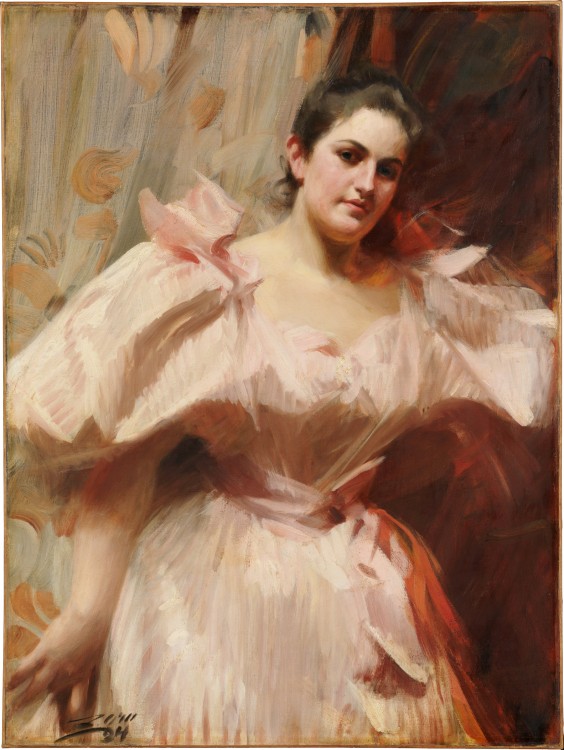
Later this month, a new exhibition will open in Boston, Massachusetts, called: Anders Zorn: A European Artist Seduces America. (Above: Mrs. Walter Rathbone Bacon (née Virginia Purdy), 1897)

The exhibition will include 24 paintings by the Swedish Belle-Epoque master (1860-1920), along with 22 drawings, photographs, letters, and gifts that Anders Zorn gave Isabella Gardner in 1894. (Above: The Omnibus, 1892.)

(Above: "Frieda Schiff, Later Mrs. Felix M. Warburg," 1894.) The show will be organized in five different segments, including “Zorn and Gardner,” “Society Portraits,” “In the City,” “Country Life,” and “Artist’s Studios.” Highlights include "Isabella Stewart Gardner in Venice" (1894), "Night Effect" (1895), and "The Ice Skater" (1898).
------
Anders Zorn: A European Artist Seduces America, February 28-May 13, Isabella Stewart Gardner Museum, Boston, Massachusetts. 
Other upcoming exhibitions that feature illustration and academic painting


Flying Squid


Scientists at Hokkaido University have released photos of a kind of flying squid. They launch above the surface by squirting a powerful jet of water, reaching speeds of 24 miles per hour. They catch air on canard fins out front and flattened tentacles aft.

-------
Huffington Post: "Japanese Flying Squid's Abilities Confirmed, Speed Measured By Scientists"
Previously on GJ:

Alien creatures of the deep
Weird deep sea creatures


Sunday, February 10, 2013

Merriott's Railway Posters

Watercolorist Trevor Chamberlain shared the following recollections about one of his heroes, Jack Merriott, whose work he saw when traveling to London by train: 

"Back then, in the glory days of steam engines, the railway companies commissioned some of the leading watercolour painters of the day, including Jack Merriott, Rowland Hilder and Charles Knight, to depict scenes from all around Britain to be displayed as prints in the passenger compartments. These prints always had a long, narrow format and were usually panoramic landscapes. I would clamber into the carriage wondering which ones I was going to see, and I got to know them all." 

Above is Merriott's poster of Aberystwyth, the historic market town in Wales.

Here is the approximate view as seen by the camera, a good deal duller and more spread out horizontally. 

Here is Merriott's preliminary watercolor study painted on location, with lines for scaling it up to the final painting.

Wikipedia on Aberystwyth
Images from Robert Kirk's blog
Travelling Art Gallery (selection of all of Merriott's Carriage Prints)
Merriott's book on watercolor can still be found inexpensively: Discovering watercolour;: A comprehensive home study course.
Chamberlain's watercolor book is harder to come by, but it's also excellent:Trevor Chamberlain: Light and Atmosphere in Watercolour

Science Visualization Award

Science magazine has announced the winner of its 2012 International Science & Engineering Visualization Challenge. This annual illustration competition recognizes the work of artists to give visual form to scientific ideas or discoveries.

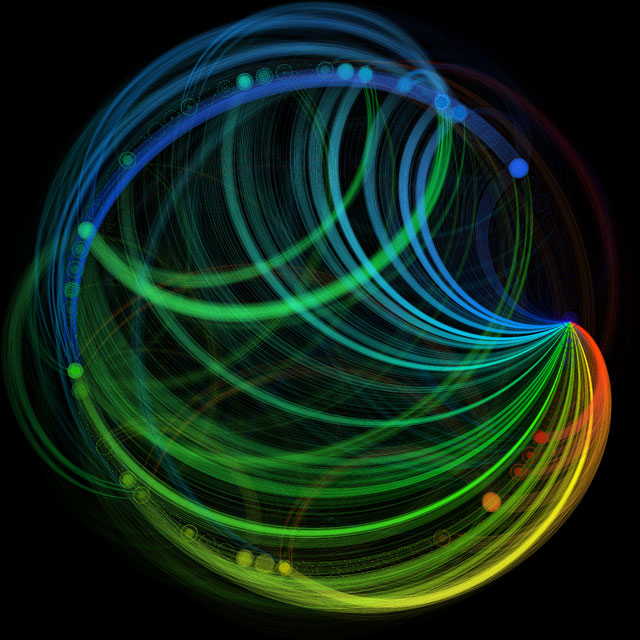
The image shows "Connectivity of a Cognitive Computer Based on the Macaque Brain."

The National Science Foundation explains: "Inspired by the neural architecture of a macaque brain, this ghostly neon swirl is the wiring diagram for a new kind of computer that, by some definitions, may soon be able to think. Over the past 2 years, IBM's cognitive computing group in San Jose, Calif., has made great strides toward designing a computer that can detect patterns, plan responses, and learn from its mistakes, says Emmett McQuinn, a hardware engineer at IBM who designed the image. First, he clustered and colored the nodes based on the 77 different functional regions that neuroscientists have identified in the macaque brain. Then, he found a circular arrangement that pleased him. "They took something that we know works fantastically efficiently in nature—the circuitry of the brain—and applied that geometry to computing. Then, they found an elegant and beautiful way to display it," says judge Thomas Wagner."
------
Credits: Emmett McQuinn, Theodore M. Wong, Pallab Datta, Myron D. Flickner, Raghavendra Singh, Steven K. Esser, Rathinakumar Appuswamy, William P. Risk, and Dharmendra S. Modha
-----
See the other winners of the 2012 International Science & Engineering Visualization Challenge.

Saturday, February 9, 2013

Answer to the Kodachrome / Digital puzzle


Here's the answer to yesterday's puzzle challenge about "Digital vs. Kodachrome." Even though the votes were 126 to 74 in favor of the one on the right being Kodachrome, actually the one on the left was Kodachrome. (Though, technically, as many of you pointed out, they were both digital in the sense that they were both presented on your computer or mobile screen.)

Photographer Walter Wick processed the digital capture to try to match the color and the grain to the unprocessed drum scan of the Kodachrome.


Walter says: "Your commenters are making some wise comments, even if their guesses are wrong. When I made the "color noise" version, I purposely held back a bit on noise and softening of the digital image on the hunch that some friends I planned to show this to would harbor a bias in favor of the legendary film. This seems to be borne out in your poll, but of course, there could be other reasons the vote is going that way.

"I would have loved to have tested Kodachrome against full-frame digital on tripod-mounted cameras with the same lens, but alas I was not able to pull that together before the December 30, 2010 deadline - the last day Kodachrome was accepted for the final processing run at Dwane's Photo.

"What you're seeing here is something quite different: a full frame film camera with a pocket sized digital - shot casually, hand-held on a beach. What surprised me was the resolving power of the small-sensor Leica compared to the full frame Contax. In the digital version, the man is slightly enlarged relative to the frame compared to the that of the film version. But this advantage pales by comparison to the relatively huge image area of the full frame film camera. This does not bode well for Kodachrome comparing favorably with the resolving power of full frame DSLR. That, combined with the huge amount of shadow detail in Raw files and extreme high ISO sensitivity of digital cameras pretty much explains why most photographers abandoned Kodachrome before Kodak did (there are other reasons too, such as vast improvements of E-6 film stocks). However, if you must have that "Kodachrome look", well, you still can!

"The graphic above shows the relative size of the two cameras, and separately, the size of the film frame relative to the size of the digital sensor.

"The film was professionally drum scanned at the resolution shown, matched to the transparency, and not further altered. Also shown is the native resolution of the Raw file from the Leica/Panasonic. It was that file that was color adjusted and had noise and blur filters applied to imitate the Kodachrome (as some of the commenters have correctly surmised).
-----
Thanks, Walter!

Friday, February 8, 2013

Adam and Dog, full version

The Academy Award-nominated animated short "Adam and Dog" has been released in its full 15-minute run time on YouTube.


(Direct link to YouTube video) The director, Minkyu Lee says, "This is a short film that me and a group of my close friends made. It was put together by artists who work at various studios, including Disney Feature, Dreamworks and Pixar; The animation is done by myself, Jennifer Hager, James Baxter, Mario Furmanczyk, Austin Madison, and Matt Williames. Glen Keane also helped by being a consultant on the film, and also doing some visual development. It is a completely independent film without any major studio involvement. We are really excited for people to see it, and wanted to share.”

90-second speed painting


(Video link) Painter D. Westry completes a recognizable image in less than a minute and a half on "Anderson's Viewers Got Talent." 

Digital vs. Kodachrome


After seeing the recent post about Steve McCurry and the last roll of Kodachrome, photographer Walter Wick sent me the following side by side comparison. These are details of two photos taken with different kinds of cameras. One is digital and one is Kodachrome. Can you guess which is which?

You can vote in the poll at left. Answers tomorrow.


Walter explains: "The film camera was a Contax G2 with a 90mm prime lens, the digital was small sensor pocket-size point-and-shoot with a zoom lens – the Leica D-LUX 4 made by Panasonic, which is now two generations old." Walter says that the digital version was processed after the capture was taken. He says, "You can get to Kodachrome from digital, but you can't go the other way around."
--------
Walter Wick's website

Thursday, February 7, 2013

Upcoming (and Ongoing) Exhibitions

There are several art museum exhibitions coming up in the next few months:


State of the Art: Illustration 100 Years After Howard Pyle at the Delaware Art Museum, Wilmington, Delaware, February 9, 2013 – June 1, 2013.

This exhibition, curated by David Apatoff of the Illustration Art blog, surveys the state of American illustration in the century following Howard Pyle’s death in 1911. The show includes the work of Peter De Sève (above), Bernie Fuchs, Milton Glaser, Mort Drucker, Phil Hale, Sterling Hundley, John Cuneo, and Ralph Eggleston, representing the diverse fields of animated movies, digital art, caricature, magazine illustration and graphic design. 
-------

Edwardian Opulence: British Art at the Dawn of the Twentieth Century at the Yale Center for British Art, New Haven, Connecticut USA February 28, 2013–Sunday, June 2, 2013.

The exhibition is a survey of the visual arts in Britain during the reign of King Edward VII (1901–10). It includes portraits by John Singer Sargent and Giovanni Boldini, as well as diamond tiaras, ostrich-feather fans, an embroidered gown, Autochrome color photography, and period sound recordings from Yale's collection.
----------


Anders Zorn: A European Artist Seduces America, February 28-May 13, Isabella Stewart Gardner Museum, Boston, Massachusetts.
Twenty-four paintings are featured together with twenty-two drawings, photographs, letters, and gifts that Anders Zorn gave Isabella Gardner in 1894. The exhibition will be organized in five different segments, including “Zorn and Gardner,” “Society Portraits,” “In the City,” “Country Life,” and “Artist’s Studios.” Highlights include Isabella Stewart Gardner in Venice (1894), Night Effect (1895), and The Ice Skater (1898).

John Singer Sargent Watercolors,
at the Brooklyn Museum (April 5 to July 28, 2013), then at the Museum of Fine Arts, Boston, (October 13, 2013- January 20, 2014). It will then travel to the Museum of Fine Arts, Houston.

The exhibit draws 93 watercolors from the holdings of both the Brooklyn Museum and the Boston collection. The exhibition will also present nine oil paintings, including Brooklyn’s “An Out-of-Doors Study, Paul Helleu and His Wife” (1889), and Boston’s “The Master and His Pupils” (1914). 
--------
Pre-Raphaelites: Victorian Art and Design, 1848-1900, National Gallery of Art, Washington, DC, February 17–May 19, 2013
"The first major survey of the art of the Pre-Raphaelites to be shown in the United States features some 130 paintings, sculptures, works on paper, and decorative art objects." Concurrently at the NGA there's an exhibition called "Pre-Raphaelites and the Book," an installation that includes "books of poetry by Dante Gabriel Rossetti and William Morris, wood-engraved illustrations by several Pre-Raphaelite artists, and material related to the Kelmscott Press (established by Morris in 1891)."
-----
Dinotopia: The Fantastical Art of James Gurney at the New Hampshire Institute of Art, Manchester, New Hampshire, February 20 - March 13. Note the short run of the exhibition.

This new exhibit of 22 original paintings from the Dinotopia books, including Garden of Hope (above), Dinosaur Parade, and Dinosaur Boulevard. This is a completely different set of original oil paintings than those that appeared at the Lyman Allyn exhibition. I'll be there on February 20 for the show's opening, which is free, and I'll give a talk that evening, which has an admission price.
------

Ongoing: Illustrating Modern Life: The Golden Age of American Illustration from the Kelly Collection is on view at the Pepperdine's Weisman Museum in Malibu, California. Ongoing, through March 31.


Ongoing: Heroes and Villains: The Comic Book Art of Alex Ross at the Norman Rockwell Museum in Stockbridge, Massachusetts, ongoing through February 24.


Girl with a Pearl Earring: Dutch Paintings from the Mauritshuis, at the de Young Museum, San Francisco, California, ongoing through June 2, 2013

The de Young will be the first venue in the American tour of paintings from the Royal Picture Gallery Mauritshuis, The Hague. One of the world's most prestigious collections of Dutch Golden Age paintings, this is the first major loan of its holding in 30 years. The exhibition features 35 paintings representing the range of subject matter and technique characteristic of 17th-century painting in the Dutch Republic.

Michelangelo Drawings, William and Mary College, Williamsburg, Virginia, through April 14.


Rembrandt, Van Dyck and Gainsborough: The Treasures of Kenwood House, February 14 - May 19 at the Seattle Art Museum.-----

Thanks, Bil, Jean, Timothy and Armand. 

Wednesday, February 6, 2013

Super Surveillance Camera

The US Army and the research organization DARPA have shared a glimpse of ARGUS-IS, a 1.8-gigapixel camera that is flying at an altitude of 20,000 feet and filming activity on the ground, with a resolution as small as six inches.

(Direct link to video) The makers tout the device as the "next generation of surveillance" which can "spot a terrorist" from four miles in the sky, track individual cars or persons, and permanently record all the data. The engineers, their faces lit creepily from below, hint that the camera is being trained on U.S. citizens. 

I suppose there's someone up there watching us make snow angels.
--