Showing posts sorted by relevance for query anders zorn. Sort by date Show all posts

Thursday, July 28, 2011

The Zorn Palette

Swedish painter Anders Zorn (1860-1920)  has long been associated with a limited palette of four colors. Rosemary Hoffman, in the book Northern Light: Nordic Art at the Turn of the Century wrote, “Zorn was noted for executing paintings using a sober color scale limited to white, ochre, vermilion, and ivory black.”


Hans Henrik Brummer, writing in the 1986 catalog on Zorn, said “basically his register was limited to black, white, earth yellows and vermilion; other pigments could be used if local accents were needed.”

Several art teachers, such as Jeff Watts, use the “Zorn palette” (sometimes substituting cadmium red light for vermilion) as a teaching tool because it provides students with a finite range of color choices with a wide enough gamut to handle most figure paintings. The gray can appear as a blue in the context of the limited palette.

But recently some authorities have cast doubt on Zorn’s use of the limited palette. 

Bob Bahr of American Artist magazine states that the so-called Zorn palette “may be a very useful tool, but it is a mistake to attribute it to Anders Zorn.”  Bahr cites Birgitta Sandström, the museum director of the Zorn Collections in Mora, Sweden, who claims that she has “difficulty even comprehending the assumption that Zorn worked with the specialized palette associated with him” because of the fact that blue and green are found in some of his paintings, and because those colors were found among his studio effects.

She reports that “17 tubes of cobalt alone are represented among the 243 tubes of paint left by Zorn in his studio in Mora.” Merit Laine, curator of prints and drawings at Stockholm's Nationalmuseum, “concurs that the notion of a Zorn palette is a bit of a misnomer.”


I don’t claim to be a Zorn expert, but speaking as a painter, I think these commentators are mistaken and have likely overstated the case. No one has suggested that Zorn exclusively used the ultra-limited palette. Obviously, many of his paintings (such as the one above) use a wider array of colors, including blue.

I believe there’s also a logical problem with the evidence of the surviving paint tubes. They don’t prove much. In my own case, the back of my paint drawer is crammed with dozens of colors. Some of them, such as Aubusson Green and Tuareg Blue, I purchased cheap and I never use; some I haven’t touched in 20 years. Some are so expensive I hesitate to use them. Some have caps or labels that fell off and I don’t know what they are. Some are so toxic that I avoid them like nuclear waste. Some are stuck to the bottom of the drawer in a pool of leaking linseed oil that turned to glue.

I often use limited palettes, but you would never guess it from looking in my paint drawer.

What evidence is there that Zorn used the famous four-color palette? First, many of his paintings appear to be painted within a narrow gamut that could have been painted from those colors.

 
Theoretically, one could paint such a picture from either a full palette or a limited palette. A chemical analysis would prove it for sure.

Many of Zorn’s heroes, such as Frans Hals, Diego Velasquez, and James M Whistler, used limited palettes. Talk about limited palettes among artists of Zorn’s day was commonplace.

There’s also the testimony of fellow painters writing about Zorn’s palette during Zorn’s lifetime. For example, European-trained Birge Harrison (1854-1929), in his book “Landscape Painting” in 1909, says: “The expert cannot be bothered with useless pigments. He selects the few that are really essential and throws aside the rest as useless lumber. The distinguished Swedish artist, Zorn, uses but two colors—vermilion and yellow ochre; his two other pigments black and white, being the negation of color. With this palette, simple to the point of poverty, he nevertheless finds it possible to paint an immense variety of landscape and figure subjects.”


Then there are the actual palettes that survive in the Zorn museums. This one may have a touch of cadmium yellow, or perhaps a dab of blue or green, but it’s a small palette and a small box, and it seems to emphasize the main four colors.


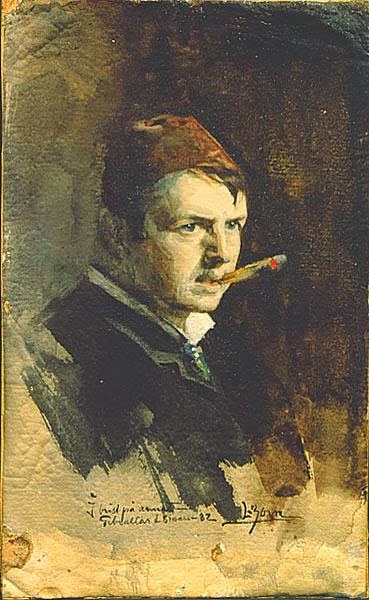
Finally, there is the self portrait, which clearly shows the palette with the four colors: white, ochre, red, and black. Zorn was conscious of his own image. He was aware that he was an artist’s artist even in his own day. He proudly showed off the four-color palette.

What the doubters need to understand is that a limited palette is not a sign of impoverishment, but rather of resourcefulness. As Brummer says, “limitation could, in fact, be an asset.” Zorn’s experiments with limited palettes were a part of his virtuosity, a token of his strength as a painter.

LINKS
"Sweden's Sargent" on the American Artist website.
Anders Zorn complete works (website)
Anders Zorn on Wikipedia

BOOKS
Northern Light: Nordic Art at the Turn of the Century
Zorn: Paintings, Graphics, and Sculpture
Landscape Painting by Birge Harrison
Color and Light: A Guide for the Realist Painter
Thanks, Tim Adkins for the palette photo.

Friday, December 13, 2013

Book Review: Anders Zorn: Sweden's Master Painter


The new book Anders Zorn: Sweden's Master Painter is a career survey catalog published to accompany the exhibition that's now in San Francisco.


I hesitated to buy it (upper left) because I already have other Zorn books, but I'm glad I did. It's got faithful reproductions, well-written essays, and quite a few images that haven't been published before.


The text is by four authors, all Zorn experts, including a biographical essay by Johan Cederlund, director of the Zorn Collections in Zorn's hometown of Mora, Sweden. They discuss his experiences in America, his nudes, his portraits, and his place in Swedish culture. There's not much coverage of his technical methods or specific insights from an artist's point of view, unfortunately.


I was glad to see many of Zorn's watercolors included. Zorn painted exclusively in watercolor early in his career, and switched mostly to oil later on. Zorn picked the most difficult subjects for his watercolors, such as boatmen in open water, or portraits of children from life.


In Zorn's etchings, figures emerge from an atmosphere of slashing parallel strokes. The etchings were my first introduction to his work when I saw an exhibition of them back in about 1977. The etchings are well represented both in the exhibition and the catalog, with a chapter by James Ganz "Etching in the City of Light: Anders Zorn Among the Post-Impressionists."

The book is hardbound, 9x12 inches, 224 pages, with many large reproductions, something many art book publishers neglect to offer.
------
RESOURCES:
Book: Anders Zorn: Sweden's Master Painter
Exhibition: at the Legion of Honor Museum in San Francisco until Feb 2, and will then travel to the National Academy in New York, opening at the end of February, 2014.

Monday, December 2, 2013

Carl Larsson talks about Zorn


Carl Larsson (second from left) and Anders Zorn (right)
Anders Zorn's contemporary Carl Larsson said that when he sat as a model for the great portraitist, Zorn "glared at him as if he would eat him up." 

Anders Zorn, Self Portrait
Biographer Karl Asplund said in 1921: "With Zorn it was not a question of the jargon of the studio, with its talk of 'the emancipation of art.' In the depth of his heart he would rather conquer the subject, retain it, explain it, and communicate to others in his own way the pleasure his eyes had experienced."

Anders Zorn, Self Portrait
According to Aslplund, "He did not care to talk about the theory of art; his theory was simple enough. He once explained to me the joy he felt in revealing the beauty of a subject through his brush, in making the spectator stop and look at Nature in a new way, a Nature more rich and beautiful —more 'Zornesque.'"
------
From Karl Asplund's 1921 book, Anders Zorn: His Life And Work
There's a new catalog available that I will soon be reviewing.

Thursday, August 2, 2018

Anders Zorn in Algiers


In 1887, Anders Zorn painted a man and a boy on a balcony in Algiers.


The painting is a sensitive study in warm and cool colors. You can see from the "bead line" over the head below how he returned with a big wash of blue over the main figure to deepen the color of the sky.


Bonhams auction house tells how the painting came to be:

"In the New Year 1887, Anders Zorn and his wife Emma (née Lamm), travelled from Sweden to North Africa to spend the winter in Algiers. There were strong European influences in Algiers at this time, even a small circle of Swedes including the physician and author Axel Munthe. Zorn met up with his fellow artist Robert Thegerström and together they rented a 'Moorish' house with a roof terrace and inner courtyard in the old town, the Casbah, where they could paint figure studies using hired models. Zorn writes, '[We] rented for ourselves an Arabian house far up, where we could paint, and took on a servant, an Arab, who got models for us, which was otherwise quite difficult work.'


"The main reason for the trip to Algiers was that Zorn had a commission from the Swedish King Oscar II to paint something from the Golden Horn. The subject that he chose was 'the Arab women who came to a priest down in the harbour to be blessed. Then they usually went down some stairs to the water and removed the veil from their faces as long as they knew no-one was looking. I chose to paint this scene and made studies in the harbour with Algiers in the background and then painted the figures on our roof.'

"In a letter from Algiers, dated 17th March 1887, Emma Zorn writes to her mother, 'Today Anders finished the large picture. It is lovely and in my opinion one of the best things he has done.' The watercolour From Algiers Harbour is nowadays to be seen at the museum, Prince Eugen's Waldemarsudde in Stockholm.

"In the present watercolour Zorn's interest in the strong and characteristic North African light is combined with his interest in exotic models and the use of traditional dress. A man and boy are sitting and standing in intense sunlight on what might be the roof terrace of the house rented by Zorn, looking out over the sea. The dark face of the man creates a strong contrast to his white dress. The colour scale keeps to light blue, grey and white, just as it does in many other of Zorn's pictures from Algiers. The scene invites an interpretation of Orientalism; however Zorn has also presented an everyday picture of life in the North African city.
----
Book: Anders Zorn: Sweden's Master Painter 

Sunday, March 31, 2019

Was Zorn an Impressionist?


Swedish artist Anders Zorn working on his
painting Mora Marknad (The Mora Fair) 1892.
Blog reader Mel Gibsokarton translated some memoirs of Russian painter Konstantin Korovin, which included this story of Anders Zorn (Swedish, 1860-1920) in Russia.

Zorn had joined a group of dignitaries for a polite evening that included the artists Korovin and Polenov, the Governor of Moscow, and a lot of high-society ladies. They were all interested in meeting the famous artist-foreigner.

As they gathered around the great round table to drink tea, one of the ladies declared:

"'I tell you, the paintings these days,' one lady said. 'Awful! All brushstrokes and brushstrokes, it doesn’t make sense. Horrible. I have been to an exhibition in Petersburg lately. They said, these are the Impressionists. A haystack is drawn, and, just imagine, blue… Impossible, awful. We have hay, and, I think, everywhere. Green, is it not? And his is blue! And yet more brushstrokes and brushstrokes… A famous, they say, artist-impressionist, Frenchman. It’s God knows what! But I'm glad you are not an Impressionist. Hopefully, we don’t have them and thank God.'"

"'I see,' Zorn blinked somewhat uneasily. 'Yes. But Velasquez is also an impressionist, my lady,' he said.

"'Really?,' the ladies were surprised.

"'Yes, and he' (Zorn pointed at me) 'is an impressionist.'

"'You don't say, really?' The ladies were surprised again. 'But he painted Sophia’s portrait so smoothly!'

"On the road back home Zorn asked me: 'Is this high society?'"

"'Yes,' I said.

"'How strange.'

"Zorn became silent. And the next morning he packed his briefcases and left for his home in Switzerland Sweden."
-----
From the book "Константин Коровин вспоминает..."  (Konstantin Korovin reminisces...) Thanks, Mel.
Book on Zorn: Anders Zorn: Sweden's Master Painter
Wikipedia: Anders Zorn

Wednesday, January 21, 2015

Anders Zorn's "Une première"


The painting "Une première" was one of Anders Zorn's first experiments portraying nude models in the open air. He was fascinated by the waves, the water reflections, the shifting weight, and the colors of the flesh as the woman and child wade into the shallow water.

Anders Zorn, Une première, gouache, 1888, 76x56 cm,
(29.92 in x 22.05 in), at the Nationalmuseum, Blasieholmen, Stockholm.
Zorn said, "My model was in Stockholm staying at a shoemaker's family with many children when I came along and asked to borrow a boy. The shoemaker had nothing against being rid of one for a while. The boy that suited me was sickly and close to death anyway. But what an effect fresh air had on a naked body. A couple of weeks later, I returned the boy and he was so healthy and rosy-checked that his parents hardly recognized him."

The original version of this gouache painting won a medal, but Zorn decided to rework it. He became so dissatisfied with the outcome that he angrily folded it and hacked it to pieces. A fellow artist, Christian Eriksson, gathered the fragments and put them back together. It is now considered a masterwork of figure painting.
-----
Books: 


Monday, February 11, 2013

Zorn exhibit coming to Boston


Later this month, a new exhibition will open in Boston, Massachusetts, called: Anders Zorn: A European Artist Seduces America. (Above: Mrs. Walter Rathbone Bacon (née Virginia Purdy), 1897)

The exhibition will include 24 paintings by the Swedish Belle-Epoque master (1860-1920), along with 22 drawings, photographs, letters, and gifts that Anders Zorn gave Isabella Gardner in 1894. (Above: The Omnibus, 1892.)

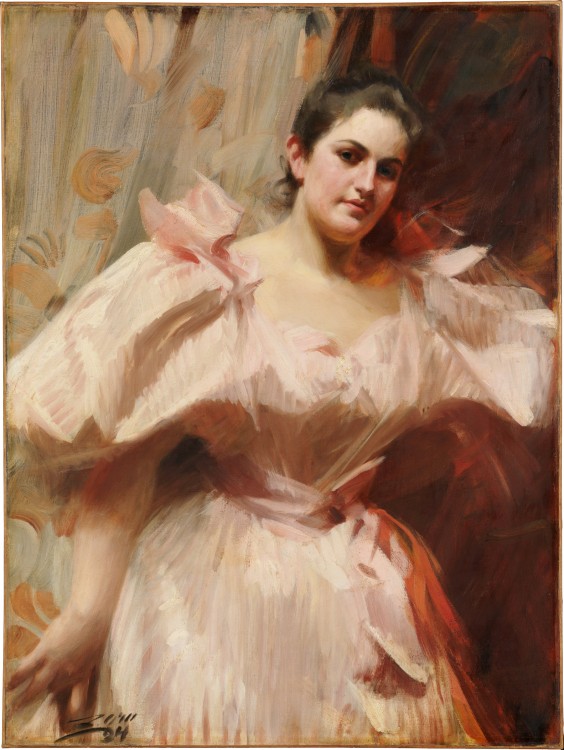
(Above: "Frieda Schiff, Later Mrs. Felix M. Warburg," 1894.) The show will be organized in five different segments, including “Zorn and Gardner,” “Society Portraits,” “In the City,” “Country Life,” and “Artist’s Studios.” Highlights include "Isabella Stewart Gardner in Venice" (1894), "Night Effect" (1895), and "The Ice Skater" (1898).
------
Anders Zorn: A European Artist Seduces America, February 28-May 13, Isabella Stewart Gardner Museum, Boston, Massachusetts. 
Other upcoming exhibitions that feature illustration and academic painting


Monday, May 20, 2013

Anecdotal Portrait

Many of Anders Zorn's early portraits are painted in watercolor. He was just 25 years old when he painted this one of Clarence Barker in 1885.


In a letter, Zorn explains the idea behind the portrait: Barker "reclines comfortably on the soft divan, having just spent time gazing at his sweetheart's portrait, and now he casts a tender glance at his dog who stands over him and looks him wonderingly in the eye. The painting could be called Rivals. I like to turn my portraits into paintings."

Zorn later abandoned the anecdotal angle in his portraits.
----
Book: Anders Zorn: A European Artist Seduces America
A large Zorn exhibition will come to the Legion of Honor in San Francisco in November, followed by the National Academy in New York.
Anders Zorn complete works online
Anders Zorn (1860-1920) on Wikipedia


Wednesday, March 23, 2022

Zorn and the Rain Storm

American painter Edward Simmons (1852-1931) was an eyewitness to how Anders Zorn painted in watercolor:

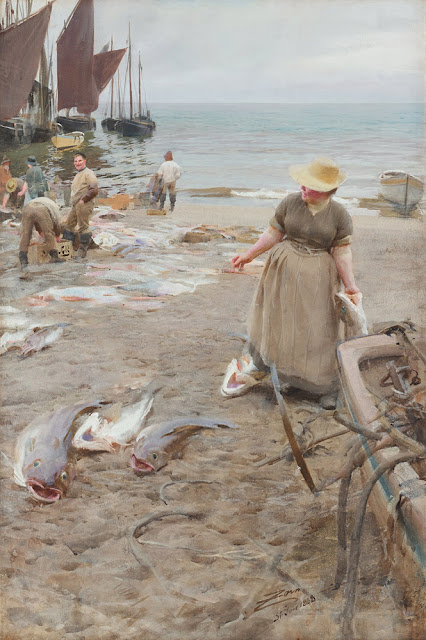
"Zorn was one of those artists who are always showing much originality in the use of their materials and combining this with a sense of humor, which often produces fine results. I went into his back yard one day, and he had a six-foot water color leaning against the house, and was throwing pails of water on it—“bringing it together.” 

Anders Zorn, Fish Market in St. Ives, watercolor and gouache, 100 x 76cm, 1888

"He had a great success at the Grosvenor Gallery with a picture of boats, sails, masts, and the seashore sand, with a fat fish-wife walking toward one. (In those days he thought the only beautiful women
were fat ones.) He laid this on a box hedge in the garden when a thunderstorm came up. We all rushed out and it seemed to me ruined."

Anders Zorn, Fish Market in St. Ives, detail

"'Now I can make a fine picture,' he said. He painted out the smudges from the sails and fixed the dirty sky, but in the foreground, in the sands, were large spots of raindrops. These he turned into footprints, and their naturalness has been commented upon more than once."
--
Books
From Seven to Seventy, a memoir by Edward Simmons (1852-1931)

Thursday, November 30, 2017

Zorn's Mephisto

Anders Zorn was in Madrid seeking portrait commissions when one morning, on a whim, he decided to paint a Swedish consul as Mephisto (the demon from German folklore who tempted Faust). 


He wrote to his wife Emma: "This morning I couldn’t paint what I was supposed to, but then Consul Dalander from Valencia came up to the studio and, as a joke, I painted him as Mephisto, quite a pretty joke in fact." 

----
Previously on the blog: Zorn's painting of an executioner
Exhibition: of Anders Zorn at Le Petit Palais in Paris through December 17

Sunday, November 10, 2013

Zorn's two-source lighting


This portrait of a peasant girl by Swedish painter Anders Zorn (1860-1920) is unusual because the head is lit from two sources, one from the right and one from the left.


These sources leave a shadowed plane on the forehead and cheek, and a dark cast shadow on the nose.


This photo shows Zorn with the painting and the model in the same spot he did the painting. There must be a large window or skylight behind the camera, as you can see from the cast shadow of the model's chair and shadow below the far chair which holds Zorn's hat. The secondary light source is the window in the far wall.

Was the photo taken while the painting was actually being done? Perhaps. Artists sometimes painted on a canvas in a frame. But it's also possible that Zorn and the model set up the photo after the painting was finished, and pretended to be working.


A major exhibition of Zorn originals opened yesterday at the Legion of Honor in San Francisco. The exhibit will continue through February 2. The exhibit will then travel to New York from February 27 to May 18, 2014.

And there's a new book: Anders Zorn: Sweden's Master Painter

The painting "Peasant Girl" is in the art museum in Worcester, Massachusetts. 
See lots of Zorns online at the Anders Zorn: the Complete Works


Saturday, May 11, 2013

Anders Zorn's Omnibus Paintings

The exhibition of Anders Zorn at the Gardner Museum in Boston ends in just two days, on May 13. The show includes twenty-four paintings and twenty-two drawings, in addition to photographs and letters.

I went to see the show with a group of artist friends last week, and we were intrigued with several variations on a theme of passengers riding an omnibus.


In one version, a young woman sits with her left hand clutching the string of a box as her fellow passengers doze or gaze out the windows. Outside it's a blur of action. Two contrasting light sources flood into the interior from the left and right.


In another, larger version, a wealthier woman hooks her fingers through a red strap in a hatbox. This time a man's arm and hand fills the lower left. The same two side lights prevail as in the previous version. But now he adds a third light source, a bar of light from the viewer's position cutting boldly across the main figure.


A smaller study shows a female omnibus rider peering out toward the light with a hand on the window.

A 'bus interior is an interesting subject for a painter, one that we can relate to now. It's an environment that mixes social classes, forcing strangers to sit together in the same space, while each is miles apart in his or her own thoughts.

Evidently all these paintings were based on visual impressions that Zorn experienced on location. Of course he couldn't have painted these fairly large canvases on the spot. My guess is that he sketched some small rapid notations in pencil or charcoal on location, committed details to memory, and then reconstructed the scene with models in the studio.

The challenge would have been to hold to the fleeting impression, and not be seduced by detail in the static posed model. The attention to soft edges and rapid paint handling in all three versions gives the effect of jostling movement and the fleeting effect of a moment glimpsed and recollected.

Book: ANDERS ZORN: A European Artist Seduces America
Anders Zorn Exhibition