Showing posts sorted by relevance for query courtroom. Sort by date Show all posts

Thursday, May 29, 2014

Courtroom Sketch Artist

Courtroom Sketch Artist on Vimeo.
The New York Times produced this video profile of Texas courtroom sketch artist Gary Myrick.

The survival of the profession depends on the prohibition of cameras in the courtroom. As cameras get less obtrusive, those prohibitions are eroding.

Defense witness in the Cullen Davis Trial, 1977. Art by Gary Myrick
This woman was part of the defense in a trial. Myrick got in trouble for referring to her as the "1957 Cadillac."

With the gradual disappearance of courtroom art, something else is lost. "Illustration is storytelling," Myrick says. "The difference between a camera in the courtroom and an artist might be the difference between just a cold, dry factual transcript, as opposed to a novel."
(Direct link to video) via BoingBoing
Previously on GurneyJourney: Jury Duty

Sunday, November 25, 2018

Two Courtroom Artists Share Their Story

Elizabeth Williams, Faisal Shahzad, The "Times Square Bomber"
Sentencing, Manhattan Federal Court, October, 2010
Elizabeth Williams and Christine Cornell are courtroom sketch artists who have covered many famous trials. At the moment they happen to be sketching the El Chapo trial.


With cameras not allowed in the courtroom, their drawings provide the only window into the events of the trial. Vice News video spotlights their work (Link to YouTube).
-----
Previous posts on Courtroom Sketch Artists

Saturday, June 24, 2017

Exhibit of Courtroom Art

Tom Girardi with beating victim Bryan Stow by Bill Robles.
An exhibit in Washington called "Drawing Justice" examines the work of courtroom artists.
"The nearly 100-work exhibit will feature historic sketches such as Howard Brodie’s drawing of Jack Ruby at his sentencing for killing Lee Harvey Oswald; Marilyn Church’s trial drawing of Martha Stewart; Pat Lopez’s capturing of a nervous Ken Lay looking at evidence during the Enron trial; Bill Robles’s drawing of the haunting, dead-eyed Charles Manson on the witness stand; and Joseph Papin’s image of “Son of Sam” murderer David Berkowitz in mental anguish." Read the rest at The Washington Post. 
The exhibition will be at the Library of Congress in Washington through October 28.
Article about the show in Columbia Journalism Review
----
Related: Sketch artist recreates Sean Spicer briefing after White House camera ban

Sunday, January 3, 2016

Fiction and Nonfiction


Muirhead Bone, World War I reportage sketch, 1918 (source)
Here's a philosophical question for discussion:

We divide writing into fiction and non-fiction. Why don't we divide art that way?

The answer seems obvious at first. Art is fictive because the images are created, not recorded.

We might regard photography as the non-fiction equivalent of art, since photography appears to capture reality without substantial human intervention. Compared to artwork made by hand, photographs seem more objective, more "true."

Yet photography involves innumerable aesthetic choices. And in the era of Photoshop and CGI, the boundary between art and photography has been blurred. Photography no longer holds the privileged position as a record of fact or truth.

Beatrix Potter, 'Studies of nine beetles' watercolor ©Warne&Co.
But supposing we stay just within the realm of handmade visual art. Can't we regard some art genres as non-fiction? Surely reportage on the battlefield or in the courtroom presents itself as a witness to true events just as much as the courtroom reporter with a notepad does. And natural history illustration presents scientific understandings with more saliency and truth than a photograph can do.

Isn't the artist dealing more in the world of truth than the writer? Art is nature filtered through a human temperament, but so is writing. By its very nature, writing is highly abstracted from reality. A journalistic reporter must convert observations into symbols that are far removed from sensory experience.

We can hardly think of writing without facing the division of fiction and nonfiction. Walk into any library or bookstore, and the demarcation is very evident. In film, the line is usually drawn between movies and documentaries.

In recent decades, there have been more and more works in film and literature that explore the boundary line of the two existing categories, such as historical fiction, novels based on real events, and biopics. Oddly enough, the library classifies books on elves, faeries, folklore, and mythology in the nonfiction section. My own book, Dinotopia deliberately blurs the boundary by presenting a fantasy world as if it were non-fiction.

At its most objective, the art of painting can bring us to an experience of the world that is closer to pure objectivity than writing can do, while forms of art can be placed on a gradient taking us into realms of pure subjectivity and invention.

I'm not saying that we should invent new categories for art, nor am I proposing that we should do away with them in writing. But I believe it's helpful to remind ourselves that the conception of fiction and nonfiction in writing is an arbitrary and inconsistent social construct. In the same way, the divisions of literature into categories of children's, young adult, and adult strikes me as arbitrary and misleading.

Devdutt Pattanaik said, "Nobody knows why we're alive; so we all create stories based on our imagination of the world; and as a community, we believe in the same story. In India, every person believes his/ her own mythosphere to be real. Indian thought is obsessed with subjectivity; Greek thought with objectivity."

If you have thoughts about this, I welcome them in the comments.

Friday, April 25, 2014

Portrait Society Conference


I arrived at the Portrait Society of America annual conference in Washington, DC last evening as the Face-off began. 

The Face-off is a competition between 15 artists who paint five models in groups of three as attendees watch. Here's Tony Pro, one of the contestants. The winner will be determined by popular vote.

One of the reasons the convention organizers invited me back was to sketch from the sidelines like a courtroom reporter. I'm using the little Schmincke watercolor kit, some gouache, and watercolor pencils in a watercolor notebook.

Instructors this year include: Sam Adoquei, Juliette Aristides, Ryan Brown, Scott Burdick, Wende Caporale, Ellen Cooper, Virgil Elliott, Rose Frantzen, Max Ginsburg, Daniel Greene, James Gurney, Jeffrey Hein, Quang Ho, Edward Jonas, David Kassan, Everett Raymond Kinstler, Robert Liberace, Susan Lyon, Michael Shane Neal, Paul Newton, Alicia Ponzio, Tony Pro, Mardie Rees, Anthony Ryder, Rhoda Sherbell, Burton Silverman, Daniel Sprick, Sharon Sprung, Alexey Steele, Jennifer Welty, Dawn Whitelaw, and Mary Whyte.

Portrait Society of America Website

Saturday, January 25, 2020

Sketches from the Impeachment Trial

Art Lien for New York Times.
Art Lien has been a witness to history as he sketches the impeachment trial in Washington, DC.

Art Lien says: "Some members took up a second activity, like fidget spinning or doodling.”

He says that he is only allowed to bring simple drawing tools into the Senate chambers to produce the line work. He is forced to paint the washes later from memory.


Art Lien's normal beat is the Supreme Court. Here's a video profile (Link to YouTube).


Most professional courtroom sketch artists work in federal jurisdictions, as many state courts have allowed cameras to cover their proceedings. 
-----

Monday, February 8, 2016

Sketching in Iraq and Afghanistan

In this TED talk, news illustrator Richard Johnson tells what it was like to sketch during the wars in Iraq and Afghanistan and how sketching brought him closer to the military company he traveled with.


Art by Richard Johnson, courtesy WBUR
He shares how the combat and courtroom artist Howard Brodie (1915-2010) inspired him early on, and he discusses what art can capture that photos can't. (Link to YouTube)
----
Interview with Richard Johnson on WBUR radio

Sunday, July 7, 2013

Composographs

In this age of easy digital manipulation, people automatically doubt the veracity of photos. But that wasn't always the case. Back in the 1920s—the era of sensational 'yellow journalism'—tabloid newspapers attracted readers with faked photos. The New York Evening Graphic made a sensation with its photomontages, which they called "composographs." 


This image was created for the coverage of the Kip Rhinelander divorce trial. A wealthy blueblood sued for divorce, claiming that his wife concealed her Negro blood from him. In the court case, she was asked to strip half naked before the jury. Cameras were banned from the courtroom, so the Graphic ran a composograph, cutting, pasting, and retouching more than 20 separate photos, including a dance hall girl who stood in for the bride.

Another news event that was never caught on film was movie idol Rudolph Valentino’s unsuccessful operation in 1926, from which he didn't recover. The Graphic reconstructed the scene with a composograph.

Did readers actually believe these were real photos taken at actual events, or was the line sufficiently blurred sufficiently between reality and illustration that people believed what they wanted to believe? That's hard to say.

The Graphic pushed the envelope with a composograph of the recently deceased Rudy Valentino in heaven, chumming it up with opera legend Enrico Caruso. Whatever the case, the Graphic's innovative composographs laid the foundation for later tabloids like the National Enquirer.
-----
Wikipedia composograph
More about the Kiplander trial

Saturday, July 7, 2018

Civil Rights Protest Drawings on Exhibit

In 1956 Harvey Dinnerstein and Burton Silverman traveled to Alabama to cover the bus boycotts that were sparked by the protest of Rosa Parks. 

Mrs. Rosa Parks by Harvey Dinnerstein
"New York artists Dinnerstein and Silverman spent several days drawing Montgomery’s African American citizens walking and carpooling, listening to speeches by community leaders and civil rights activists, and participating in the trial that challenged the segregation of public transportation. This exhibition features their drawings, ranging from expressive portraits to impassioned courtroom drama, and capture the spectrum of actions and emotions that marked the boycott as a turning point in the struggle for civil rights."
Their sketches are now on view at the Delaware Art Museum through September 9.
----
"The Montgomery Bus Boycott: Drawings by Harvey Dinnerstein and Burton Silverman" at the Delaware Art Museum.
• Previously on GJ: Sketching the 1956 Protests in Montgomery, Alabama
• Take part in the challenge "Paint a Parking Lot"

Friday, November 26, 2021

Howard Brodie's Portraits

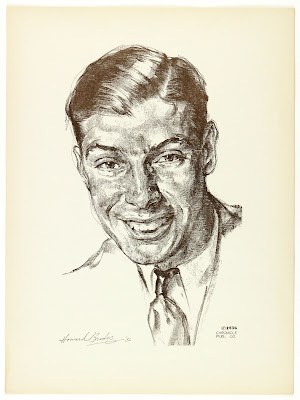
Joe DiMaggio by Howard Brodie, 12x16" 1936

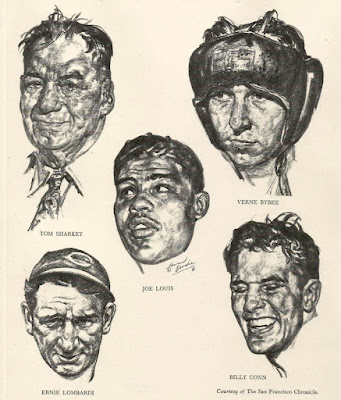
Before he worked as a war reporter and a courtroom sketch artist, Howard Brodie (1915-2010) produced a lot of portraits in crayon of sports figures for the San Francisco Chronicle. 

Brodie drew from life whenever he could. According to Gene Byrnes, "He avoids any mechanical means of drawing, and says that when he is asked to use a photograph for factual reference he goes to considerable pains to avoid copying it."

Books: A Complete Guide to Drawing, Illustration, Cartooning, and Painting by Gene Byrnes

Drawing Fire: A Combat Artist at War : Pacific Europe Korea Indochina Vietnam