Saturday, December 7, 2013

Archival footage of diorama painting


The American Museum of Natural History shared this short video featuring archival footage of James Perry Wilson's working method. Wilson painted many of the finest diorama backdrop paintings for the American Museum of Natural History in New York.

The video refers to a unique grid system that Wilson used for projecting a scene onto a curving backdrop, so that the forms don't get stretched out. Wilson called the grid "the unsquare square." Based on his background as an architectural illustrator, he was meticulous about planning, and did a complete full-size charcoal drawing on the back wall before painting in oil. You can see him covering up the drawing as he applies the paint. (Direct link to video)

Wilson was also unusual for plein-air painting completely in the nude, but that's another story.
------
More about the diorama art in Stephen Quinn's book: Windows on Nature: The Great Habitat Dioramas of the American Museum of Natural History
Thanks, Jason Peck

Friday, December 6, 2013

The fate of artist colonies


Edward Simmons, "Gathering Wood, Concarneau" - 1883
After visiting the Newlyn colony of painters in Cornwall, American artist Edward Simmons described the usual fate of artist colonies:

"The artist finds a place that is beautiful, undiscovered, and suits his pocketbook. He goes there for two years. The third year other artists follow him; the fourth year come the retired British admirals and "vamps"; the fifth year the artist leaves; the sixth come the wealthy people who spend a lot of money on it, making it as ugly and dear as possible, but soon tire and go away. Then the artist comes back again and begins all over, picking the bones of what the Money Bags had killed."

Fluid dynamics effects reel


Artists in the digital realm continue to create fresh visual wonders. Here's a fluid effects reel by Jesse Pitela that shows off some amazing splash and flow dynamics.

I'm not sure exactly how this stuff works, but I'm guessing it involves some sophisticated simulations involving momentum, air resistance, surface tension, and gravitation. Plus a wonderful artistic sense of timing, lighting, and composition. (Link to video) Thanks, CG Bros.

Thursday, December 5, 2013

"Saying Grace" sets auction record

Norman Rockwell's Post cover "Saying Grace" sold at Sotheby's for a record $46 million, setting an all-time record for an American painting.* According to Time magazine, the previous record was held by a George Bellows painting called “Polo Crowd,” which sold  $27.7 million in 1999.

This is good news for American illustration, but a sad loss for the Norman Rockwell Museum, which was borrowing and displaying the painting while the estate of Rockwell's former art director decided what to do with it. Let's hope the new owner will allow it to remain on public display somewhere.

*Edit: Time Magazine's claim doesn't acknowledge the auction sale last May for $86 million of a painting by Latvian-born American citizen Mark Rothko.

Thanks, Tom Hart!

Overcast light for a complex subject


Robert F. Blum, The Ameya, 1893, The Metropolitan Museum
Quick tip: When painting a complex scene, especially one with color and pattern, use overcast or indirect light. This choice removes from the scene the complex pattern of cast shadows, and it keeps the color values more in their home ranges.

Indirect light is also very flattering for faces of women and children. Generally the more the planes face upward, the lighter they are.

This painting by Robert Blum (1857-1903) of Cincinnati was based on sketches and studies he did from life in Japan. Thanks to the Met's wonderful web interface and large files, you can get a close look at the painting even if you don't live near New York.

Previous post on Robert Blum

Wednesday, December 4, 2013

Charles Keene's cartoons about artists

Charles Keene (1823-1891) was a cartoonist for the British humor magazine Punch. His incisive characterization was admired by Edgar Degas and Adolph Menzel.

Many of his cartoons poke fun at problems faced by artists. Some are universal problems, and some are peculiar to Victorian society.
A tourist tries to help an artist by posing in the foreground of his scene, hoping to be painted into it.


The fellow on the left paints ships and the other paints pictures of ships. When the low-class chap presents himself as a brother brush, the other takes a dislike to the whole place.

After a long look, the farmer's wife doubts that the artist is painting "any place hereabouts."
The artist brings his friend to a favorite sketching spot, but the non-artist doesn't see the beauty in it.

Two bystanders, a village schoolmaster and an intelligent farmer, observe the artist's fumbling efforts and conclude that he's an amateur.

A buyer asks for "a little more picture and a little less mount."

An Irish model objects to wearing a dilapidated costume.

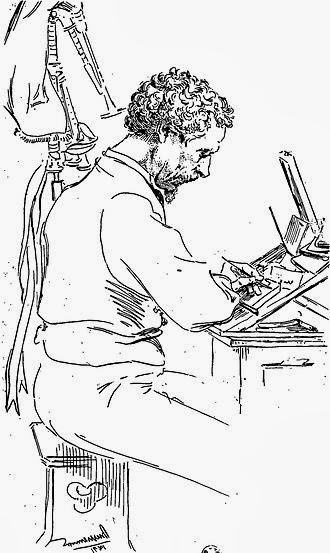
And here's a peek behind the curtain at the man himself, Charles Keene, as seen by Félix Bracquemond
------

Tuesday, December 3, 2013

Lines and Colors reviews 'How I Paint Dinosaurs'


Charley Parker of the art blog "Lines and Colors" just reviewed my instructional video, "How I Paint Dinosaurs."
"Like many of the best instructional art videos, on a second viewing, you’ll find little nuggets that you may have cruised over on initial viewing (like doing a pencil drawing on illustration board with the pencil held horizontally, so the point doesn’t indent the board, making it easier to erase and move lines). Much of the detail is visual, beyond the verbal instruction, in good close-ups of brush work and paint application."
Read the full review.
The DVD is available at Kunaki.com or Amazon.com.
Digital file from Gumroad (credit card) or Sellfy (Paypal): buy

CBS report on cheap counterfeit paintings from China


(Video link) CBS News reports on the booming trade of forgeries of original paintings coming from China. The biggest buyers are hotels and corporate clients.Link to CBS News article Thanks, Lucas Antoniak

Monday, December 2, 2013

Carl Larsson talks about Zorn


Carl Larsson (second from left) and Anders Zorn (right)
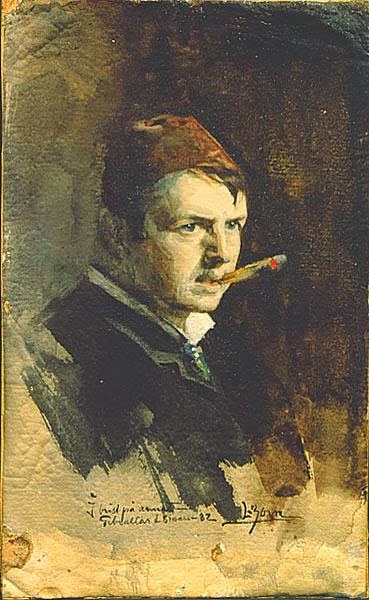
Anders Zorn's contemporary Carl Larsson said that when he sat as a model for the great portraitist, Zorn "glared at him as if he would eat him up." 

Anders Zorn, Self Portrait
Biographer Karl Asplund said in 1921: "With Zorn it was not a question of the jargon of the studio, with its talk of 'the emancipation of art.' In the depth of his heart he would rather conquer the subject, retain it, explain it, and communicate to others in his own way the pleasure his eyes had experienced."

Anders Zorn, Self Portrait
According to Aslplund, "He did not care to talk about the theory of art; his theory was simple enough. He once explained to me the joy he felt in revealing the beauty of a subject through his brush, in making the spectator stop and look at Nature in a new way, a Nature more rich and beautiful —more 'Zornesque.'"
------
From Karl Asplund's 1921 book, Anders Zorn: His Life And Work
There's a new catalog available that I will soon be reviewing.

Sunday, December 1, 2013

Painting in a Blacksmith Shop


I produced this mini-doc about painting in a blacksmith shop at Old Sturbridge Village. (Direct link to video)

One of the reasons I'm playing around so much with video is that I'm developing a series of instructional DVDs about painting on location in various media: watercolor, gouache, casein, watercolor pencils, ink wash, and oil. Each full-length video will feature two or three plein-air paintings done right front of you in real time, plus a variety of informative short features.

In the two polls at left, please let me know which media and topics you're most interested in. You can select multiple answers. And in the comments, tell me what else you'd like to see in the long-form DVD/videos.


Garin Baker's painting is in oil, 14 x 27 inches. It was amazing to watch him do it, an impressive feat of concentration. He says: "From the moment you suggested going to Sturbridge Village to paint on the spot, a flood of memories came back to me. Year ago when my daughter was in grade school I was a parent chaperone on a class trip there. I remember the completely authentic feel of the place, so I knew we would find some interesting scenes to inspire a painting or two."


Garin continues: "A few years ago I also remember seeing the original of Norman Rockwell's blacksmith shop ("Horseshoe Forging Contest," above) and how amazing and lovingly every square inch of that painting was handled. So with those two points of interest in mind I set out."


I approached the two portraits separately, since the workers kept changing places and taking breaks. The man above was a retired police lieutenant who was just learning the trade.


I'll be writing in more detail about our blacksmith shop paintings in the next issue of International Artist magazine.

Materials: I was using casein paint, various flat and round brushes, and a Moleskine watercolor book  on a homemade pochade easel. Most of the video is shot with a Canon VIXIA HF R400 Camcorder. The opening shot was with a Canon EOS Rebel T3i with a Canon 50mm 1.8 prime lens.

Previously: Creamer in Casein
My first full length video: How I Paint Dinosaurs
Don't forget to vote at left.