"This is the book that started it all" —Patrick O'Brien, MICA
James Gurney
This weblog by Dinotopia creator James Gurney is for illustrators, plein-air painters, sketchers, comic artists, animators, art students, and writers. You'll find practical studio tips, insights into the making of the Dinotopia books, and first-hand reports from art schools and museums.
You can write me at: James Gurney PO Box 693 Rhinebeck, NY 12572
or by email: gurneyjourney (at) gmail.com Sorry, I can't give personal art advice or portfolio reviews. If you can, it's best to ask art questions in the blog comments.
Permissions
All images and text are copyright 2020 James Gurney and/or their respective owners. Dinotopia is a registered trademark of James Gurney. For use of text or images in traditional print media or for any commercial licensing rights, please email me for permission.
However, you can quote images or text without asking permission on your educational or non-commercial blog, website, or Facebook page as long as you give me credit and provide a link back. Students and teachers can also quote images or text for their non-commercial school activity. It's also OK to do an artistic copy of my paintings as a study exercise without asking permission.
Scivias, a 12th-century book written by the nun Hildegard of Bingen and painted by two anonymous artists.
Who painted the illustrations on medieval manuscripts? According to new archaeological evidence, some of them may have been nuns rather than monks.
The evidence comes from deposits of ultramarine or lapis lazuli pigment in the tartar of the teeth of a female skeleton who was associated with the convent that produced medieval manuscripts.
The suggestion is that she may have ingested some of the pigment into her mouth while licking her brush to give it a fine point, or perhaps she inhaled some of the pigment while grinding it.
Researcher Christina Warinner has "found everything from insect parts and the pollen of exotic ornamental flowers to opium, bits of wool, and milk proteins—all of which tell stories about what people ate and how they lived. The detritus of everyday life accumulates in the gunk that modern dentists are so vigilant about scrubbing off."
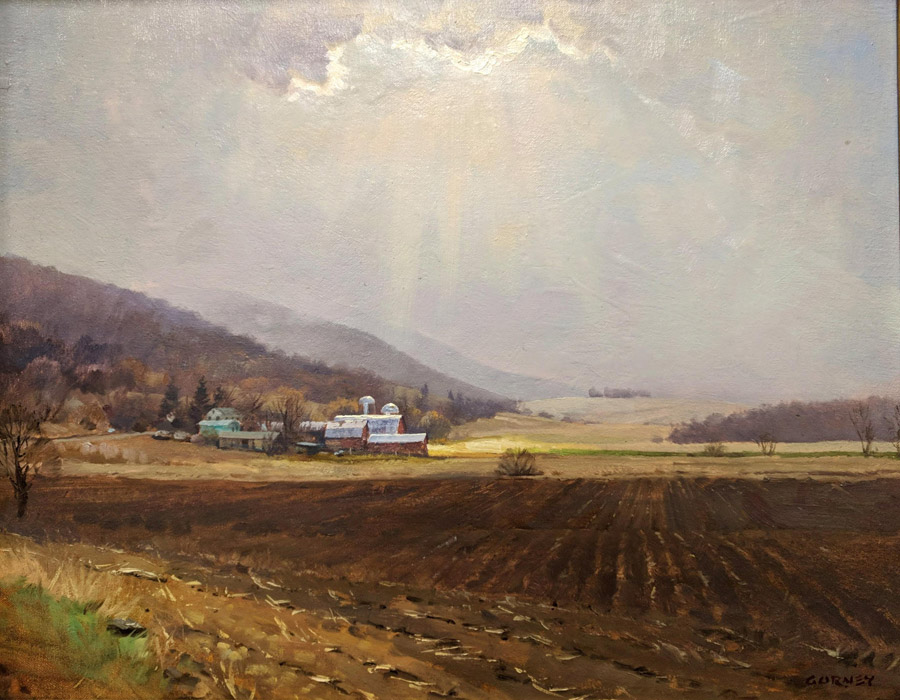
What makes me want to paint this scene is the way the light and atmosphere work together to create depth. Here's what I'm thinking as I paint it.
Farm in Harlem Valley, oil, 12 x 16
The cloudy sky has a low ceiling. The tops of some of the hills are lost in fog. Also the far horizon is enveloped by the low clouds, so the warm colors in the farthest fields are greyed down before they disappear.
The fields are illuminated in the lower left foreground. Then as you go back across the perspective of the plowed field, you travel through the shadow area and back into the light again.
The principal area of illumination is not on the farm buildings, but a little beyond them. The light is coming through a breach in the clouds with very subtle rays.
Concealing both the source of light and the effect area adds to a sense of mystery. One way to make a striking light effect is to downplay and conceal most of the scene to set up for the accent area.
-----
For more on light and atmosphere in painting, check out my book Color and Light can be found on Amazon or signed at my website.
I take a walk alongside the far hayfields with my son's dog Smooth.
Church Bells, watercolor and gouache, 5 x 8 in.
There's a little snow left over in the tire tracks, but it's disappearing, since it's above freezing. I'm fascinated by the way the tractor tracks wind back and ascends the hill. The far sky is framed by the delicate branches and deep woods.
Smooth sits by me quietly, listening to the sounds of the sparrows flitting in the bushes, the geese flying over, and the faraway noon sirens and church bells (link to video on FB).
In this photo, an unidentified artist has set up a life-size portrait.
The canvas is approximately on the same plane as the model, so that when the artist backs up from both, he can compare the painting and the subject side by side in the same light. Note the planks of wood to protect the lawn from wear when the artist backs up from the painting or steps over to his taboret. Sight-size is good exercise.
The sight-size method, which is in common practice in many ateliers, is one practical way to achieve accuracy, and it makes sense when you want your painting to be the same size as the subject. That works for portraits and still life studies.
Sometimes people apply the term "sight-size" to landscape in the sense of matching the apparent visual size of the scene to the image on the canvas (link to video by Marc Dalessio).
It's worth pointing out that the method isn't strictly an "observational" method. When done with figure painting, it requires a good deal of short-term memory practice, and some of the leaders of the sight-size movement have written books about drawing from memory.
I'm not going to get into all the pros and cons of the sight-size method, because I don't practice the exact same method that's taught in the ateliers, but I should point out that various art teachers have criticized the way the sight-size method is held up as the only method that was taught in the 19th-century academies. Here's one free online pamphlet by Semyon Bilmes that addresses the issue.
And not all ateliers use the sight-size method in its absolute form. The Swedish Academy promote a comparative method, which they explain on their website.
The Brooklyn Art Library is a collection of 41,000 sketchbooks from over 130 countries. The library has the collection on shelves, but it's also digitally cross-referenced and available for free for the public to browse.
They have launched a project to encourage the creation and dissemination of sketchbooks. Participants order standard-sized blank sketchbooks and fill them up. The project is funded by a payment from the creator when they buy the sketchbook or pay an extra fee to have it digitized.
The "sketches" can be anything: doodles, observational studies, photomontages, or imaginative works. The artist assigns keywords and search terms so that the content can be discovered online. You can visit the website and search by keyword or theme.
Like the internet itself, the Sketchbook Project appears to be uncurated and unfiltered, with no gatekeeper. That can be either attractive to you or not, depending on your point of view. Part of the appeal to people who visit the collection is the fun of randomly encountering someone else's point of view.
All the books are displayed on the shelves and available for browsing, and some are even brought around the neighborhood by bookmobile.
----- Sketchbook Project
Two hours north of Tokyo is a museum featuring rocks that appear to have human faces. It's called Chinsekikan, which translates as 'Hall of Curious Rocks.'
The collection was originally assembled by Yoshiko Hayama who discovered rocks that he compared to E.T., Elvis Presley, Jesus, Gorbachev, Nemo, and other personages. His only requirement is that every rock be formed by natural processes.
------
Via WebUrbanist
More samples at This is Colossal and Kotaku
Previously: Apophenia and Pareidolia
Gaston la Touche (1854 - 1913) was a French painter whose creative approach to light, color, and composition was a big inspiration to his contemporaries.
Gaston la Touche
He was not a product of the Academy, but instead learned to paint independently. He made friends with Degas and Manet at the cafés in Paris.
La Touche wanted Manet to teach him, but Manet declined, saying "he had nothing to teach him other than to paint what he saw and to use a variety of colors."
Gaston la Touche, The First Born, 1883.
His early paintings represent a low-key realism in a traditional mode. This painting, "The First Born" is a rare survival, because he burned most of his early paintings in 1891.
Gaston la Touche, Pardon in Brittany, 1896
But before long he started to explore unusual compositions and brilliant ideas of light. A "Pardon" is a Breton form of penitential pilgrimage conducted at twilight with candles.
Gaston la Touche, The Joyous Festival, 1906
According to Wikipedia: "Félix Bracquemond, a friend and associate, suggested that he might be more successful if he brightened his color palette and chose different subjects, recommending Antoine Watteau and François Boucher as models."
Gaston la Touche, Nocturnal Spirits
The following quotes are from a 1921 museum publication: "Gaston La Touche was above all, the artist of imagination. Starting as a realist in his early days, he gradually worked towards a particular kind of idyllic subject which has become identified with him."
"He was a modernist, in that he used all the tricks and subtleties of modern technique, but his subjects were generally phrased in the graceful idiom of the eighteenth century. He reconquered the charm of Watteau and Fragonard and reclothed the classic myths of Boucher in modern guise."
In his beloved Normandy, at Flers de L'Orne, where he spent many a summer, or at his home in St. Cloud, in surroundings where the spirit of the eighteenth century still lingers, he painted untiringly, a true product of his environment."
Henry Field said: “In the years I spent in Paris I never heard the Frenchmen discussing technique. Simon, Menard, Gaston La Touche, Fantin-Latour, indeed, all my French friends were intent on expression and never bothered about brushwork.”
"His subjects are always filled with intense vitality. He painted the world as he saw it and found it a fairyland. He rediscovered the poetry of existence for those who can and will see. In the woods and plains the satyr and nymph form part of a classic fantasy or a "Fête Galante" of modern life."
"Like Debussy in "L'apres-midi d'un faun" he has retold the ancient legend in the colloquial language of today. He was a decorative artist at all times, but he never lost his touch on reality."
"With that as a foundation he chose the same gay setting beloved by the eighteenth century artists and treated his subject with their unfailing grace and sense of decoration."
-----
Frank Duveneck (October 9, 1848 – January 3, 1919) painted this oil portrait of a fellow artist.
The portrait has some animation in the mouth and eyes, as if the subject was talking. The portrait is essentially made up of spots of tone, almost like pixels. But under the strokes is a careful arrangement of tone and edges, gradating down from the light area on the forehead.
A few days ago (January 3) marked the 100th anniversary of his death. Artists in Cincinnati, such as Linda Crank, Carl Samson, Jeff Morrow, and Richard Luschek, went through a scrapbook of Duveneck's paintings at the Mother of God Cemetery in Fort Wright Covington, Kentucky.
(Link to video) There were other commemorations at the Cincinnati Art Museum, including a group of artists doing master copies of Duveneck originals. Read more at Linda Crank's Facebook page.
Public libraries today offer a collection of books that you can borrow, as well as a place to read periodicals.
Reading room, Magnus Enckell 1899
In the 18th and 19th centuries, those functions were typically separated. A reading room, or cabinet de lecture, was a place where you could, for a small fee, read newspapers, magazines, novels, and pamphlets.
Libraries didn't stock those publications, and most ordinary people didn't get them delivered to their homes.
In France, cabinets de lecture were especially popular after the Revolution, as people became more interested in politics. According to Wikipedia:
"Often at the cabinets, as with at the clubs, coffee houses, salons and bookshops, serious discussions would break out. People argued, hurled abuse and fought one another over specific facts in order to attack or defend the public figures being discussed. Whether by the light of a lantern or a simple oil lamp, people came to feed their political appetite and to leave better prepared for the debates that took place in the street."
Did you make an art-related New Year’s resolution? If you don’t mind, please share it in the comments, and I’ll try to address the topic in future videos.






 "With that as a foundation he chose the same gay setting beloved by the eighteenth century artists and treated his subject with their unfailing grace and sense of decoration."


