Tuesday, December 10, 2019

Richard Ansdell's Collaborations


Animal painter Richard Ansdell (British 1815-1885) collaborated with other artists, who helped him by providing the figures and landscapes.

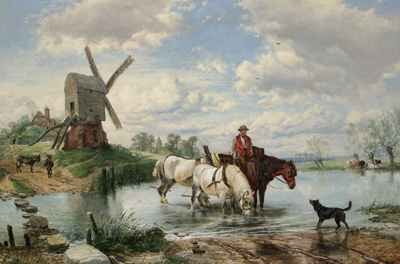
Richard Ansdell and Thomas Creswick, The Nearest Way in Summertime
His friend Thomas Creswick supplied the background for ‘The Nearest Way in Summertime.’ Ansdell painted the horses and the dog. In this case the windmill and the grouping of horses fight for attention, making the painting feel disharmonious.
 
A Dream of the Future by William Powell Frith, RA (British, 1819-1909),
in collaboration with Richard Ansdell, RA (British, 1815-1885)
and Thomas Creswick, RA (British, 1811-1869) 
According to a 1906 Art Journal, "In ‘A Dream of the Future’ (R.A. 1856), the figure was by Frith, the landscape by Creswick, and Ansdell put in the dog." 

Richard Ansdell, A Spanish Shepherd

"In 1856 he made his first visit to Spain, with John Phillip, R.A., and at the Royal Academy he showed ‘Going to be Fed,’ to which that artist had contributed."

Richard Ansdell, Lytham Sandhills, (1853)
Richard Ansdell on Wikipedia

Monday, December 9, 2019

Why Can't Flower Pigments Be Used in Paints?


Thom Rozendaal asks: "Why don't we use flowers to make pigments? I understand it would be hard to separate the biological matter from the pigments so maybe it would be possible to study how flowers produce these colors and recreate the processes in a lab? Has this ever been attempted before? Are there any pigments that are already made from flowers? It seems most are made of some type of mineral or something, and I guess I'm just worried we'll some day over-mine some of them as we are already doing with so many other things, whereas flowers are already being produced on a mass scale and are a renewable resource."

Thom, There are two main types of pigments in flowers: carotenoids and flavonoids. Scientific American says: "Carotenoids include carotene pigments (which produce yellow, orange and red colors). Carotene pigments are also found in vegetables, which is what gives carrots their colors. Flavonoids include anthocyanin pigments (which produce red, purple, magenta and blue colors)."

Both of these are natural organic pigment compositions that fade quickly because the large molecules are easily broken by ultraviolet light. You can make ink out of anthocyanin pigment, but it will be subject to photodegradation. People who collect dried flowers keep them pressed in books to protect them from ultraviolet light.

One organic pigment that has been traditionally been used as an artists' pigment or a vegetable dye is madder root, made from the dried root of rubia tinctorium. The root pigment is "laked" which means "bonded chemically to a colorless, transparent, insoluble salt that often acts as its own mordant — which turns the dye into an insoluble pigment. The gum arabic in watercolors then binds this complex but chemically stable pigment to the paper." (Source)

Natural organic pigments are rarely used in modern paints because of issues of lightfastness, so paint manufacturers use synthetic organic pigments or inorganic pigments. This webpage explains more about that process.
----
Scientific American: Springtime Science: Exploring the Pigments in Flowers
Anthocyanin pigments on Wikipedia


Sunday, December 8, 2019

Clean the Brush Before Each Mixture?


Doan Le says: “What do you do when you need to change colors? Do you simply change brushes, or wash off the previous paint with water?”

If the new color I need to mix is not a big color change, I can keep using the same brush, even if there’s already some paint in it. I factor the paint that's in the brush into the new mixture. If the color I want to mix is significantly different, I may need to remove most of the paint with a paint rag. If I must mix a fresh, pure mixture that’s different from what’s in the brush, I have to thoroughly wash out the brush in a plastic tub of water and then dry it off with the rag. Each of these water cleanings dirties up the water supply, so if I’ve only brought a small amount of water, I try to limit the number of deep cleanings.

Saturday, December 7, 2019

Leonard Squirrell's Scenes of East Anglia

Leonard Squirrell, watercolor over pencil
Leonard Russell Squirrell, R.W.S., R.I., R.E. (1893-1979) was a versatile British artist who captured compositions of the architecture that was disappearing in 20th century.

Leonard Squirrell, watercolor over pencil
According to a recent book on Squirrell, he was known as the 'Grand Old Man of East Anglian Painting', "beloved by many people well outside the boundaries of East Anglia and admired by many more as an outstanding topographical artist. Ranked by many collectors and connoisseurs with John Sell Cotman, Thomas Girtin, Philip Wilson Steer (who taught him) and other famous East Anglian artists." 

Leonard Squirrell, Etching
According to a book on sketching from the 1930s,  Squirrell's pastel work "comes to us as a revelation," because he would do careful lead pencil studies before attempting his pastel drawings on tone paper.
Leonard Squirrell, pastel
"For him these are more than mere sketches, embodying not only the conception but all the study necessary to the production of a completely worked out pastel."
-----

Friday, December 6, 2019

Leonard Campbell Taylor's Compositions

In his painting Women Playing Chess, Leonard Campbell Taylor limits himself to a restricted gamut of, essentially, white, black, and red, with a little blue-green mixed in with the grays.
Women Playing Chess by Leonard Campbell Taylor (British 1874-1969)
Thanks to his skillful value organization, the composition holds together well. The dark tones of the man in the distance blends into the background tones and yet is still readable. The black dress of the woman on the far side of the table also links up with the dark tones around her.


The first picture must have been successful for Taylor, as he echoed the idea in later paintings, and he even quoted the first composition in a print on the wall behind the man.
---
Discover more works by LCT on the ArtUK website.

Thursday, December 5, 2019

Allen Anderson's Pulp Covers

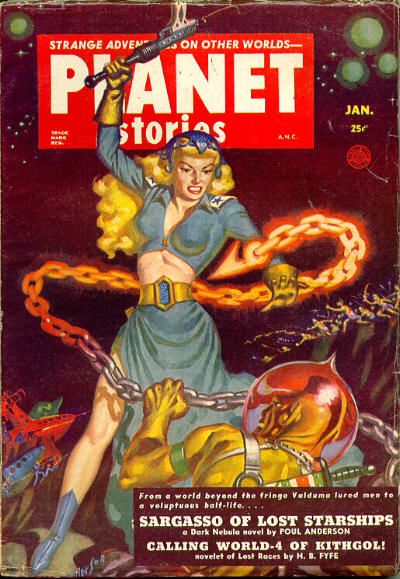
The art of Allen Anderson is featured in a new hardbound book from the Illustrated Press.


Anderson (1908-1995) created dynamic, action-packed covers for the pulp magazines.


He worked for the westerns, "spicy" pulps, comic covers, and science fiction stories.


The book reproduces original art, tearsheets, and reference photos.


The hardcover book is compiled by author David Saunders, an expert in the field, and the book is limited to just 900 copies.

The Art of Allen Anderson available on Amazon
or at the Illustrated Press website.

Wednesday, December 4, 2019

Artists in the Calais Jungle


What happens if you're a refugee but also a dreamer? This mini documentary takes us inside the life of stateless artists who make time for their calligraphy, painting, or filmmaking. (Link to YouTube)
---
Thanks, Dan

Tuesday, December 3, 2019

Priest Before the Sermon

Here's a priest before the sermon, turned inward in contemplation. 


I used just four tools: black and red-brown water-soluble colored pencils, a water brush filled with black ink, and a water brush filled with clear water.

Monday, December 2, 2019

Krøyer's Studio


This photo of the studio of Peder Krøyer (Danish, 1851-1909) studio shows his famous painting Hip, Hip, Hurrah! Just below that is a parabolic reflecting lantern, and on the floor is his field box.

Wine Bar by Peder Severin Krøyer
------
Peder Krøyer on Wikipedia

Sunday, December 1, 2019

Morphing Stockholm

Refik Anadol has developed software that can melt one form into another in an ever-evolving flow of dreamlike images. Forms that we think of as stable—such as architecture—rise and fall away like the tides and the flowers.


(Link to YouTube) The system draws on a collection of over 300,000 photographic images. The process uses a generative adversarial network, where one computer network creates images and the other judges whether the result is plausible.
-----
Latent History – a machine dream of a Stockholm that never was (Thanks, K-Blogg)