Showing posts sorted by relevance for query focus on nature. Sort by date Show all posts

Tuesday, September 3, 2013

Focus on Nature exhibit accepting entries

Susan Elmblad Rubin (Denver, Colorado, USA)
Titan Arum or Corpse Flower, Flesh Fly
(Amorphophallus titanum, Sarcophagid species)
Mixed media (colored pencil, digital, pastel,
collage) on paper, 2011

Calling all natural science illustrators: The Focus on Nature XIII exhibition is accepting online entries through the rest of this month.

Says Patricia Kernan: "Focus on Nature is a juried biennial, international exhibit of natural history illustration. It began in 1990 with the intention of highlighting illustrations that are done in support of natural and cultural history research and education."

Criteria include: 
• a high degree of technical skill
• scientific accuracy
• aesthetic qualities, including composition
• a unique scientific and/or artistic viewpoint
• traditional, mixed media, or CG images OK
• a broad representation of artists

"1) Up to two submissions in any one subject [but no limit on media]. No more than a total of four entries will be considered. There is no entry fee for Focus on Nature. The artwork submission deadline is October 1, 2013." 

Accepted artwork will be exhibited at the New York State Museum. See the FON website for exhibition dates.
------

Friday, December 2, 2016

Natural history illustration exhibit opens in Jamestown


An exhibition of natural history illustration called Focus on Nature will open tomorrow at the Roger Tory Peterson Institute of Natural History in Jamestown, NY. 

"Since its inception in 1990, the New York State Museum’s Focus on Nature exhibit series has reflected the standards, materials, and skills of contemporary natural history illustrators. It promotes awareness of a genre of art that requires scientifically accurate illustrations such as those used in textbooks, research journals and publications, interpretive nature centers, and nature guide books. Focus on Nature XIV will feature over 60 works in a variety of mediums representing artists from a diverse geographic range. These works represent a marriage of pleasure and practicality – wherein the artist’s keen observations and sensory interpretations of their subjects are exquisitely rendered."
Two paintings of my paintings will be in the show, the images of tyrannosaurs that I did for Scientific American. There will be an opening reception on December 9, but I won't be able to attend. The show will be on view through April 9, 2017.

Saturday, September 24, 2011

"Focus on Nature" Call for Entries

Do you paint scientifically accurate illustrations of birds, insects, mammals, dinosaurs, or plants?

There’s still a week left to enter your natural science artwork in the prestigious biennial exhibition Focus on Nature.

The exhibit is open to artists of every medium worldwide. The winning entries will be exhibited in Albany, New York in the spring of 2012.

Unlike most art competitions, it’s free to enter, and you can do it digitally. The deadline is October 1.

Credits and Links:
The Zebra Swallowtail (right) is by Gillian Harris
 Focus on Nature Call for Entries Related organization: GNSI--Guild of Natural Science Illustrators
Previously on GJ: Focus on Nature Exhibition
Poster for the Last Exhibition
Related books: Botanical Illustration with the Eden Project

Saturday, August 25, 2012

Focus on Nature exhibition

Yesterday in Albany, New York, we attended the artists' reception for the exhibition of natural science illustration called "Focus on Nature."

Many of the artists attending talked a little about their paintings. Beverley Irwin described how she was able to observe this specimen of Brush-tailed Rock-wallaby near her home in Toowoomba, Australia. 

In addition to being an artist, Elayne Leighton has been a high school teacher and farmer. She noticed this relatively rare wasp-like fly (Physocephala tibialis) and rendered it with colored pencil and gouache on frosted mylar drafting film while observing it through a stereoscopic microscope. 

"I'm like a little kid who never grew up," Elayne said. Encouraged by her aunt, Elayne did sketches of animals so that she could take them home and share them with others.

Trudy Nicholson won a jury award for her scratchboard rendering of a sycamore tree in various growth stages throughout the year. It's hard to convey the intricacy of the 14.5 x 18.5 inch drawing on the web, but it's full of beautiful gradations and textures.

Milly Acharya of Ithaca, New York, painted this watercolor portrait of a garlic plant, with great attention to positive and negative shapes. What makes this painting different from a strictly aesthetic work of art is that it clearly displays the diagnostic features of the plant form, the qualities that botanists would be looking for.

Kathryn Chorney, a teacher at Sheridan College in Toronto, painted this graphite and watercolor portrait of a Great Horned Owl in a Silver Maple in winter, noting that the pattern of snow on the tree is closely matched by the camouflage of the feathers.

Watercolor is the dominant medium in the exhibit, but just about everything else is represented, including oil, acrylic, graphite, colored pencil, and digital.
------
I have two paintings in the show, "Mud Trap" and "Elasmosaurus."
Focus on Nature will be on view at the New York State Museum through December 31st, 2012.
View the whole catalog as a PDF, with artist commentaries and contact info.

Tuesday, May 1, 2012

Focus on Nature Exhibition

Focus on Nature, an international exhibition of natural science illustration, opened at the New York State Museum in Albany last Saturday. The show includes 93 images by 72 artists from around the world, this year including Germany and Thailand.  

 
This acrylic painting, by Tara Dalton, shows the elusive California giant salamander, which can grow up to twelve inches long, and will bark when startled.

Other art includes scientifically researched paintings of insects, plants, birds, mammals, dinosaurs, and marine reptiles. I have two oil paintings in the exhibition, Mud Trap and Elasmosaurus. 

The show, which happens every two years, will be on view through December 31 of this year. There will be an artist event on August 24, and a gallery tour by its curator, Patricia Kernan, today, May 1, at 12:00 noon.

You can download the whole catalog as a PDF here.
Previously on GJ: Titanoboa at FON

Friday, April 2, 2010

Focus on Nature Exhibition

"Focus on Nature XI: Natural History Illustration opens April 12 at the New York State Museum, showcasing world-class, juried artwork by top illustrators from 13 countries," says the official press release.

"This exhibition, open through October 31 in the Photography Gallery, will feature 93 natural history illustrations, representing the work of 73 illustrators from the U.S., Australia, Brazil, Canada, England, Hungary, Italy, Mexico, The Netherlands, New Zealand, Portugal, South Africa and Spain. The subjects represented are diverse, ranging from those only found in the artists’ home country to those that have a worldwide distribution.

"They include the Short-beaked Echidna, the Platypus, and the Leadbeater’s Possum, all mammals found only in Australia, and the Red Andreaea, a plant endemic to the Agulhas Negras Mountains of Brazil. Also represented are many birds familiar in the northeastern U.S. such as the Peregrine Falcon, Barred Owl, Connecticut Warbler, House Sparrow, and one of the world’s most widespread -- the Barn Owl. There also are illustrations of an African Dung Beetle, along with the producer of its nourishment -- an African elephant. Also included are recreations of extinct organisms such as the Apatosaurus (a dinosaur), Deinosuchus (an ancient crocodile), Odontochelys (the ancestor of turtles) and Titanoboa (shown above)."

Due to New York State budget woes, there won’t be a formal opening event, so I may not be able to be there on the first day.
--------
More at the Focus on Nature website.

List of selected artists.
Guild of Natural Science Illustration (GNSI), a related organization.
Message from founder and juror Patricia Kernan.
Previously on GurneyJourney: Titanoboa (giant snake).

An online catalog with images and statements by the artists, as well as the names of Jury Award winners, will be available on this website after April 13. An interactive with this information also will be in the exhibition gallery.

Saturday, December 26, 2015

Call for Entries: Natural Science Art

Spear Lily by Mali Moir

Attention natural science illustrators: The Focus on Nature XIV exhibition is accepting online entries.

What is it? Focus on Nature is an international juried exhibit of natural history illustration. It has taken place every two years since 1990. Artists all the way from Australia to Argentina to Austria send their work, and some come to the openings.

Who is on the jury? The jury includes a scientist (evaluating the scientific merit) and an artist (evaluating the aesthetics).

What are the criteria the jury will be looking for?
  • a high degree of technical skill
  • scientific accuracy, including taxonomic definition
  • aesthetic qualities, including composition
  • a unique scientific and/or artistic viewpoint, techniques, medium, or format (organic depiction, schematics, diagrams, etc.) including traditional, mixed and multimedia, or computer-generated images
  • a broad representation of artists
How many pieces may I enter? Up to two submissions in any one subject [but no limit on media]. No more than a total of four entries will be considered.
What's the deadline? March 16, 2016.

What does it cost to enter? Nothing! It's free to enter.

Where will the exhibition be? Roger Tory Peterson Institute in Jamestown, NY, December 3, 2016 – April 9, 2017. 

Official website: Focus on Nature

In the comments, please let me know about other calls for entry (especially those that are free or cheap to enter) that you think GurneyJourney readers would be interested in.

Friday, April 18, 2014

Focus on Nature XIII Exhibition

Yesterday we attended the preview opening of Focus on Nature XIII, the exhibition of natural science artwork at the New York State Museum in Albany.
The show presents 91 illustrations by 71 illustrators, hailing from 15 different countries. Many of the artists attended the event, some traveling all the way from Australia and Spain.

The art is juried in on the basis of both artistic and scientific merit, and the show includes both digital and hand-painted images.

Artists were invited to share some stories about their work. Dorie Petrochko brought an actual horsehoe crab exoskeleton as she explained the creature's unique biology and how its blood is drawn for the medical industry. "This creature sacrifices a lot for science," she said. It's the oldest living fossil, and has survived twelve mass extinctions.

I was surprised and thrilled that my painting of Kosmoceratops for Scientific American won a jury award. I described how I made a maquette of the dinosaur to study the cast shadows and the dappled light in the forest interior. 

The show also includes my original gouache preliminary study for the Australian dinosaur stamps.

All the attending artists had a wonderful opportunity to visit behind the scenes at the museum, and we had a look at the Native American artifacts in the archaeology collection. 

The New York State Museum also has a very large insect collection well arranged in glass-topped boxes. Any artist or art student who would like to draw a study of a particular insect, plant form, or other biological specimen can make arrangements to visit behind the scenes in the collection. It's good to know in advance exactly what you're looking for because they have so much.
-----
Focus on Nature XIII officially opens to the public tomorrow and will be up through January 4, 2015 at the New York State Museum in Albany, NY. Admission is free.
-----
Download the PDF of the full catalog of the show.
----
Dorie Petrochko is launching a natural science illustration program at the Yale Peabody Museum in New Haven, CT. 
----
There's a detailed making-of video of my painting Kosmoceratops, that you can order on DVD from Kunaki.com (shipped internationally) or from Amazon.com, or you can get the digital download of the video from Gumroad.


Wednesday, March 16, 2016

Today is the Deadline for Focus on Nature [DEADLINE EXTENDED]


If you're a natural science illustrator, here's an important reminder. Today is the deadline to enter your work in Focus on Nature, an exhibition of scientifically-based nature art hosted by the New York State Museum.


[Edit: Note: I received the following from the exhibition director, Patricia Kernan: "Because the FON XIV on-line form was not working today, the entry deadline will be extended until midnight on Thursday, March 17th. I’m told that the issues with the form will be resolved Thursday, but if anyone wishes to enter and has a problem with the form, please email me directly (Patricia.Kernan@nysed.gov) so that I can make sure your entry is recorded. 
We appreciate your patience and apologize for the situation.
If you have already entered, you should have received an acknowledgement."


It's free to enter. Entries must be science-based. You're limited to two entries in any given category. Illustrators from around the world enter their work in all media.

The exhibit of accepted entries will be held in Jamestown, New York this year, at the Roger Tory Peterson Institute in December 3, 2016 - April 9, 2017.

Tuesday, July 21, 2009

Call for Entries: Focus on Nature XI

Those of you who create science-based images of nature might be interested in this call for entries.

The New York State Museum hosts a biennial exhibition of natural history artwork called Focus on Nature. Artists all around the world are eligible, and the show has grown to be one of the most prestigious in natural history art.

The upcoming 11th edition will be held April 29- October 31, 2010. The deadline for entries is October 1.

The show includes images of plants, birds, insects, geology, paleontological, and archaeological restorations. All media are considered, and the exhibition is free to enter. Follow this link for the entry form.

Here's my blog report on the last exhibition.
Art above is "Spear Lily" by Mali Moir.

Tuesday, May 1, 2018

Natural Science Exhibition Call for Entries

Do you paint natural science artwork? The field includes illustrations for museums, science magazines, nature textbooks, and field guides. 

Boletus permagnificus' by Juan Luis Castillo, a botanical illustrator from Spain
Subjects include things like birds, butterflies, flowers, fish or dinosaurs. It can't be generic: You have to know the Latin name of what you're painting and it has to be scientifically accurate. 

This premier international exhibition in the field happens every two years, and it is called Focus on Nature. The next exhibition will be in 2019 in Binghamton, New York. They just announced a call for entries. 

It's free to enter.  Four images max. Deadline is October 1. Keep in mind that the jury includes both an artist and a scientist, and the scientific content counts. Here's the entry form and here's more information about the show.
-----
Previous posts about Focus on Nature exhibitions

Saturday, July 4, 2015

GJ Book Club, Chapter 13: Variety of Mass

On the GJ Book Club, we're looking at Chapter 13: "Variety of Mass" in Harold Speed's 1917 classic The Practice and Science of Drawing. The following numbered paragraphs cite key points in boldface. If you would like to respond to a specific image or point, please precede your comment by the corresponding number.

This chapter brings us to some Speed's best material about painting, with some insights that I haven't seen in other instructional manuals.

1. Variety of shape is one of the most difficult things to invent, and one of the commonest things in nature.

He brings up the excellent point that if you don't regularly study from nature, your work will contain "two or three pet forms repeated." I'm thinking of N.C. Wyeth's whipped-cream clouds, for example (sorry, N.C.) . I think this tendency to see forms in a standardized way can even be a problem for a plein-air painter if they aren't sufficiently patient and selfless to really observe carefully and slowly and vary their approach.

2. Nature does not so readily suggest a scheme of unity, for the simple reason that the first condition of your picture, the four bounding lines, does not exist in nature. 

Despite the fact that we must go to nature to appreciate the endless variety of nature, at some point we need to impose design order on it because we're operating within the artificial universe of a rectangular picture.

3. Variety of tone values

Speed defines tone value (light to dark on a gray scale) as a property of light on form, and also as an element of pictorial design. Both of these properties can influence the tone you choose for a passage, and alter it from the actual local color of the object you're painting. 

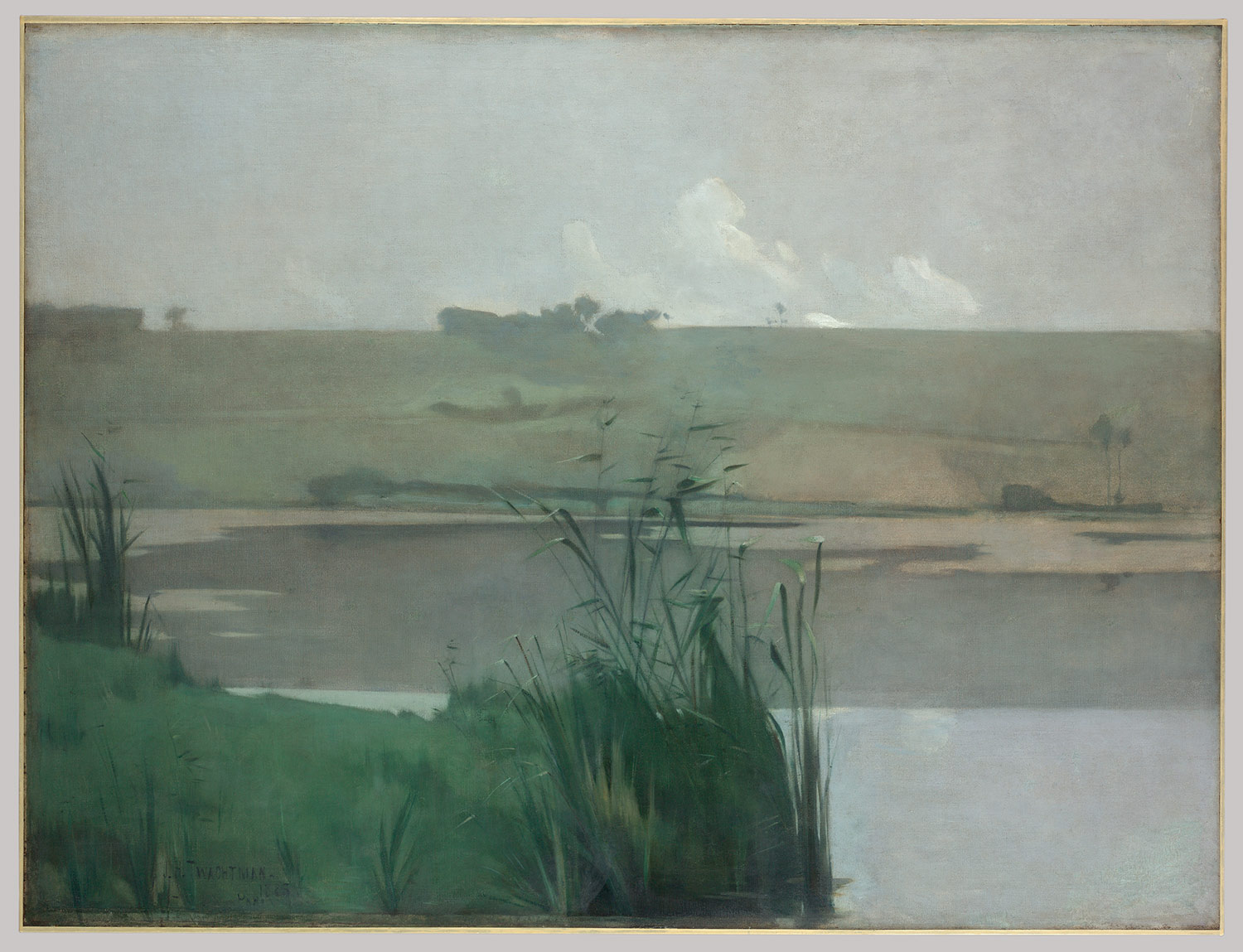
Twachtman at the Metropolitan Museum
4. This quality of tone music is most dominant when the masses are large and simple.

Another way to say it is: "big tones create mood." The Twachtman above has both big tones and simple shapes. Large, simple masses of similar tone are what give a picture poetic impact, but they can be hard to achieve. Speed mentions that mist or fog can help. I would add that backlighting can too, because it automatically reduces complex value patterns to simpler silhouettes. 

5. Tone relationships are most sympathetic when the middle values of your scale only are used, that is to say, when the lights are low in tone and the darks high. They are most dramatic and intense when the contrasts are great and the jumps from dark to light sudden.

This is a great truth in keying a picture. The value scale has a lot to do with lighting, as any photographer knows. Fashion or food photographers can control the lighting ratio and the softness of the light using fill lights and diffusers and thereby achieve an image well within the middle range. By contrast, film noir directors use lighting to emphasize dramatic contrasts between light and dark areas. 

But unlike photographers, painters have complete control over all the variables of a picture, and we can achieve effects that are almost impossible in photography.

6. Variety in quality and nature is almost too subtle to write about with any prospect of being understood.
C'mon, Harold! It's a bit of a cop out for him to bring up this point and then not really explain it. But I think he's talking about variety of textures within a painting, including the types of brushstrokes (dry vs. wet, large vs. small, thick vs. thin paint, etc.). He argues—and I agree with him—that many of the celebrated Impressionists suffer from an overall sameness of paint texture, which interferes with any sense that you're looking at nature's infinite variety. You just get stuck in the paint instead.

I love his line "Nature is sufficiently vast for beautiful work to be done in separate departments of vision, although one cannot place such work on the same plane with successful pictures of wider scope." 

7. Every student should make a chart of the colours he is likely to use. 
The purpose of this chart is to see how the paint changes over time. In oil, the chart should have thick blobs of paint on one side thinned with the palette knife to a thin smear. There's a tendency, he says, for oil to rise up through the paint if it can't sink into an absorbent ground, and certain oils can darken. Can one of our paint material experts explain this a bit more?


8. Variety of edges.
He gives the usual advice to vary the edges around a given form—hard, soft, hard, etc. 

He then makes the more unusual observation that in some great works: "the most accented edges are reserved for unessential parts." In other words the face is handled with a lot of softness, and the accessory areas around the face, such as the costume, is given more hard-edge handling. He shows the detail from Velazquez's Surrender of Breda, but I think Sargent has many good examples of this, too.

It strikes me that this quality is the opposite of what you would do in focusing a camera on a face with a shallow-focus prime lens, where you'd want sharpness and detail in the eyes and the center of the face, and softer edges everywhere else. 

9. A picture that is a catalogue of many little parts separately focussed will not hang together as one visual impression.

Little bits separately focused is a common flaw in beginner's work. The unity of vision that he's setting up as a goal in picture-making is one of the marks of enduring masterpieces, and it requires conscious effort to achieve.

10. What perspective has done for drawing, the impressionist system of painting to one all-embracing focus has done for tone. 

We're talking about atmospheric perspective here, which he says is as radical a discovery as the discovery of linear perspective in the Renaissance. 

He continues, "Before perspective was introduced, each individual object in a picture was drawn with a separate centre of vision fixed on each object in turn. What perspective did was to insist that all objects in a picture should be drawn in relation to one fixed centre of vision." These days we've absorbed impressionist values so completely that it's hard to appreciate the impact that the revolution in vision brought to painting.


11. Treatment of foliage edges

Speed discusses the challenge of painting convincing foliage silhouettes. He says: "The poplar trees in Millais' "Vale of Rest" are painted in much the same manner as that employed by the Italians, and are exceptional among modern tree paintings, the trees being treated as a pattern of leaves against the sky. Millais has also got a raised quality of paint in his darks very similar to that of Bellini and many early painters."

He continues, "It is interesting to note how all the great painters have begun with a hard manner, with edges of little variety, from which they have gradually developed a looser manner, learning to master the difficulties of design that hard contours insist on your facing, and only when this is thoroughly mastered letting themselves develop freely this play on the edges, this looser handling."

12. Variety of Gradation
There's one more thing to consider when planning how to handle tone—variety of gradation. He concludes: "There you have only the one scale from black to white to work with, only one octave within the limits of which to compose your tone symphonies."

The Practice and Science of Drawing is available in various formats:
1. Inexpensive softcover edition from Dover, (by far the majority of you are reading it in this format)
3. Free online Archive.org edition.
and The Windsor Magazine, Volume 25, "The Art of Mr. Harold Speed" by Austin Chester, page 335. (thanks, अर्जुन)
GJ Book Club on Pinterest (Thanks, Carolyn Kasper)

Friday, July 8, 2011

Natural History Art: Call for Entries

A biennial international exhibition for natural history illustration called “Focus on Nature” has just posted a call for entries.


The selected entries will be exhibited in 2012 at the New York State Museum in Albany, NY. The competition is free to enter.

LINKS AND CREDITS
About Focus on Nature
Submission information and criteria
 The gouache painting here shows a Leadbeater’s Possum (Gymnobelideus leadbeateri)
by Rodger Scott of Princess Hill , Australia
Previously on GJ: FON XI
Natural History Painting: With the Eden Project
Amazing Rare Things: The Art of Natural History in the Age of Discovery
The Art of Natural History: Illustrated Treatises and Botanical Paintings, 1400-1850 (Studies in the History of Art Series)

Saturday, September 12, 2015

Chernyshevsky's Philosophy of Art

I've been reading about 19th century Russian painting, and several books on the topic have mentioned that the artists were influenced by an 1853 essay called "The Aesthetic Relations of Art to Reality" by Nicolas Chernyshevsky.

By all accounts this essay was a kind of manifesto for the Russian painters and was a particularly significant influence on its leaders, such as Ilya Repin, Ivan Shishkin and Kramskoy. It explains why realism flourished longer there than it did in Western Europe.

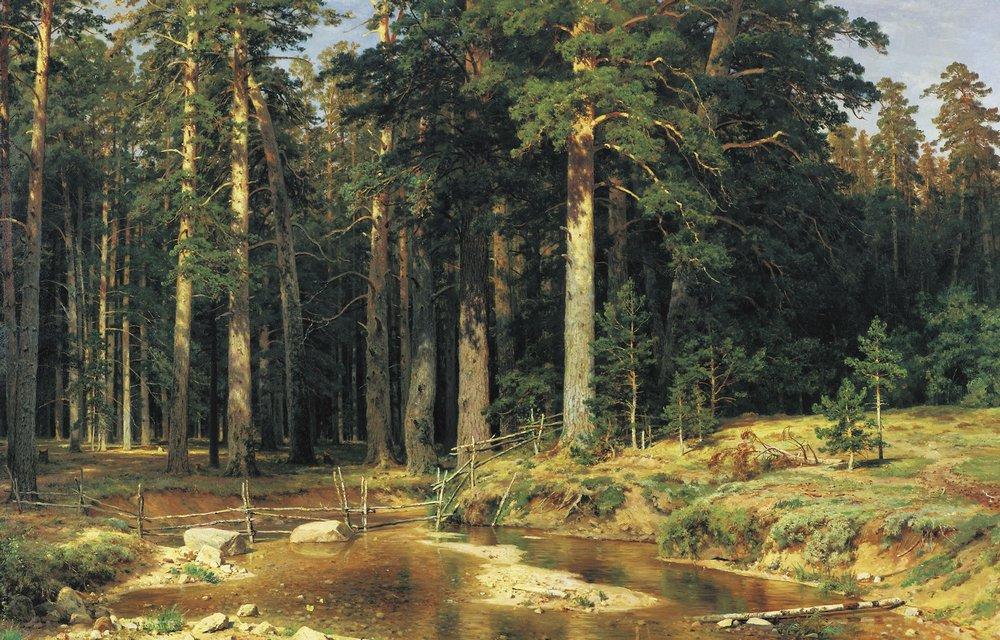
Ivan Shishkin, Mast Tree Grove, 1898
For example, compare this painting by Shishkin in Russia in 1898....

Paul Cezanne, The Bathers, 1898-1905
...to this one by Paul Cezanne in France at the same time. What was different about the aesthetic philosophy in Russia?

The central notion of Chernyshevsky's essay is that reality is greater than art. At best, art is an attempt to replicate or reproduce reality, and therefore art is on a plane lower than reality.

This is a very different idea from the aestheticism of J.M.W. Whistler and others who suggested that it is the business of art to improve on nature. Whistler said, "Nature is very rarely right, to such an extent, even that it might almost be said that Nature is usually wrong." 

Around the same time that Chernyshevsky's influential essay was published in Russia, related ideas were published in England and America. John Ruskin's Modern Painters and Asher B. Durand's Letters on Landscape Painting (1855) preached a version of Truth to Nature that had a great influence on the movements Pre-Raphaelitism and the Hudson River School in English speaking countries. The main difference with Chernyshevsky is that he seems to lack the moralizing tone of Durand and Ruskin.

Ilya Repin, Portrait of Aleksei Pisemsky. 1880
All these thinkers advocated that the artist should have a reverence for the concrete facts of reality and to allow as much as possible for the painting to be a clear window to that reality. Repin's portrait of Pisemsky is a good example, where the technique is subordinated to the force of personality, made manifest in concrete facts.

Ruskin, Durand, and Chernyshevsky all advocated that artists—students especially— paint as faithfully from nature as possible, but since absolute leaf-for-leaf imitation of external details is impossible, artists should re-create (Durand used the word "represent") on canvas the truth they have experienced, penetrating to the Platonic essence.


In Shishkin's case this meant painting scenes that seemed "found" or "photographic" to the untrained eye, but were in fact carefully constructed using his deep knowledge of natural effects.

It took him a lifetime to discard the conventional formulas of the picturesque in landscape, and to invent a way to interpret the reality of a forest interior in oil paint.

Many contemporary realists place a great value on the aesthetics of brushwork, paint texture, and composition, but Chernyshevsky would have regarded this preoccupation as a foolish distraction, like focusing on the scratches and skips on a phonograph record instead of listening to the music. Just as a phonograph record aspires to deliver the experience of a live concert, a painting aspires to the fullness and presence of reality. (The concert/phonograph analogy is my own, and of course the phonograph came after his time; Chernyshevsky actually uses the analogy of an original painting versus an engraved reproduction of it).

Here are some excerpts of Chernyshevsky:
  • A reproduction must as far as possible preserve the essence of the thing reproduced; therefore, a work of art must contain as little of the abstract as possible.
  • Art expresses an idea not through abstract concepts, but through a living, individual fact.
  • The essential purpose of art is to reproduce what is of interest to man in real life. 
  • Reality stands higher than dreams.
In order to grapple with these ideas, I imagined a conversation between myself and Chernyshevsky. Please note that Cherny's comments are my supposition of how he would answer.

Me: Can a camera or a high resolution motion picture achieve this result? 
Cherny: No. The excitement that the human being experiences in the presence of reality can only be evoked by an artist with an inquiring mind who can imaginatively see into the structure and essential features of the subject, and express what it is about that subject that makes it interesting.

Me: Is the imitation of reality what we're after?
Cherny: No, the mere copying of external features will only lead to boredom, both for the artist and the viewer. There's a big difference between mindless copying and insightful reproduction of nature.

Me: Aren't such insights highly subjective? Science in recent decades has shown that there is no such thing as objective reality. Our perception of the world around us is a construct of our perceptual systems. Therefore, shouldn't we paint the world in a personal style that matches our own subjective view of the world?
Cherny: You make too much of that. Painting in the way you suggest is just an excuse for laziness. Two careful artists with good training will produce studies that match each other very closely. But such studies are just the beginning. It takes a lifetime to create works that address the deep experiences of life. 

Me: What about the Surrealist's goal of painting what is inside the mind, the world of dreams and nightmares?
Cherny: Your dreams ultimately come from reality. Imagination plays a key role, but the aim of the artist is to use the imagination to see into the heart of reality itself, which is the source of everything in its fullest and purest form. Reality is also full of latent mystery that cannot be fully understood by either the poetic avenue of art or the fact-based avenue of science.

Me: If reality is greater than art, of what value is a visit to the art museum?
Cherny: If it's a choice between the two, artists should look to reality for their chief inspiration; otherwise their work will become second-hand and mannered. But it is extremely valuable to study the means by which great artists of the past have expressed the essence of reality. Look for artwork that brings you closest to the feeling that you are in the presence of real life, and then try to understand how those effects are achieved. The challenge when you leave the art museum is to leave behind the conventions of past art movements, and to see reality for yourself without preconceptions.

Me: What categories of art are most worthy—sublime, comic, tragic, or beautiful?
Cherny: They are all important. A sensitive person will respond to the problems presented by life, and will want to create art that speaks to those problems, so that a fellow human can gain wisdom and insight from the art. Those impulses can run the gamut of emotions. Whatever way you respond to nature should be the subject of your art, but it should be conveyed in concrete, material terms.  

My concluding thoughts: I don't think Chernyshevsky's idea is completely tenable intellectually for me. I can't get past the idea that "reality" is a provisional thing, constructed in our own minds, and subject to the whims of our very selective and subjective visual systems. I also resist the notion that abstraction must always be avoided. Of course I love the Russian realists, but I also feel that a pulsing sense of life can emerge from certain highly abstracted forms of art, such as hand-drawn animation or comic art. 

But Cherny's idea that reality stands on a plane above art is for me an extremely useful driving concept that helps focus my mind when I'm out painting from nature. I often achieve my best results when I try to capture what's in front of me without trying to "improve" on it in any way. When I compare the immense complexity, subtlety, and richness of the real world to my own paltry efforts, I'm left with a sense of how far I have fallen short of the truth in front of me.
-----
"The Aesthetic Relations of Art to Reality" by Nicolas Chernyshevsky.
Nicolas Chernyshevsky on Wikipedia
Recommended book: The Russian Vision: The Art of Ilya Repin by David Jackson

Friday, April 18, 2008

Focus on Nature

Yesterday in Albany we attended the opening of an exhibit of natural history artwork at the New York State Museum called “Focus On Nature X.” The exhibition is held every two years, and this is the 10th time the show has been assembled.


My own painting showing T.rex at a watering hole was accompanied by 93 other works by artists from 13 other countries and 21 states in the USA, many of whom are members of the Guild of Natural Science Illustrators. The paintings of birds, bugs, mammals, and plants are mostly in gouache and watercolor, plus a few in pen and ink and scratchboard and oil.

Patricia Kernan, who helped organize the exhibit, hosted tours through the New York State natural history art collection, which includes bird illustrations in watercolor by Luis Agassiz Fuertes (1874-1927). Susan Bull Riley, an artist from Marlboro, Vermont, said: “It’s really neat to see these originals after loving these reproductions all my life.”

The exhibition will continue through September 7, 2008.

Wednesday, May 5, 2010

Natural Science Exhibition

Last Friday we visited the Focus on Nature exhibition at the New York State Museum in Albany.

This exhibit happens every two years, and brings together the work of over 70 natural science artists from 13 countries.

The artwork shows plants, insects, mammals, and amphibians, and is primarily executed in watercolor, colored pencil, and digital.

It was fun to meet the other artists, and we went upstairs in the museum to see the collection of jury award winning paintings from previous years.

Focus on Nature website

Follow the link to download the PDF of the catalog (23MB) with samples of artists's work and statements.

Sunday, January 24, 2016

Three Challenging Questions

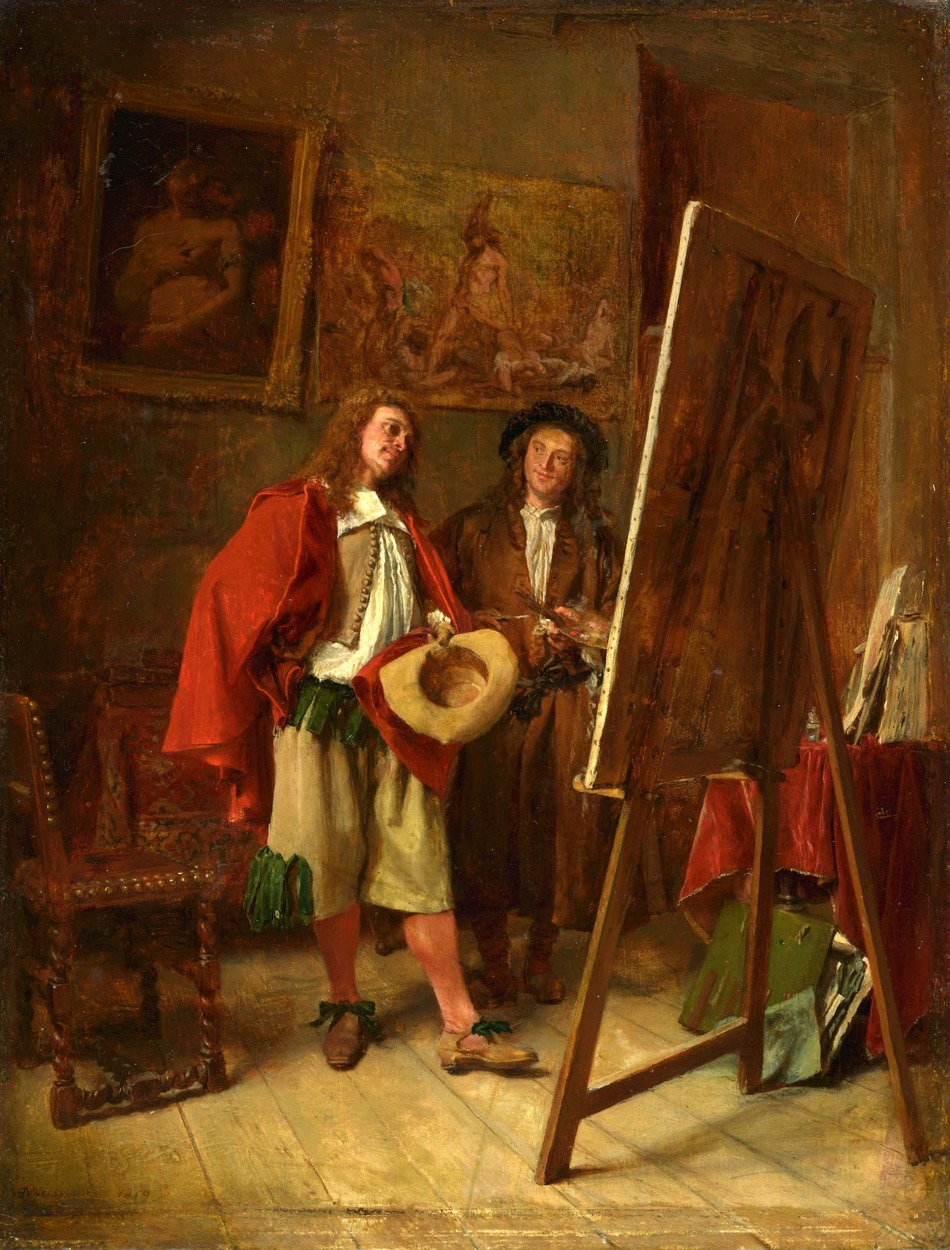
Ernest Meissonier, Connoisseur and Artist

Andrzej Tokarski asks:
How are you still not bored by painting the nature? Not trying to be unpolite, I'm just curious. You're already an amazing artist with nearly perfect understanding of the light. Why do you still paint from nature? Isn't it more interesting to paint from imagination when ur understanding of light/form is as good as yours? I really love your Dinotopia series and for me it seems more fun to paint it than from nature. I hope you will answer me, I'm really curious why do you still paint so much from nature. Cheers smile emoticon

James Gurney Hey, Andrzej, That's nice of you to say, but I'm a long way from a perfect understanding of anything. My first answer is to say that I really love both imagination and observation equally. One feeds inspiration to the other. When I'm painting an imaginary scene, I pretend that I'm really observing it, and when I paint something in front of me, I try to bring something of my inner life to the experience of seeing it.

Painting from nature is a lifelong quest in itself that demands every ounce of my concentration, focus, and skill. I feel a strong desire to capture my view of the beautiful ordinariness of the world around me. All through my life, I've done paintings from observation and imagination side by side.

For the next issue of International Artist I've just written an article called "On-the-Spot Surrealism" which explores ways to morph the two together. And I guess that's the second answer. I'm becoming more and more interested in exploring the borderline between the real and imaginary worlds, which may not be as separate as you suppose.

Zedasilva3 says:
I really admire traditional painting, I really do. I have a lot of respect for it. But being honest, is it worth it when digital painting have reached such a tremendous quality standard and also take a lot less effort? And may it be clear that I'm not criticizing here. The guy is a true master of art, but I ask myself if [it] is fit for the 21st century.

Thanks for the compliment. It's hard for me to compare digital painting to physical painting, since I've never really done much with digital art-making. For the kind of work I do, I find the traditional tools to be the most productive, efficient, and satisfying. Part of the reason is that the lack of an "undo" button forces me to focus and commit and take risks, and I like that.

And I love having my work embodied in a physical object that I can hold in my hands or exhibit in a museum. Making a physical painting is a very basic thing for me, like chewing food with my teeth instead of getting it in an IV drip. For outdoor painting, physical tools have clear advantages of being visible in very bright light, portable, and workable without electricity.

Of course I respect those who work with digital tools for whatever reason, and I do use digital tools for graphic design, photography, video capture, and editing. We all make our peace with computers in one form or another, and there's no ideal mix of tools that works perfectly for everyone.

What we're seeing as we get farther into the 21st century is not more and more digital, but more interesting ways of combining handmade and digital to create new expressions that we haven't seen before. We're seeing that in movies, animation, crafts, graphics, and everything.

Karen asks:
You mentioned something in passing in one of your postings (I'm sorry, I can't recall which) and repeated it during an interview for Savvy Painter. You said, to paraphrase, that artists should study dead artists, not current artists. As a self-directed painter, I very consciously work on improving my craft by taking workshops and classes. I follow a number of inspiring painters online at Facebook, my primary source. I respect your opinion and ideas, so when you made this statement, I became worried that I may be limiting my study habits or studying incorrectly, and may be missing out on more artists. What artists should we be looking at? 

Hi, Karen,
Good question. There's nothing wrong with looking at the work of living artists. The main reason I said that in the interview is because I find if I look too much at the work of any single artist, I might end up emulating them too much. The best I could ever hope to achieve is a second-best to their style. Looking at diverse artists from past eras and cultures makes it more likely that I'll develop my own original voice.

Another reason to study dead artists is that the best work has already been pre-sifted. The best stuff has a way of rising to the top, and you can look at the best of the best from different eras. Looking through the current crop of art, one has to be more selective. There's great work going on right now, don't get me wrong, and I admire the work of many of my colleagues greatly.

As to which artists? That's totally for you to decide.

All that said, it's best to put most of your time into studying nature directly. I have this strange feeling when I'm copying an artists work that if they were standing there they would be saying: "Don't copy my work. Go outside and paint from the real world!" In fact most of your time should be spent cultivating patience and focus in the face of nature. Ultimately, that's the source of it all.

Friday, June 22, 2018

Challenge: Paint a Parking Lot

Painting by Scott Lloyd Anderson
There's beauty everywhere, right? Well, how about in a parking lot?

That's the subject for the next GurneyJourney on-location painting challenge. We've done this before with gas stations, graveyards, weeds, and outdoor markets, and you've created stunning artwork.

Art in a parking lot
I invite you to paint some interesting aspect of a parking lot. You might paint a view across a lot, with or without cars. You could emphasize a light effect, an interesting sign, or a cluster of shopping carts, or a little bit of nature alongside the lot. It can be a New York vestpocket parking lot, an underground parking structure, or a suburban big-box lot.


How does the challenge work?
Everyone can upload their examples to this special Facebook event page. I will choose a Grand Prize winner and five Finalists. Each receive a coveted "Department of Art" embroidered patch, and the Grand Prize winner will also receive a free tutorial download.

I hesitate to call it a "contest" because there's no entry fee and the spirit is more about cooperation, community, and camaraderie than competition. We're all at different levels of skill and experience, but we're all out there braving the elements and trying out new painting ideas.

Painting by William Wray
Guidelines
• Must be painted outdoors, or at least mostly outdoors.
• The composition can include the scene beyond the parking lot, but the parking lot itself itself must be a part of the scene.
• You can focus on the ordinary aspects, the sublime aspects, the ugliness, or the beauty. Just make it  interesting. 
• All physical painting media accepted, such as oil, watercolor, acrylic, gouache, acryla-gouache, alkyd, casein, or water-soluble colored pencils.
• No limits on palette of colors.

Deadline
• You can enter as soon as you finish the piece, but no later than the deadline: Friday, July 27, 2018 at midnight New York time. Winners will be announced on Wednesday, August.

Bird's Foot Trefoil, donut wrapper, and plastic bottle
alongside supermarket parking lot
Submission Guidelines
• Free to enter
• It must be a new painting done for this challenge. In addition to a scan of the final painting, your entry must include a photo (or video) of your painting in progress in front of the motif.
• Upload the images to this Facebook Event Page. If you don't have a Facebook account, please ask a friend with an account to help you. Please include in the FB post a mention of what medium you used, and if you want, a word about your inspiration or design strategy, or an anecdote about your painting experience.
• In addition to the Facebook event page, you can use the hashtag #parkinglotchallenge on Instagram or Twitter to see what other people are doing.
• If you end up doing more than one entry, please delete your weaker entry so that we end up with just one entry per person.

Prizes
I'll pick one Grand Prize and five Finalists. All six entries will be published on GurneyJourney, and all six will receive an exclusive "Department of Art" embroidered patch. In addition, the Grand Prize winner receives a video (DVD or download) of their choice. Everybody who participates will have their work on the Facebook page, too.
-----
Check out the previous results for gas stations, graveyards, and outdoor markets.

Own the 72-minute feature "Gouache in the Wild"
• HD MP4 Download at Gumroad $14.95
• or HD MP4 Download at Sellfy (for Paypal customers) $14.95
• DVD at Purchase at Kunaki.com (NTSC video) $24.50
GurneyJourney YouTube channel
My Public Facebook page
GurneyJourney on Pinterest
JamesGurney Art on Instagram
@GurneyJourney on Twitter

Tuesday, July 25, 2017

Tom Kegler's Niagara

Landscape painter Thomas Kegler recently completed a three-year project to paint a panorama of Niagara Falls. He documented the process on an instructional video with a running time of more than 8 hours. 

Thomas Kegler’s painting “Niagara, Psalms 84:11”

It's a big painting, more than 8 feet wide, and the video covers everything from the concept sketches to building the frame. Kegler produced it all, and he took time out to answer a few of my questions. 

J.G. What feelings went through you when you got close to Niagara Falls?

Thomas Kegler:
Having grown up near Niagara Falls and experienced it many times, I frankly was often turned off due to the commercialization and touristy atmosphere. As I embarked on this quest, I began to look at the Falls differently – through the lens of an artist. Once I was able to filter out the human distractions and focus on the majesty of this natural wonder, I was in utter awe. This especially hit home when I began the long-duration drawing and field paintings and got up close and personal with the Niagara River. The sounds, smells and sensations transfer you into a trance when you just sit and watch.


J.G. Do you think those feelings are different from those of someone 100 or 200 years ago?
T.K.  I think the feelings and emotions that Niagara can evoke are likely the same as they were back when the Hudson River School painters visited in the mid 1800s. In our modern society we are conditioned for immediate gratification sustained with a rapid paced life. Thus, it may take a bit more effort on our part to slow down and really experience what the Falls has to offer.


J.G. How did you deal with the precedent of Frederic Church's famous paintings of Niagara?
T.K.  Church had set the bar very high and I certainly was influenced by what he was able to capture. There was a part of me that at first was reluctant to take on this challenge. I intentionally chose a very different vantage, time of day, and emotional charge. This helped me design the painting with a fresh approach.


J.G. How did you decide on the length of the video?
T.K.  The amount of raw footage I had to work with was over 130 hours. My initial goal was to edit this down into a 5 hour video. Half way through the editing I realized that in order to convey all I intended, I did not want to limit the length of the film and jeopardize any pertinent information.

J.G. Were there aspects of the video-making process that turned out to be more difficult than you had anticipated?
T.K.  Since I self-produced the video, my most significant hurdle was to balance the emotional and spontaneous aspect of painting, along with the necessity of managing 4 running cameras. This meant that I would need to adjust each camera every 10 minutes as I moved across the canvas while painting. This took a great deal of diligence and patience to interrupt the creative act to deal with the cameras, and then get right back into it. I did hire some talented videographers to help occasionally, but the majority of the camera operation was overseen by me as I painted.

J.G. Thanks for mentioning me on disc 2! What did you make your maquette out of?
T.K.  The Maquette was made from foam, plaster gauze and acrylic paint.

J.G. You mentioned that you were inspired by Ruskin's view of God as manifest in nature, and you quote scripture in the title. Is the spirit of the divine that you experience when painting landscape distinct from the spiritual life that you encounter in church or when reading scripture?
T.K.  My faith and spirituality are manifested in my everyday life and my work and I try to not separate them. I look at my paintings as devotional works that celebrate creation. Having said that, the spirit I experience when painting is different and often more tangible than when reading. I invite the spirit to bless my hands and work through me. Often I feel my works seem to paint themselves.

J.G. In your timeline you indicated that it took about 1000 days to do the whole project—preparation, painting, frame, and video. How do you feel now looking back on the scale of the project?
T.K.  The first reaction when the final cut was delivered for duplication was a big exhale. I still see aspects that I would change or do differently, but overall I am pleased with the final result. I knew from the start this would be a long term endeavor, and thus I did not plan a final deadline initially. I wanted it to be just right. Nevertheless, it took twice as long as I anticipated.


J.G. Was it emotionally and financially rewarding? Do you want to keep doing other big projects?
T.K.  This project was by far the most challenging and rewarding endeavor I have attempted. The challenges were profound - both from the standpoint of the sustained focus for such a long time, as well as the expenses involved in funding your own publication. Emotionally, I am very gratified. I trust that the financial success of the video will be evident in the long term.

J.G. What will be the fate of the painting? Will it be in a private collection, or will it be visible in future exhibitions?

T.K.  The painting is currently on exhibit at the Castellani Art Museum on the campus of the Niagara University along with about 15 other works related to Niagara Falls. This exhibition runs until January of 2018. There is discussion of evolving this into a traveling exhibition to other Museums. I would like the final resting place for this work to be in a public space...ideally the Castellani Museum itself. We are currently seeking a patron to purchase the painting for the Museum. A portion of the proceeds will go to the Buffalo Niagara River Keeper organization and the Western New York Land Conservancy.
------
Castellani Art Museum: "Painting Niagara: Thomas Kegler"
Thomas Kegler's website
"Painting Niagara" Instructional video, purchase or watch previews