"This is the book that started it all" —Patrick O'Brien, MICA
James Gurney
This weblog by Dinotopia creator James Gurney is for illustrators, plein-air painters, sketchers, comic artists, animators, art students, and writers. You'll find practical studio tips, insights into the making of the Dinotopia books, and first-hand reports from art schools and museums.
You can write me at: James Gurney PO Box 693 Rhinebeck, NY 12572
or by email: gurneyjourney (at) gmail.com Sorry, I can't give personal art advice or portfolio reviews. If you can, it's best to ask art questions in the blog comments.
Permissions
All images and text are copyright 2020 James Gurney and/or their respective owners. Dinotopia is a registered trademark of James Gurney. For use of text or images in traditional print media or for any commercial licensing rights, please email me for permission.
However, you can quote images or text without asking permission on your educational or non-commercial blog, website, or Facebook page as long as you give me credit and provide a link back. Students and teachers can also quote images or text for their non-commercial school activity. It's also OK to do an artistic copy of my paintings as a study exercise without asking permission.
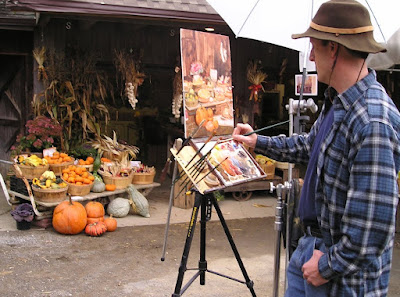
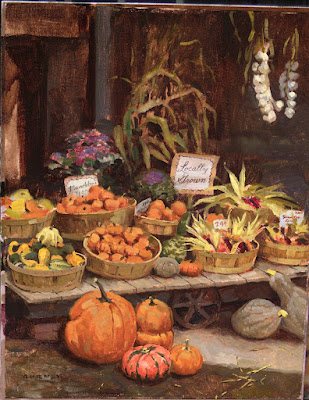
On Instagram, I posted about this plein-air still life in oil, and some of you had questions:
fefecru: "Can I ask you what umbrella is that? Anyone in particular you’ll recommend?
A: It’s a Jullian umbrella, designed to clamp onto a French easel, but I keep it on a C-stand so that it doesn’t blow over and bring my painting into the wreckage."
bencrastinate "Does painting with an easel help? Ive always painted my canvas flat on my desk. What are the benefits of painting on a vertical surface?"
A: I find it helps my speed and accuracy to have my painting set up perpendicular to my line of sight, and directly adjacent to, the same size as, and in the same light as my subject.
grinningink "Since you used oil here, wasn’t it still wet when you sold it that same day? Was there something to protect it when the customer took it?"
A: Yes, this was for a paint-out. I framed it and it was auctioned same day. I knew the owner, and after it was thoroughly dry I borrowed it back to varnish and photograph it.
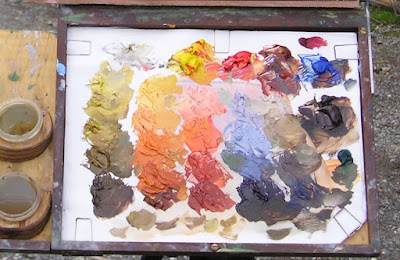
thefrankryan "Is this palette approach inspired by Carolous Duran’s method?"
A: A lot of oil painters have used premixed colors. I was thinking mainly of Frank Reilly, but using an adapted version of his practice.
janice_skivington "Please list the names of oil colors on the pallet, looks like three primaries and white."
Judy P asks: "James, I've can't remember if you ever discussed the topic about painting in daylight, and the value problems it causes. Umbrellas are a pain, so often I paint in the sun, with my canvas and palette aimed away, not getting hit by the light. But even if I am in shade, often my painting ends up way too dark, with little contrast, when I get it inside. That just happened yesterday. My painting looked successful while I was working, good value contrast, strong color and temperature variation. Then I bring it inside, and all of that is lost. I'm been doing plein air about 6 years now- how long does it take to make that automatic eye adjustment, to paint lighter and brighter than you perceive? Do you have any tips to keep on top of this problem during painting? So far my only aid is to use the middle grey paper palette to keep track- lighter or darker than middle. But 'paint what you see' is problematic!"
Painting under an umbrella held on a C-stand at right
Judy, You've got two important questions here. The first is how to set up your artwork so that the light on it isn't jarringly different from the scene you're looking at. The second is how to accommodate your eye and brain to the inevitable differences in illumination. The answer to the first question is that you ideally want the illumination on the artwork—both the painting and the palette—to be identical to the light in the scene—identical both in terms of brightness and color.
A close match of illumination levels makes color choices easier
If you're painting a front-lit subject, the full sun shining on your painting may be OK, but it may be too harsh and bright. This can be a problem for gouache and other water media because it makes the paint dry too fast.
One of the worst problems is dancing shadows and dappled light from a tree or the line of a cast shadow going across half your picture or your palette. This makes accurate color judgments almost impossible.
To solve all these problems, a diffuser can smooth out variations in illumination and reduce the brightness of the sun. It also makes a softer light that's nicer to work under. A diffuser is a layer of thin, translucent white nylon cloth suspended above your painting and easel. It might be a white umbrella or a smaller frame that's held closer to your work and that's less susceptible to wind.
Here's a video trailer that introduces some of the options of diffusers. (Link to YouTube)
Painting toward the light (or contre-jour) gets rid of the problem of uneven, dappled, or overly bright light, but it can sometimes be hard to get enough light on your work.
Using a diffuser while painting contre-jour
In some instances, like pubs or concerts, there's nothing I can do about the light being way too dim or differently colored on my work relative to the subject. In that case, I often work in black and white.
In the video below, I share some tips for increasing the light on your painting when you're facing toward the light. If you're working in deep shadow, there are ways to bounce light or use portable illumination to get the light levels higher and more even. I show how to build several basic diffusers in my video tutorial How to Make a Sketch Easel .
Most of these things can be made from inexpensive materials. (Link to YouTube)
The second problem has to do with accommodating your eyes to different light levels and getting the right contrast within your painting. A gray palette can reduce glare, but you need a white palette for transparent mixtures. Also, even if you use the gray palette, I find it's helpful to always have at least a patch of pure white and pure black in view somewhere as a reference to calibrate the rest of your values.
When I'm painting in bright sun, the problem for me is that my pupils get fatigued from alternately opening and closing. That can cause headaches as well as making it hard to judge relative values. The ability of your pupils to rapidly dilate and constrict diminishes with age.
In direct sun I tend to misjudge the variations in the colors, and either make the lights too dark or the darks too light. Regardless of the relative illumination levels, you have to always be conscious of comparing values within the little universe of your composition. To avoid "middle value mumbling," it helps to group the light values together and the dark values together, and keep the lights and darks separate.
----- How to Make a Sketch Easel (video tutorial) on Gumroad Previously on GurneyJourney White Umbrellas Contre-jour Lighting Middle Value Mumbling
Branch diffuser
For the branch diffuser, you'll need the white rip stop nylon and a branch with a flat growth habit. I used gray birch and let it cure a few months before I used it. I ran coated picture wire around the slotted tips of the branches before sewing the seams. You'll need a needle and thread because you can't machine-sew the edge.
Artist's umbrella
If you do use a traditional artist's white umbrella, I've found the Jullian gives good light, but it does get damaged if it hits the ground too hard. To keep it from taking down your easel, you can clamp it to a C-stand (century stand), which is heavy, but sturdy, and you'll use it for a lot of other uses.
Kite option
Alternate methods: Instead of buying the parts separately, you can buy a cheap white kite for $10.00.
It's 30 inches across, and includes the kite sticks, twill tape, and white rip stop nylon.
You can also use white corrugated plastic for diffuser, and save having to deal with fabric and frame.
-----
This information is in reference to the video "How to Make a Sketch Easel," which shows you how to build both the easel and the diffuser.




 (3)
(3) (12)
(12) (2)
(2) (2)
(2) (1)
(1)
 (17-20)

 or
or 


 (2)
(2) (For making an oil palette)
 (optional, if you want to make a camera bar)
 (optional) or
 or
or  (for drilling flat bottomed holes)
 —small drills for screw pilots and
  for T-nut.
 or just a big nail.
 (optional)
 and
and 
 with a
  (Optional. Your lumber supply or hardware store will usually be able to cut the wood for you if you don't have a saw)
 and a
and a 


 (you could also use sandpaper on a thin piece of wood)
 and a
and a  ,
,  (for small diffuser) or
  and access to a sewing machine.


 around the slotted tips of the branches before sewing the seams. You'll need a
  because you can't machine-sew the edge.
 , I've found the Jullian gives good light, but it does get damaged if it hits the ground too hard. To keep it from taking down your easel, you can clamp it to a
  , which is heavy, but sturdy, and you'll use it for a lot of other uses.
 for $10.00.