Wednesday, January 2, 2019

Ron Lesser in Illustration #62

The new issue of Illustration magazine features the art of veteran illustrator Ron Lesser.

Ron Lesser cover for Curtains for a Lover, gouache
(I'm not sure why the colors are so different.)
Lesser, who is still active as an illustrator, started doing book covers in the late 1950s. He has done it all, from movie posters to advertising art to gallery work, but he's probably best known for painting sexy crime paperback covers.

Many of his early covers were painted in gouache. He says: "I was using water-based paint—casein white for body and then designers colors [gouache], which have more covering ability than watercolors, but less than casein."


Lesser used photographic reference from professional models in New York City. The models charged around $150 per hour in the 1970s, and all the costs—professional photographer, model, and print costs—were covered by the publisher.

The second article in the current Illustration magazine chronicles the art that was created for World War I, from recruitment posters to battlefield sketches by artist-reporters.

Tuesday, January 1, 2019

Shake Your Head to Make an Image Appear


If you shake your head, an image should appear out of this illusion.
----
via: BoingBoing

Using machine-learning to arrange a bedroom

This computer rendering shows a 1980s teenage bedroom. There are posters on the wall and some stuff on the floor. It's a little messy. 


The elements were arranged by a recently announced machine-learning program called "Promethean AI."


(Link to YouTube) This video announces how the automated system selects and arranges elements in the room according to a written description.

The creators of the program say: "It knows what goes where, just like you and I do. It also has something we call a context. It can pick it up from the environment or you can expressly set it by saying that we are in the 80s for example and then it will make sure the suggestions fit the context."

This may be a glimpse of things to come, at least in the VFX and game worlds. However the video is a little misleading, because it's not creating things ex nihilo. The assets being arranged by the machine-learning algorithm are separately created with more conventional techniques.

Although this kind of emerging technology fascinates me, for my own art, I'll stick with pencils, paint, and brushes. If my role was limited to "specifying high level creative intent," I wouldn't be closer to the creative nexus; I would be banished from it. I'd rather be an artist expressing my intent at much lower levels.
-----
Website: The Tricks of Learning Game Art

Monday, December 31, 2018

A Dinosaur on a Bicycle

Yes, dinosaurs can ride bicycles. And they'll give you a lift.
Don't worry if you're riding in the back seat. Civilized dinosaurs poop intentionally.
-----
From: 
Dinotopia: Journey to Chandara (Signed copies on my website)

Sunday, December 30, 2018

Shishkin's 'First Snow'

First Snow by Ivan Shishkin, 1875 
The snow has melted in contact with the relatively warm, wet ground, but it still clings to the branches, surrounded by the colder air. 
----

Saturday, December 29, 2018

Is it cheating to base my art on computer-generated images?

Artistic-looking mages created by computers
courtesy Medium essay "What are Creative Adversarial Networks?" 
Barrett asks "I've seen these new CGI tools that can generate any kind of scene in any artistic style, and it makes me wonder: Is it OK for a painter to use computer-generated imagery for reference and inspiration? Sometimes it seems like the computer is doing the artistic work for me, and making aesthetic decisions, and I wonder if it's cheating for me to use them?" 

My answer: Like photography, these new computer techniques merely present us with another way of seeing.

Artists have always been sponges for new imagery. You can see the effect of photography on painting over the last 150 years. There are so many types of lenses, films, and processes before you even get into digital manipulation and CGI. Photography lets us freeze action, see through things with x-rays, and witness wildlife action up close. Photography has given us new eyes.

That doesn't mean we have to project and copy the random detail of a single given photo, though that's OK, too, if that's what you want to do (as long as you take the photos yourself or you have cleared the copyrights, of course).

The more we understand how cameras see, and now how computers can generate images, the more we appreciate the little "meat cameras" we were born with. And the more we learn about technologically-derived imagery, the more we realize our eyes and our visual brains behave very differently.

In my case, I'm usually trying to interpret my experience of reality directly into a sketchbook, or I'm trying to visualize a scene from the ancient past or from a science fiction future. I often think about photos I've seen and the effects they create, and I'm influenced by those images.

In some cases I want my paintings to look like photos so that they can fit into a magazine presentation that's mostly comprised of nature photos. To get those effects, I try to learn the theory behind photography, and I also surround my easel with a lot of different reference photos, taking a little from one and a little from another to make something new.

I don't know how the CGI technology will influence me, but I welcome it and am not threatened by it. Some CGI video imagery blends abstraction with reality in ways that resemble hallucinations or hypnagogic dreaming.

So I would say, embrace it all, vacuum it up into your eyes and see where it takes you. But don't forget to develop your skills, and to trust your own imagination and memory. It's essential to get beyond style and technique, beneath the surface, and dig down to an authentic expression that belongs to you. To get there, sometimes you have to unplug from all references and tunnel inside your own mind.

In the end, whatever tools you use, as long as your work is original and it communicates your own experience, it's not cheating.

Friday, December 28, 2018

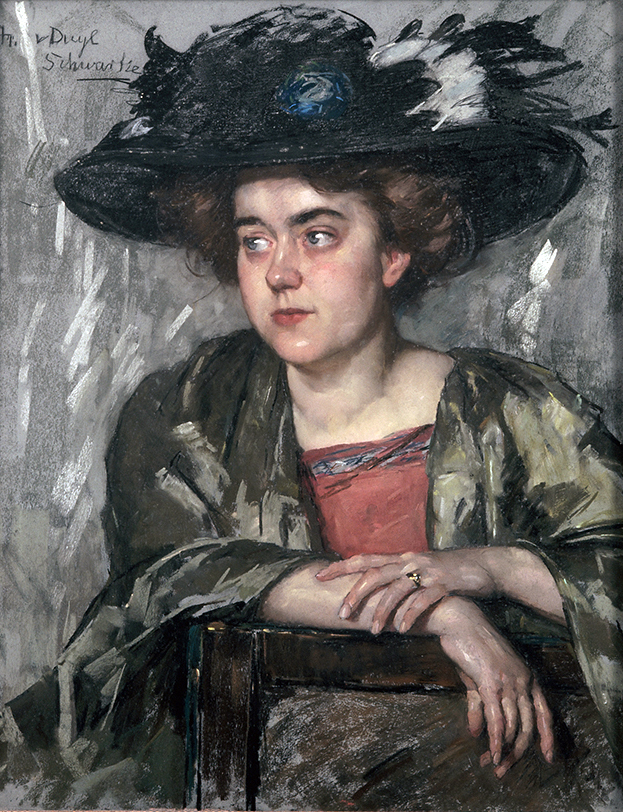
Thérèse Schwartze paints a portrait

A Dutch portrait painter named Thérèse Schwartze (1851-1918) was invited to paint the daughter of the mayor of a coastal town.


She packed up her portable easel and paints and set up in a temporary studio in the mayor's attic. Fortunately someone took photos of her at work.

The girl sits in a chair facing a high window, supervised by a nursery maid. The artist's back is to the window.


Thérèse Schwartze, Portrait of Geradine
Marguerite van Hardenbroek,
 1903
Here's the portrait that resulted from the sessions. 

Thursday, December 27, 2018

Catskill Center Residency Now Inviting Applicants


The Catskill Center is now accepting applications for its little red cabin, perched at the top of Platte Clove, one of the wildest regions in New York State. 


A jury selects artists to stay in the primitive cabin for week-long residencies from July 1 - September 30. There's running water, a propane stove, a refrigerator, an outhouse, basic electricity and no internet.

The location was a favorite spot for Hudson-River-School painters such as Asher B. Durand and Thomas Cole, although the long vistas are more hemmed-in by trees these days. The nice thing about staying up there is that you can walk outdoors and paint streams and waterfalls from morning to night. 

Wednesday, December 26, 2018

Two WWII Posters

Recently we saw the exhibition of World War II posters at the FDR Library and Museum in Hyde Park.

Out of all the posters in the show, let me focus on just two of them with a very similar concept: machine gunners in action. Let's compare the compositions:

"Your Metal is their Might!" 1943 Jes Wilhelm Schlaikjer (American, 1897–1982)
The Schlaikjer painting shows three figures, a background that's light and dark, lots of bullet casings flying, and a slight upward angle of the gun barrel.
"Let's give him Enough and On Time" Norman Rockwell
What strikes me is how much simpler and more memorable the Rockwell is. There's just a single figure; we don't see the gunner's face; the background is black; the image is divided by a straight diagonal line; and the typography reads clearly against the light yellow background. 

By leaving out non-essential information, Rockwell makes a much stronger statement. In a poster, simplicity is crucial.   


Rockwell usually started out with a sketch made purely from his imagination and built his final concept around it. This germinal idea, which says "Are you backing me up?" is similar to the final, except that the soldier is turned toward us.
----
The exhibition "The Art of War: American Poster Art 1941-1945" ends December 31, but unfortunately, because of the government shutdown, the museum will be closed.

Tuesday, December 25, 2018

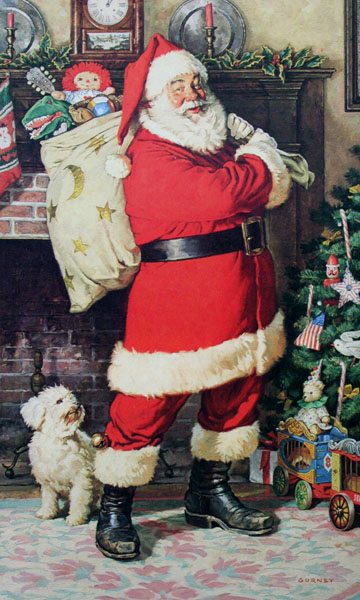
Merry Christmas, 2018

Santa Claus by James Gurney, Oil on canvas, 24 x 36.
Hoping the holiday season brings you good fun and togetherness.