Sunday, December 15, 2019

Was Gauguin a Creep, and Should it Matter?

Gauguin, Dr. Gouzer and two Tahitian women, courtesy Hyperallergic 
The New York Times posed a question:"Is It Time Gauguin Got Canceled?" That's kind of a provocative, click-baity title. The term 'canceled' implies that someone is proposing he should be erased from all public exhibitions. But I don't think they're seriously contemplating that.

"Museums," the article says, "are reassessing the legacy of an artist who had sex with teenage girls and called the Polynesian people he painted 'savages.'" Who wants to look at paintings made by the guy who spread syphilis to underage island girls?

Painting by Paul Gauguin
The article quotes an audio guide at a London exhibition "Gauguin Portraits" saying “Is it time to stop looking at Gauguin altogether?”

Photo by Jules Agostini allegedly showing Gauguin in Tahiti.  © 2017 Daniel Blau, Munich
The story mentions that qualms about the artist prompted a museum director to rewrite some captions, but admits that there have been plenty of exhibitions about Gauguin lately. There have been retrospectives at the National Gallery in Washington, at the Tate Modern, the Art Institute of Chicago, and other museums.

The question leads to other questions. Should Caravaggio's paintings be taken out of circulation because he was a murderer? Should we ban Egon Schiele's drawings of underage girls because he allegedly abused them? Should we remove all of Picasso's work because of the way he treated women?

I think the work should be available to those who want to see it without someone deciding in advance to take it away. If someone really wanted to censor an artist because of their personal life, who would make such a determination, and by what standards? Should it be according to today's standards, or to those of the artist's time? How can a deceased artist defend himself or herself from false accusations?

Not everything in a museum's collection gets exhibited or published, and many factors go into doing so. In my view, the decision to mount an exhibition or to publish a book on a given artist should be based on the merit of the work itself, whether there's really new light to shed on their life story, and how many shows there have been in recent years. Maybe we should mothball Gauguin because we've seen enough of him. How about a show of other, more able artists who haven't received the exposure, such as Edwin Austin Abbey or Alphonse Mucha?

A related question is whether you can appreciate someone's art without knowing about their biography. Do you enjoy an artist's work more after you learn about their life?  How does your evaluation of someone's work change after you find out they had a dark or criminal personal history? Can you keep your feelings about the art separate from your feelings about the person?

That depends on what their work is about, and how they presented themselves to their audience. I recognize that all of us are flawed, and that artists in particular are almost a separate species from the rest of humanity. Artists tend to live more at the fringes of the mainstream world. I almost expect artists to have taken more risks than average people. Rock 'n' roll wouldn't be the same if some authority applied a morality test to all the musicians.

Recently published letters have cast doubt on Gauguin's portrayal of his life in Tahiti. It apparently wasn't quite the erotic mecca that he tried to convey. He evidently hoped the scandal that surrounded him in Paris would help promote his work. 'The island [and the realities of Gauguin's life there] are virtually unrecognisable in his representations, carefully calculated to intrigue the French audience,' says Nancy Mowll Mathews, author of Paul Gauguin: An Erotic Life.

It may be that the museums and newspapers are also being a little disingenuous in wringing their hands about Gauguin as the lascivious colonialist. Let's face it: a little bit of scandal is a good thing for publicity and for the sales market, and it probably doesn't hurt the Gauguin exhibition to receive press coverage, negative or positive.

What do you think? Do you have any examples of how your knowledge of personal biography has changed your appreciation of a given artist's work?
------
Book: Paul Gauguin: An Erotic Life.
The Guardian: Gauguin's erotic Tahiti idyll exposed as a sham
New York Times "Is It Time Gauguin Got Canceled?" 
Gauguin: It’s Not Just Genius vs. Monster
Thanks, Winsor.

Saturday, December 14, 2019

Planning a Lighting Scheme


I used two contrasting lighting sources for this painting from Dinotopia: Journey to Chandara. There's a low, warm, frontal light and a high, cool backlight.


I reality-checked the effects of such a scheme by shooting reference of me and my maquettes in the same light environment. The Bix maquette is by Jim Henson’s Creature Shop.
-----
From Amazon: Dinotopia: Journey To Chandara
From my web store: Dinotopia: Journey to Chandara 

Friday, December 13, 2019

Cubies: A 1913 Satire on Cubism

The 1913 Armory Show introduced Cubism and other modern ideas to the New York art world. In the wake of the confusion and chaos that ensued, Mary Mills and Earl Harvey Lyall wrote and illustrated an alphabet book called "The Cubies."


"F's for the future for which Cubies hanker;—
To Hals, Perugino and all that old crew
They give up the Past without envy or rancor,
While saying in tones than which naught could be franker:
'Come, move on,—it's our turn! They have finished with you.'
—F's for the Future with Cubies hanker."
------
Read the rest at Public Domain Review

Thursday, December 12, 2019

Breathing Illusion


This optical illusion from How Equipment Works demonstrates how breathing seems to be tied in with visual perception.

Wednesday, December 11, 2019

Can You Reconstitute Gouache?


Rick asked me: "Can [gouache] paint which has completely dried and hardened in its tube be rescued and reconstituted to an original consistency, after it has been stored too long?" I didn't feel sure of the answer, so I posed it to the Group Mind on Facebook:

Theresa M Quirk No. I think it goes in the garbage

Паулина Зетина Mine are very hard and I think to cut the tube because it's hard to paint without it but mine were hard after 5 years I say that to me if it works

Robert Tunstall it can't be brought back to its former glory. It does have limited use as a watercolour substitute though. As for tips, I store the tubes cap down on a wall rack I made. I drilled holes in a strip of wood.
Brad Fuller Nope, but it can be used as an indicator you aren’t painting enough.😀

Randy C. Spear Yeah Rick...how long has it been ? Over 30 yrs? LOL!!!

Dirk Shearer Amateur experience: I once poured gouache into little film containers for some reason. Over the years they dried up, and I was able to reconstitute it slowly back to a paste constituency. I’m not a gouache expert, and the gouache I used was not high quality, so I can’t speak to the quality before and after, but I was able to paint with the gouache again to a degree.

Robert Tunstall if they dry out, check they still adhere to paper when applied thick. if not, a touch of gum arabic will help with adhesion.

Cathy Johnson I squeeze mine into a travel palette and allow it to dry. Before painting, maybe 5 minutes before, I rewet and allow to sit. Not the SAME as fresh, but fine for working in the field in my journal. (Some brands rewet better than others...I have the best luck with M. Graham and Schmincke...)

Robert Tunstall schmincke has a finer grind of pigments than WN. It always causes me trouble when using the two brands as they need different amounts of water to achieve the thickness of cream.

Marcus M Mashburn Just stayed up all night doing 6 gouache illustrations. You sure can reuse them. I cut the tube open and grinde them with a mortar, pestle and water. If I'm out a color, I look in the dry tube box. Works great at 2 AM.

...and on Twitter:
Lucille Halfon Dan Yes, absolutely. Except for the earth colors, which usually don't soften well. Remove the dead gouache tube, let pigment soak in water for a while. Then, 'grind' the color with a firm bristol brush. You may, or not, add a bit of glycerin for added gloss.

carlydraws I had some success crushing up the dried paint in a pestle and mortar and then soaking it in water and remixing. It was not quite the same as before but was usable!

Travelling Cat Studio
Take the top off and soak in water for several days. Repeat as it only softens near the top. You might also squish it a few times to help the process of absorbing water back into paint. I've also thought of using a syringe with very thin needle to squirt water into paint tube.

Chilly.Chaii
The most I've been able to do is cut open the tube and have the chunks go into a dedicated pallete well and alternate between wetting it and mushing it in so it fuses. But then it's basically a watercolor cake, it doesnt have that acrylic vibe anymore.

Shepherd
If all you want is portable, opaque paint, then I do suggest using small containers of poster paint instead since they keep their fresh consistency & rewet better when dried Eh, definitely less painterly than gouache, but it gets things done

What has been your experience?

----
Previously:
Don't throw out your old gouache
Tip: Keep Gouache Fresh in Jars

Tuesday, December 10, 2019

Richard Ansdell's Collaborations


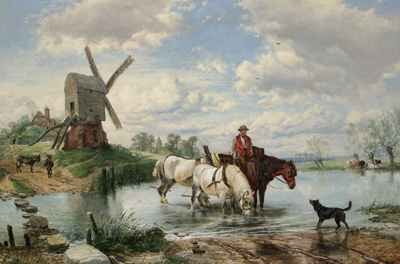
Animal painter Richard Ansdell (British 1815-1885) collaborated with other artists, who helped him by providing the figures and landscapes.

Richard Ansdell and Thomas Creswick, The Nearest Way in Summertime
His friend Thomas Creswick supplied the background for ‘The Nearest Way in Summertime.’ Ansdell painted the horses and the dog. In this case the windmill and the grouping of horses fight for attention, making the painting feel disharmonious.
 
A Dream of the Future by William Powell Frith, RA (British, 1819-1909),
in collaboration with Richard Ansdell, RA (British, 1815-1885)
and Thomas Creswick, RA (British, 1811-1869) 
According to a 1906 Art Journal, "In ‘A Dream of the Future’ (R.A. 1856), the figure was by Frith, the landscape by Creswick, and Ansdell put in the dog." 

Richard Ansdell, A Spanish Shepherd

"In 1856 he made his first visit to Spain, with John Phillip, R.A., and at the Royal Academy he showed ‘Going to be Fed,’ to which that artist had contributed."

Richard Ansdell, Lytham Sandhills, (1853)
Richard Ansdell on Wikipedia

Monday, December 9, 2019

Why Can't Flower Pigments Be Used in Paints?


Thom Rozendaal asks: "Why don't we use flowers to make pigments? I understand it would be hard to separate the biological matter from the pigments so maybe it would be possible to study how flowers produce these colors and recreate the processes in a lab? Has this ever been attempted before? Are there any pigments that are already made from flowers? It seems most are made of some type of mineral or something, and I guess I'm just worried we'll some day over-mine some of them as we are already doing with so many other things, whereas flowers are already being produced on a mass scale and are a renewable resource."

Thom, There are two main types of pigments in flowers: carotenoids and flavonoids. Scientific American says: "Carotenoids include carotene pigments (which produce yellow, orange and red colors). Carotene pigments are also found in vegetables, which is what gives carrots their colors. Flavonoids include anthocyanin pigments (which produce red, purple, magenta and blue colors)."

Both of these are natural organic pigment compositions that fade quickly because the large molecules are easily broken by ultraviolet light. You can make ink out of anthocyanin pigment, but it will be subject to photodegradation. People who collect dried flowers keep them pressed in books to protect them from ultraviolet light.

One organic pigment that has been traditionally been used as an artists' pigment or a vegetable dye is madder root, made from the dried root of rubia tinctorium. The root pigment is "laked" which means "bonded chemically to a colorless, transparent, insoluble salt that often acts as its own mordant — which turns the dye into an insoluble pigment. The gum arabic in watercolors then binds this complex but chemically stable pigment to the paper." (Source)

Natural organic pigments are rarely used in modern paints because of issues of lightfastness, so paint manufacturers use synthetic organic pigments or inorganic pigments. This webpage explains more about that process.
----
Scientific American: Springtime Science: Exploring the Pigments in Flowers
Anthocyanin pigments on Wikipedia


Sunday, December 8, 2019

Clean the Brush Before Each Mixture?


Doan Le says: “What do you do when you need to change colors? Do you simply change brushes, or wash off the previous paint with water?”

If the new color I need to mix is not a big color change, I can keep using the same brush, even if there’s already some paint in it. I factor the paint that's in the brush into the new mixture. If the color I want to mix is significantly different, I may need to remove most of the paint with a paint rag. If I must mix a fresh, pure mixture that’s different from what’s in the brush, I have to thoroughly wash out the brush in a plastic tub of water and then dry it off with the rag. Each of these water cleanings dirties up the water supply, so if I’ve only brought a small amount of water, I try to limit the number of deep cleanings.

Saturday, December 7, 2019

Leonard Squirrell's Scenes of East Anglia

Leonard Squirrell, watercolor over pencil
Leonard Russell Squirrell, R.W.S., R.I., R.E. (1893-1979) was a versatile British artist who captured compositions of the architecture that was disappearing in 20th century.

Leonard Squirrell, watercolor over pencil
According to a recent book on Squirrell, he was known as the 'Grand Old Man of East Anglian Painting', "beloved by many people well outside the boundaries of East Anglia and admired by many more as an outstanding topographical artist. Ranked by many collectors and connoisseurs with John Sell Cotman, Thomas Girtin, Philip Wilson Steer (who taught him) and other famous East Anglian artists." 

Leonard Squirrell, Etching
According to a book on sketching from the 1930s,  Squirrell's pastel work "comes to us as a revelation," because he would do careful lead pencil studies before attempting his pastel drawings on tone paper.
Leonard Squirrell, pastel
"For him these are more than mere sketches, embodying not only the conception but all the study necessary to the production of a completely worked out pastel."
-----

Friday, December 6, 2019

Leonard Campbell Taylor's Compositions

In his painting Women Playing Chess, Leonard Campbell Taylor limits himself to a restricted gamut of, essentially, white, black, and red, with a little blue-green mixed in with the grays.
Women Playing Chess by Leonard Campbell Taylor (British 1874-1969)
Thanks to his skillful value organization, the composition holds together well. The dark tones of the man in the distance blends into the background tones and yet is still readable. The black dress of the woman on the far side of the table also links up with the dark tones around her.


The first picture must have been successful for Taylor, as he echoed the idea in later paintings, and he even quoted the first composition in a print on the wall behind the man.
---
Discover more works by LCT on the ArtUK website.