
Monday, August 3, 2015

Edelfelt's Sketchbooks

The Finnish National Art Gallery has released online the sketchbooks of Albert Edelfelt (1854-1905).


Since the 104 sketchbooks are in chronological order, you can trace the journey of his mind and see the people he met and the moments he lived.

The books begin in his youth and reflect his early exposure to academic drawing at the Drawing School of the Finnish Art Society. He also studied with Adolf von Becker and later with Jean-Léon Gérôme at the Ecole Nationale des Beaux Arts in Paris (1874-1878).


There are babies newly born and relatives on their death bed, both common subjects of 19th century artists.

Edelfelt had a special gift for painting children. His sketchbooks reflect unselfconscious moments of children's lives, such as musical evenings, and kids at play. 

Albert Edelfelt, Boys Playing on the Shore, courtesy Google Art Project
Here's one of his finished paintings of children, for which he is justly revered not only in Finland, but around the world.


Don't miss his copies of Sargent in #19, dissections in #22, studies at the Prado in #27, and testing out a watercolor set in #100 (above).
-----
Thanks to the Finnish National Gallery for making these works accessible to the public, and thanks to Finnish illustrator Ossi Hiekkala (check out his work) for letting me know about it.

Sunday, August 2, 2015

Lovell's Frozen Companion


A friend sent me this unusual painting by Tom Lovell (1909-1997). Apparently Lovell came across the strange true story about two gold miners in Greenland. One of them couldn't take the weather and died. His companion buried him under the woodpile because the ground was frozen. After a while the survivor went a bit crazy with loneliness. Every once in a while he brought the frozen corpse into his little cabin as a dinner companion. He wasn't much for conversation, but he brought back memories of the good old days.

Saturday, August 1, 2015

GJ Book Club: Chapter 17: Portrait Drawing

On the GJ Book Club, we're looking at Chapter 17: "Portrait Drawing" in Harold Speed's 1917 classic The Practice and Science of Drawing.

Now we arrive at a solid chapter that is full of Speed's best thoughts about how to approach a portrait. He's not only talking about drawing, but about painting, too. I'll paraphrase Speed's points in bold, followed by further comments and links to previous GJ posts that discuss the topic further.

1. An individual's personality affects the outward appearance of their face, both the overall form and the features.
This leads to a question I've often pondered when I'm riding the subway or looking at criminal's mugshots. Can you read a person's biography from their face alone? How much are our innermost lives written on our faces?

2. The real object of the portrait painter is to seize on these unique characteristics of the sitter, even if they are shy and self-conscious about those qualities.
Speed says, "Some close study of individual characteristics must be the aim of the artist." Recent studies of face recognition have shown that the way we remember faces is by cataloguing the ways they deviate from the norm. We keep a mental catalog of their unusual qualities.


Caricaturists know this (above by David Boudreau) and they're experts at emphasizing those deviations.


King George V by Joseph Solomon
3. Some people think that emphasizing the uniqueness of the sitter goes against the goal of capturing their ideal beauty, but if you don't focus on this, you'll lose the likeness.
In Speed's words: "Catching the likeness, as it is called, is simply seizing on the essential things that belong only to a particular individual and differentiate that individual from others, and expressing them in a forceful manner."

4. No two people look alike; even if the differences are slight, we can recognize someone after a long time or from far off.
We've all noticed this when we see someone we know in a crowd way off. We're also attuned to recognizing very slight differences in body posture and walk cycles, too, which is why a walk cycle is a central job of designing an animation character.

5. We record the memory of a face not as a collection of individual details, but as a gestalt, or an overall impression.
He says it's important not to dwell too much on any one feature, but to develop the whole subject as a general impression and get that right before honing into the details. You can see this in quick portrait sketches (above) or unfinished paintings by master portraitists.

6. Your eye has to be "fresh" to recognize these differences. If you've been looking at your picture for too long, you lose sight of the uniqueness of the subject. 
The best illustration of this is this video, which will blow your mind if you haven't seen it before. Look at the cross in the middle of the frame, as unaltered photos of celebrity faces flash by. They will appear to be distorted caricatures, but they're not. Your "fresh eye" is seeing them as distinct and unique variations.  

7. Look for great qualities in the old masters, and then seek those qualities as you observe living examples in nature.
Another point Speed makes is to get to know the person's biography first, at least the main qualities of his temperament that are likely to have influenced his or her face. Another way I think of this is, what is their central metaphor? What is the basic story they keep telling about themselves? Do they present themselves as a victim, a clever trickster, a lover, a thinker, or a rogue? Speed says, "The habitual cast of thought in any individual affects the shape and moulds the form of the features. So I would say, chat it up with the person, and if possible keep them talking throughout the sitting. If they're sitting there like a wooden statue, there's no way you'll capture their true likeness.

8. Get the exact proportions correct first. The metrics have to be right.
We saw this in an earlier post when I interviewed one of the artists for Madame Tussaud's.
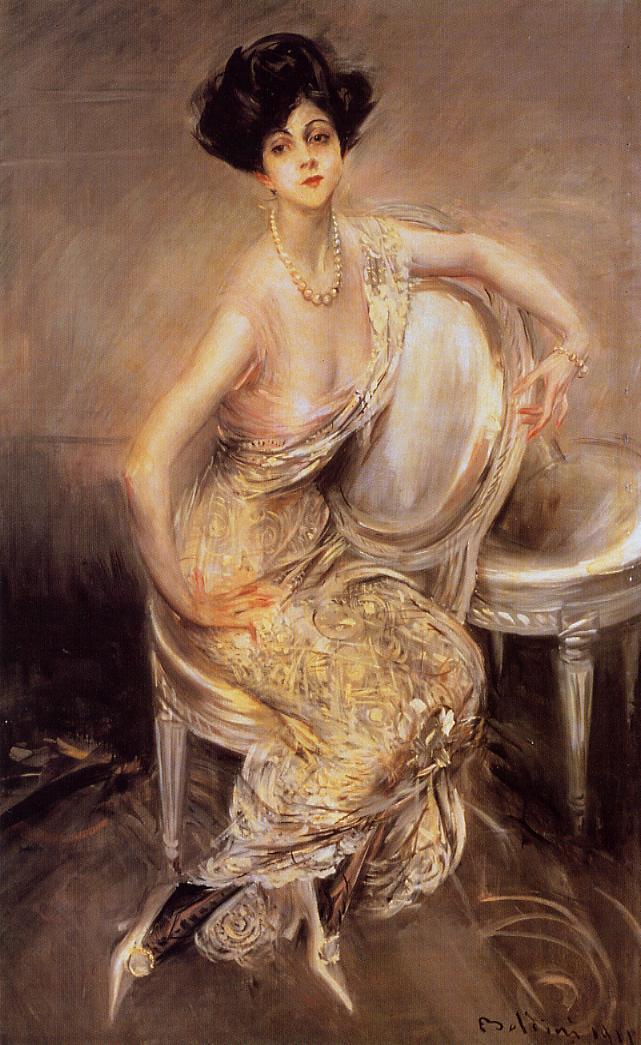

Portrait by Boldini

9. Speed's criticism of the "striking" portrait. 
Speed says, "Probably the most popular point of view in portraiture at present is the one that can be described as a "striking presentment of the live person. This is the portrait that arrests the crowd in an exhibition. You cannot ignore it, vitality bursts from it, and everything seems sacrificed to this quality of striking lifelikeness. And some very wonderful modern portraits have been painted from this point of view." 

He then goes on to question this fashion. I'm not sure exactly who he had in mind, but it might be Boldini, who did many such striking portraits, and they're related to the bravura of Hals. I doubt that Speed is criticizing Sargent, but he might be.


9. Speed outlines two methods for developing the portrait:
a) Mass in the impression, then finish the eyes first and then finish the rest of the face, moving outward from the eyes. Some contemporary painters advise actually constructing the face outward from the eyes, a more radical version of what Speed is proposing—but this method, I believe, is prone to errors in construction.

b) Block in the overall impression and develop areas throughout the face all together, finishing up the eyes later in the process.


10. Speed's classifications of portrait styles:
a) The quiet and sober portraits of Holbein (above).
b) "Seeking in the face a symbol of the person within." He gives the example of G.F. Watts (below).

Watts portrait of Wm. Morris
c) "Treating the sitter as part of a symphony of form and color." Example, J. McNeill Whistler.

11. Speed cautions against capturing momentary expressions (or contemporary fashions).
He traces this to the ability of the camera to capture a smile. Speed says you wouldn't want to live with a person who is smiling all the time (creepy), so you wouldn't want to live with a portrait like that, either. What would Speed think of modern portraits, where the fashion nowadays is to show the subject grinning? A "fixed smile is terrible," Speed says.

No one can hold a smile very long. That's why someone needs to count down "3, 2, 1, Cheese!" when we take a smiling photo. (See my previous post on Smiling Presidents)


Feel free to offer your comments on any of the points mentioned above, or other points I may have missed.

-----
The Practice and Science of Drawing is available in various formats:
1. Inexpensive softcover edition from Dover, (by far the majority of you are reading it in this format)
3. Free online Archive.org edition.
and The Windsor Magazine, Volume 25, "The Art of Mr. Harold Speed" by Austin Chester, page 335. (thanks, अर्जुन)
GJ Book Club on Pinterest (Thanks, Carolyn Kasper)

Friday, July 31, 2015

Entrance Ramp

At sunrise I'm standing at the bottom of an entrance ramp leading down into a parking lot in Kingston, New York. It's not a place that tourists would ever think of going.

Entrance Ramp, casein, 5 x 8 inches. 
Instead, ordinary people come here on their daily routines. At this hour it's mainly older guys arriving for fitness sessions at the YMCA and patients showing up for appointments at the nearby radiology lab.

Off in the hazy distance is a tangle of street lights, utility poles and cell towers. The sun is coming up hot. A few pools of cool air settle in the shadows around my ankles.
I limit my casein colors to three (plus white): raw umber, golden ochre, and cobalt blue. The underpainting of tinted Venetian red adds a contrasting hue. (By the way, using a contrasting colored underpainting is a legal way to sneak in an additional color in the "Outdoor Market Challenge.) 


Halfway into the block-in. The blue-yellow limited palette mixes with the red of the underpainting.


Covering the surface with grayish opaques is like putting out a fire. A few red embers still glow. 

Now I can concentrate on the close value contrasts and the oppositions of warm and cool colors.


I'm glad I've got my night-painting Department of Art shirt on, because I'm standing a little ways into the road. 

As I paint, I wonder about strange stuff, like why poles are never vertical, and who chose those ball-shaped street lights, and what the sounds would have been like here 100 years ago. I think this sunken parking lot was once the basement of a bustling factory.

Thursday, July 30, 2015

Diner Portrait in Gouache

This guy eats his bacon at a diner table near me. 

Gouache, 4 x 5 inches
There's a soft light from the right, and a bright edge light from behind. He has a dark mustache, dark eyebrows, graying hair, no teeth. Maybe he's on his way home from the Hemingway Lookalike Contest.

Art Sperl Disposal: "You propose it, we dispose it."
I lean over my coffee and shoot a glance from under my hat brim. This is portrait painting in the wild. The guy never looks up. He doesn't notice me painting him.
----
Previously: Portrait Noir

Wednesday, July 29, 2015

Joy Ride in a Paint Box


After leading the Allies to victory in World War II, Sir Winston Churchill (1874-1965) became an ardent outdoor painter. Never has painting had such an enthusiastic and eloquent champion.

"Painting is a companion with whom one may walk a great part of life's journey."

"When I die and go to heaven, I want to spend the first million years painting – so I can get to the bottom of the subject."

"We must not be too ambitious. We cannot aspire to masterpieces. We may content ourselves with a joy ride in a paint box. And, for this, Audacity is the only ticket."

"Painting is the same kind of problem as unfolding a long, sustained interlocked argument... It is a proposition commanded by a single unity of conception."

"Without tradition, art is a flock of sheep without a shepherd. Without innovation, it is a corpse."


"Armed with a paint-box, one cannot be bored, one cannot be left at a loose ends, one cannot 'have several days on one's hands.'"

"Painting is complete as a distraction. I know of nothing which, without exhausting the body, more entirely absorbs the mind. Whatever the worries of the hour or the threats of the future, once the picture has begun to flow along, there is no room for them in the mental screen. They pass out into shadow and darkness. All one’s mental light, such as it is, becomes concentrated on the task. Time stands respectfully aside, and it is only after many hesitations that luncheon knocks gruffly at the door."
----
Most of these quotes are from Churchill's slim but inspiring book Painting As a Pastime, and many of them can be found on the website Art Quotes

Prehistoric Times Reviews "Tyrannosaurs"

Prehistoric Times, the magazine of all things dinosaurian, reviewed my recent tutorial video Tyrannosaurs: Behind the Art. 


"Jim's new video tutorial gives you front row seats at the creation of two Tyrannosaur paintings for Scientific American magazine, including one. Super talented illustrator James Gurney fully explains his process as he reconstructs two recently discovered relatives of Tyrannosaurus rex, as if you were sitting right there with him. Working closely with scientist Stephen Brusatte, who discovered one of them, he shows his process including thumbnails and color comprehensives. He shows how he uses photos and models, as well as outdoor studies, as he moves ahead to the final oil illustration."

"He explains both his methods and his thinking with an emphasis on the techniques for portraying feather and foliage textures, thereby creating a believable reconstruction of a scene that is imagined based on scientific evidence. Jim Gurney shows how he chooses his colors, what brushes he uses at each stage, and how he prepares his board for painting. The production is packed with information that will fascinate dinosaur artists as well as all other artists. I promise you will be most impressed."

—Mike Fredericks, editor, Prehistoric Times
-----
Available as an HD download from Gumroad (credit cards) or Sellfy (Paypal).
and as a DVD from the manufacturer Kunaki, or on Amazon.com

Tuesday, July 28, 2015

Pinterest

Do you do Pinterest? If so you might want to check out my Pinboards on Gouache and Casein painting.

Co-op Truck

"Co-op Truck," black and white gouache, 5 x 8 inches.
I have a half hour while they unload the food co-op truck, so I set up my sketchbook on a garbage can. The driver waits in the shade, leaning against the truck.


The preliminary drawing has accurate measurements, but it is very rough and incomplete, just a map of the big shapes.


I lay a light wash over most of the scene (lighter than it appears here), using some warm and cool colors from my watercolor set. This is to lower the tone just a bit from white so that I can come back up to white with the gouache.

I begin to define the dark values. I want to push the values to very light and very dark, not too many middle tones.


The driver comes over to take a picture of the sketch with his cell phone.


Monday, July 27, 2015

Embodied Cognition

Embodied cognition is an emerging idea in neuroscience which explores the connection between the mind and the body.

Contrary to the older view dating back to Descartes that the mind and body occupy separate realms, and that aesthetic activity is a largely disembodied experience, embodied cognition holds that the body is not only intimately connected to brain activity, but that it plays a strong role in shaping it.

Tom Lovell, 1949 illustration for Redbook, courtesy Jim Pinkoski 
The implications for practicing artists are profound. Recent studies have shown that the act of observing a painting of people participating in an action engages mirror neurons in our own brains. That activity in turn is greatly influenced by similar experiences that we have had.

"Performing an action requires the information to flow out from the control centers to the limbs. But observing the action requires the information to flow inward from the image you're seeing into the control centers," says science writer Kat Zambon. "So that bidirectional flow is what's captured in this concept of mirror neurons and it gives the extra vividness to this aesthetics of art appreciation."

The act of drawing or painting engages the brain in even deeper ways. Lora Likova, PhD, of the Smith-Kettlewell Eye Research Institute in San Francisco, is working on art-based interventions with blindfolded and sight-impaired subjects to better understand the integrative process between the body, the mind, and the perceptual system. 

She says that drawing is “an amazing process that requires precise orchestration of multiple brain mechanisms, perceptual processing, memory, precise motor planning and motor control, spatial transformations, emotions, and other diverse cognitive functions.”

It's no wonder then that talking while drawing requires such mental effort—unless a person is practiced enough at it that the neural pathways have had time to develop in the more automatic centers of the brain.
Auditory mirror neurons
This is true not only for artists but for musicians. Appreciating the art of another artist practitioner engages our brains in deeper ways, especially if you are an experienced practitioner. 

My son is an accordion player, and I've noticed that when he listens to another accordionist playing, my son's fingers are twitching slightly.
Previously on GurneyJourney: Brain Scans of Artists While Drawing
Irish Music from the Hudson Valley by Dylan Foley and Dan Gurney