Earlier this year, the National Wildlife Federation asked me to do a couple of paintings of Pteranodons for their magazine, Ranger Rick. The final artwork appears in the current October issue.
Here are some preliminary sketches. The first painting they wanted was a double-page-spread title opener, with the giant pterosaurs skimming low over the edge of the surf, looking for fish. I started by studying photos and videos of albatrosses and pelicans, watching how they fly, land, and fish.
I did all these small thumbnail sketches in watercolor, water soluble colored pencils, and white gouache, about 1.5 x 2 inches each.
Here's another batch of sketches. I find it helps to consider the whole effect of the page from the very start, because eventually the art director and I will need to come to terms with headlines and type, and there's no point falling in love with a composition that won't serve its design purpose.
They're numbered from one to ten. Can you guess which one the art director picked?
Tomorrow I'll show you how I made the maquette.
------
Ranger Rick October issue
Previous posts about Ranger Rick paintings
Tylosaurus
Mega Rodent
The Pteranodon series:
Part 1: Pteranodons / Thumbnails
Part 2: Pteranodons / Maquette
Part 3: Pteranodons / Step by Step
Thursday, October 4, 2012
Part 1: Pteranodons / Thumbnails
Labels:
Animals
Wednesday, October 3, 2012
Flags and Cutters
A "flag" —also known as a "cutter" — is a piece of opaque black cloth or board held in position to block a source of light.
Here's a photo of John Singer Sargent painting Mrs. Fiske Warren (Gretchen Osgood) and her daughter Rachel at the Fenway Court in Boston (now the Isabella Stewart Gardner Museum), where Sargent had set up a temporary studio.
Sargent placed a chair behind the sitters, with poles strapped to the back of the chair. Across those poles he draped a piece of cloth as a cutter to reduce the backlighting and the glare into his eyes. The soft key light comes from a window unseen to the right.
------
New book on Sargent (released yesterday):John Singer Sargent: Figures and Landscapes, 1900-1907: The Complete Paintings, Volume VII
More about that Sargent painting.
Sargent photo from "Representational Painting" Facebook page
Photo of modern cutter from Enchanting Kerala.org
Previously on GJ: C Stand
Here are some modern flags, held in position by a C-stand. These allow a director of photography in a photo lab or a movie shoot to control exactly which surfaces the light touches or to keep a light from shining into the lens.
Here's a photo of John Singer Sargent painting Mrs. Fiske Warren (Gretchen Osgood) and her daughter Rachel at the Fenway Court in Boston (now the Isabella Stewart Gardner Museum), where Sargent had set up a temporary studio.
Sargent placed a chair behind the sitters, with poles strapped to the back of the chair. Across those poles he draped a piece of cloth as a cutter to reduce the backlighting and the glare into his eyes. The soft key light comes from a window unseen to the right.
------
New book on Sargent (released yesterday):John Singer Sargent: Figures and Landscapes, 1900-1907: The Complete Paintings, Volume VII
More about that Sargent painting.
Sargent photo from "Representational Painting" Facebook page
Photo of modern cutter from Enchanting Kerala.org
Previously on GJ: C Stand
Labels:
Academic Painters,
Lighting,
Portraits
Tuesday, October 2, 2012
Chinese Interview about Sketching
"Fantasy Art" magazine from Beijing China has just released a new issue with feature stories about Thomas Kuebler, Tony Hough, A.J. Manzanedo, David Renn, and Young-june Choi.
The magazine also includes an interview with me about my sketching habit. The article was inspired by a trip to Shanghai last fall. I met the magazine's founder, Wang Wei, and went watercolor painting with him on the canals of Zhujiajiao.
Here's the full interview in English:
Introduction
When I travel, I enjoy sketching from observation. My sketchbooks are an important record of my contact with the world. They are also a source for ideas for me as I generate ideas for fantasy and science fiction pictures.
How many travel you will have at one year in the usually?
I usually travel on five or six trips per year, usually to lecture at art schools or to teach the artists at movie studios. I always bring a sketchbook so that I can draw pictures of what is around me in the spare moments when I am waiting.
Is every travel you have some unambiguous target? Or you like the randomness?
I like both kinds of travel. Most of my trips are for lectures or book signings, but I usually take one trip per year just for relaxation and sketching.

(Beara Peninsula--lower left image in the spread above)
11 x 14 inches, watercolor. A few years ago, I traveled to the southwest of Ireland to paint the landscapes and ancient monuments. I used watercolor because it is convenient for traveling. When I paint fantasy landscapes, I look at my observational paintings like this to get ideas for light and color.
Could you tell me when you come to Ireland? No need exactitude.
I came to Ireland in 2010 in order to paint on location and to enjoy the traditional music..
Why you will painting this landscape? Did you felt some especial? Or just like this landscape. Or something else?
This is a very ancient landscape, with stone structures dating to thousands of years ago. I was interested in the history and archaeology of Ireland, and also the mythology. I love the mystery of such old landscapes because they are inhabited by the memory of many lives that have passed before.
It seems you stood on a hill that sew those landscape, do you want to tell us how do you got there?
I drove up a long dirt road to visit an ancient Celtic monument. While searching for the rocky ruins, I was on a hilltop and saw this view. I brought my watercolors with me so that I could paint this scene.
(The Morrocan city of Aït Benhaddou) photograph 2008. In 2008 I traveled to the High Atlas mountains of Morocco for a sketching trip. This mud brick city was where I painted several portraits. This place seemed more fantastic than anything I could have imagined.
Why you made this trip?
I traveled here with a science fiction writer friend named Alan Dean Foster. We were both interested in learning more about Morocco. It was my first time in Africa.
When you photoed this picture, did you saw something behind this mud brick city? For example, the same style city will appear at the Dinotopia universe? Or some kind of life behind this mud brick? Why you photo it? Just surprised you?
This is a famous city because it is one of the best preserved of the mud brick cities of the Atlas Mountains. It is also the location where many films were shot, including “Gladiator” by Ridley Scott.
What happened after your photoed this picture? Did you bought something at the booth that in the picture?
It was at the end of my day in the city. I had done a portrait of one of the souvenir sellers. Afterward I drove back to the town where I was staying.
(Arab Guard) 5 x 8 inches. In the narrow streets of the city of Fes, Morocco, I met a man named Hassan whose job was to stand watch over the doorway of an antique store. He patiently posed for me while I drew his face in brown and black water-soluble colored pencils.
Is that a same trip with when you photoed the picture of The Morrocan city of Aït Benhaddou.
Yes, this was on the same trip.
Why you want drew Mr. Hassan? Or it just happened when you walked to him?
I was interested in drawing someone from Morocco. He was a guard, so he wasn’t doing anything. I asked him in French if I could have permission to draw his portrait. He agreed, and he seemed to enjoy posing.

(Morgan) 5 x 8 in, watercolor. This is a watercolor study of a 1931 three-wheeled car from England called a Morgan. Three-wheeled vehicles were classified as a motorcycles in Britain, so owners could avoid road taxes. The Morgan was low to the ground and weighed only about 850 pounds. It could go up to 80 miles per hour. When I need to design a spaceship or a robot, I look through my sketchbooks for vehicles, and that way I can get ideas from the real world.
Where you found this Morgan?
At the Rhinebeck aerodrome, a museum near where I live where they keep old airplanes, cars, and motorcycles.
When you got this travel? Why? This museum is close to my home, less than 5 miles away. I am interested in all kinds of old cars and trucks.
Did you talk with the owner? How did he get this Morgan?
I talked with someone who worked at the museum. This car was more than 50 years old. It was given to the museum by a collector.
What kind of vehicle you will painting it? I mean you may not painting a Rolls-Royce when you see one on the street, isn't it?
I more often paint older, unusual things, not new and fancy things, because older things have more character.
As I know some concept artist had designed some very amazed vehicles, why you want to painting some one in the really world not just see what the other people made? For the first-hand experience?
All the fantasy and concept art pictures that I do come from my imagination, but my imagination must begin with what I have seen with my eyes. I believe a concept artist will be stronger and more successful if he or she studies the real world very closely, because Nature is full of wonderful surprises.
(Cow Portrait) 5 x 8 inches. This is just one cow, but I drew her head in two different angles, because she kept turning her head. She was restless when I painted her portrait because she was hungry and it was her feeding time. She swung her big head back and forth. I tried to pick two angles that she kept returning to.
When and where you made this images?
This was painted at a farm which is close to my home.
Why you want to drawing a cow?
Because I was interested in understanding better its form and movement. Also, I like cows.
(Gurney’s sketch of Gorilla) 5 x 8 inches, pencil. If you want to draw portraits of apes, you have to approach them in the proper way. You can’t approach a great ape enclosure and start staring at them, or they will become unhappy and turn their back on you, because staring is a threat to them. When I went to a zoo, I approached the gorilla enclosure with a submissive posture, looking down at the ground and backing up with my hand out. (Link for original blog post)
When you made this portrait?
I made this in 2009 at the North Carolina (USA) zoo.
How do you know this knowledge of ape?
I studied anthropology and primate behavior in college, but I really don't know that much about gorillas.
(Gorilla , photograph.) The gorilla loved being approached this way. She had never seen a human act like a polite ape before. She came right up to the glass and posed for me while I did this half-hour portrait from just two feet away.
How many travel you will have at one year in the usually?
I usually travel on five or six trips per year, usually to lecture at art schools or to teach the artists at movie studios. I always bring a sketchbook so that I can draw pictures of what is around me in the spare moments when I am waiting.
Is every travel you have some unambiguous target? Or you like the randomness?
I like both kinds of travel. Most of my trips are for lectures or book signings, but I usually take one trip per year just for relaxation and sketching.
(Beara Peninsula--lower left image in the spread above)
11 x 14 inches, watercolor. A few years ago, I traveled to the southwest of Ireland to paint the landscapes and ancient monuments. I used watercolor because it is convenient for traveling. When I paint fantasy landscapes, I look at my observational paintings like this to get ideas for light and color.
Could you tell me when you come to Ireland? No need exactitude.
I came to Ireland in 2010 in order to paint on location and to enjoy the traditional music..
Why you will painting this landscape? Did you felt some especial? Or just like this landscape. Or something else?
This is a very ancient landscape, with stone structures dating to thousands of years ago. I was interested in the history and archaeology of Ireland, and also the mythology. I love the mystery of such old landscapes because they are inhabited by the memory of many lives that have passed before.
It seems you stood on a hill that sew those landscape, do you want to tell us how do you got there?
I drove up a long dirt road to visit an ancient Celtic monument. While searching for the rocky ruins, I was on a hilltop and saw this view. I brought my watercolors with me so that I could paint this scene.
(The Morrocan city of Aït Benhaddou) photograph 2008. In 2008 I traveled to the High Atlas mountains of Morocco for a sketching trip. This mud brick city was where I painted several portraits. This place seemed more fantastic than anything I could have imagined.
Why you made this trip?
I traveled here with a science fiction writer friend named Alan Dean Foster. We were both interested in learning more about Morocco. It was my first time in Africa.
When you photoed this picture, did you saw something behind this mud brick city? For example, the same style city will appear at the Dinotopia universe? Or some kind of life behind this mud brick? Why you photo it? Just surprised you?
This is a famous city because it is one of the best preserved of the mud brick cities of the Atlas Mountains. It is also the location where many films were shot, including “Gladiator” by Ridley Scott.
What happened after your photoed this picture? Did you bought something at the booth that in the picture?
It was at the end of my day in the city. I had done a portrait of one of the souvenir sellers. Afterward I drove back to the town where I was staying.
(Arab Guard) 5 x 8 inches. In the narrow streets of the city of Fes, Morocco, I met a man named Hassan whose job was to stand watch over the doorway of an antique store. He patiently posed for me while I drew his face in brown and black water-soluble colored pencils.
Is that a same trip with when you photoed the picture of The Morrocan city of Aït Benhaddou.
Yes, this was on the same trip.
Why you want drew Mr. Hassan? Or it just happened when you walked to him?
I was interested in drawing someone from Morocco. He was a guard, so he wasn’t doing anything. I asked him in French if I could have permission to draw his portrait. He agreed, and he seemed to enjoy posing.
(Morgan) 5 x 8 in, watercolor. This is a watercolor study of a 1931 three-wheeled car from England called a Morgan. Three-wheeled vehicles were classified as a motorcycles in Britain, so owners could avoid road taxes. The Morgan was low to the ground and weighed only about 850 pounds. It could go up to 80 miles per hour. When I need to design a spaceship or a robot, I look through my sketchbooks for vehicles, and that way I can get ideas from the real world.
Where you found this Morgan?
At the Rhinebeck aerodrome, a museum near where I live where they keep old airplanes, cars, and motorcycles.
When you got this travel? Why? This museum is close to my home, less than 5 miles away. I am interested in all kinds of old cars and trucks.
Did you talk with the owner? How did he get this Morgan?
I talked with someone who worked at the museum. This car was more than 50 years old. It was given to the museum by a collector.
What kind of vehicle you will painting it? I mean you may not painting a Rolls-Royce when you see one on the street, isn't it?
I more often paint older, unusual things, not new and fancy things, because older things have more character.
As I know some concept artist had designed some very amazed vehicles, why you want to painting some one in the really world not just see what the other people made? For the first-hand experience?
All the fantasy and concept art pictures that I do come from my imagination, but my imagination must begin with what I have seen with my eyes. I believe a concept artist will be stronger and more successful if he or she studies the real world very closely, because Nature is full of wonderful surprises.
(Cow Portrait) 5 x 8 inches. This is just one cow, but I drew her head in two different angles, because she kept turning her head. She was restless when I painted her portrait because she was hungry and it was her feeding time. She swung her big head back and forth. I tried to pick two angles that she kept returning to.
When and where you made this images?
This was painted at a farm which is close to my home.
Why you want to drawing a cow?
Because I was interested in understanding better its form and movement. Also, I like cows.
What happened when you talk with the farmer you want draw his cow? I don’t always see the farmer when I sketch at his farm. But I have his permission to sketch there anytime. When I see him, he tells me stories about his adventures on the farm.
(Cow Sketching , photograph.) When the cow heard the farmer’s voice, she let out a powerful moo that echoed through the whole barn. I could feel the hot, moist blast of breath. It was feeding time. She was hungry. Bits of hay and drool dropped onto my watercolor sketchbook.
Did you talk with cow? It looks like on the picture.
The cow was trying to talk to the farmer. She was making a lot of noise hoping that he would come with some food.
Why there have many childrens with you? What happened? Who they are?
The children help to feed the animals and clean the stalls. They are not my children, but they often see me sketching there.
(Jill the Farm Dog) , 5 x 8 inches. Watercolor and water-soluble colored pencils. Jill was an old dog that lived on a farm near my home in New York. She only had three legs. She held still because she was watching some piglets nearby.
Is that dog was painted at the same farm that you painted the cow? Yes, this was at the same farm. Jill belonged to the farmer.
What kind of particularity that make this old dog attract you? Did the owner told you why she just have three legs?
Yes, she has three legs because she was kicked by a horse that she was bothering. I admired the way the dog lived cheerfully despite her suffering.
(Chop Suey) , oil paint, 16 x 8 inches. This is a sign for a restaurant near where I live. The picture is painted in oil on location.
Why you painted this facia? Did the light attract you?
Yes, I was interested in the way the light touched the top of the sign.
Were you will used it, if you think?
I painted this for myself, but sold it in a gallery, and published it in my newest book, Color and Light, which will soon be published in China.
(Irish Stove) , oil paint, 8 x 10 inches. This 8x10-inch oil study of an Irish hearth was painted on two consecutive mornings in a cottage in County Kerry, Ireland. The cool light from the open doorway and an adjacent window casts soft warm shadows to the right of the black stovepipe, the china dogs, and the plastic bucket of turf.
Is that made the same travel of Beara Peninsula be made?
No, this trip occurred more than 10 years ago.
Why you made this by oil?
Oil allows me to control color and value more precisely.
Did you slept at this house? How about this owner? Did they like you painting? Yes, I slept in the house. We rented the house. The owner was not there. I showed them a scan later, and they liked it.
Did this stove have some story?
It is a typical Irish stove that burns peat or turf, which is fuel cut from the ground.
(Gurney’s sketch of Gorilla) 5 x 8 inches, pencil. If you want to draw portraits of apes, you have to approach them in the proper way. You can’t approach a great ape enclosure and start staring at them, or they will become unhappy and turn their back on you, because staring is a threat to them. When I went to a zoo, I approached the gorilla enclosure with a submissive posture, looking down at the ground and backing up with my hand out. (Link for original blog post)
When you made this portrait?
I made this in 2009 at the North Carolina (USA) zoo.
How do you know this knowledge of ape?
I studied anthropology and primate behavior in college, but I really don't know that much about gorillas.
(Gorilla , photograph.) The gorilla loved being approached this way. She had never seen a human act like a polite ape before. She came right up to the glass and posed for me while I did this half-hour portrait from just two feet away.
In the some kind of way, the ape is the animal that most like human, when you draw it. what you felt?
I was impressed with how much the gorilla seemed to behave like a human, with curiosity and interest in my drawing.
Why is she not he?
The zookeeper told me she was female.
As we know the New York City zoo had thousands all kinds of animal, when you see them, do you feel sadness? I mean those animals live in the zoo just because they can be saw by human at the safe place. What you thoughts?
I would be happier to see them in the wild, but perhaps zoos can do some good. Those of us who can’t travel all the way to Africa can see and appreciate these beautiful animals up close. In this way, we learn to understand them so that their habitat can be protected. Also, many zoos have breeding programs that help preserve endangered animals and sometimes release them into the wild.
Illustrators Magazine
The first issue of a new quarterly magazine called "Illustrators" has appeared. Its mission is to spotlight the talents through history of the British and European illustration scene.

The issue takes a look at the hardboiled art of Denis McLoughlin...

...the science fiction comics and illustration of Ian Kennedy...

...the 60s chic of Angel Badia Camps....

....and the sensuous fantasies of Cheri Herouard.
The magazine is similar to the American equivalent "Illustration Magazine," with high quality reproductions, a mix of art and graphics, and often rare interviews. But this magazine is published by Geoff West and the Book Palace, Ltd. in London. It presents a rare opportunity for illustration fans to get to know who was working in England and Europe in the last century.
Take a peek inside with cool page-turning feature
Illustrators magazine

The issue takes a look at the hardboiled art of Denis McLoughlin...

...the science fiction comics and illustration of Ian Kennedy...

...the 60s chic of Angel Badia Camps....

....and the sensuous fantasies of Cheri Herouard.
The magazine is similar to the American equivalent "Illustration Magazine," with high quality reproductions, a mix of art and graphics, and often rare interviews. But this magazine is published by Geoff West and the Book Palace, Ltd. in London. It presents a rare opportunity for illustration fans to get to know who was working in England and Europe in the last century.
Issue 2, due in the winter, will feature David Wright, Cecil Doughty, Raymond Sheppard, and Renato Fratini, and beyond that, future issues will spotlight other greats like Fortunino Matania.
Take a peek inside with cool page-turning feature
Illustrators magazine
Labels:
Golden Age Illustration
Monday, October 1, 2012
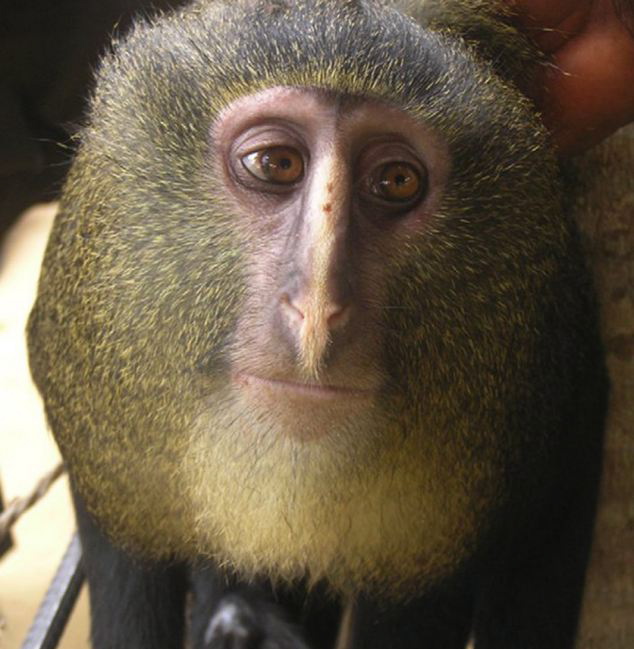
New African Monkey
Science Daily reports on a monkey previously unknown to science. It's the second African monkey to be "discovered" in 28 years.

Conservation biologist John Hart heard that a schoolmaster's daughter at the edge of a forest in the Democratic Republic of the Congo had an unusual pet monkey known locally as a "lesula." Hart tracked its growth for 19 months, and then observed individuals in the wild. The lesula spends most of its time on the ground foraging in small groups.
The Guardian describes the face as sensitive and intelligent, "like it is sitting for its portrait by Rembrandt. It reveals a staggeringly insightful, wise, and melancholy face. Like Rembrandt's son Titus in the portrait of him by his father that hangs in London's Wallace Collection, the lesula looks right back at its beholder, calm and pensive, examining you as you examine it. Its eyes have the depth and frankness of those seen in moving portraits on Roman-era mummies from the Fayoum, or in Antonello da Messina's haunting portrait of a man gazing back out of a glassy oil panel."
Sunday, September 30, 2012
Lime Rock Races
(Direct link to video) I made this little video about a sketching trip to the car races yesterday at Lime Rock Park in Connecticut.
Alex Gurney and Jon Fogarty closed out the Grand-Am road racing championship with a 2 3/4 hour sprint in their Gainsco Corvette, which I sketched on location in watercolor and colored pencil.
Alex led the race for a while near the end, so I painted his car out front. He finished in third place, the third straight podium finish for the team.

Before the race we enjoyed hanging out with Grand Marshall Sam Posey, a celebrated race driver, TV commentator, architect and artist.
Report on the race on the Gainsco site
Wikipedia on Sam Posey
Driver's eye video of Lime Rock passing strategy
Previously on GJ
Last year's race with Alex Gurney
The Delta Wing
Labels:
Pencil Sketching,
Video,
Watercolor Painting
Saturday, September 29, 2012
Trost Richards at PAFA
The exhibition "A Mine of Beauty: Landscapes of William Trost Richards" opens today at the Pennsylvania Academy of the Arts in Pennsylvania. (PAFA) in Philadelphia.

I had a chance to preview the exhibition, and it's a wonderful collection of the 19th century master's miniature watercolor landscapes, plus a few of his large oils.
Catalog: A Mine of Beauty: Landscapes by William Trost Richards
Labels:
Watercolor Painting
Solomon’s Book, Day 3
(We're finishing a discussion of: The Practice of Oil Painting and Drawing by Solomon Solomon, first published in 1911, new intro by James Gurney)
Even a century ago, Solomon regretted the disappearance of the workmanlike skills of the Renaissance masters. The problem, he said, stemmed from the overuse of opaque pigments, the fashion for impressionism, and the proliferation of art exhibitions. He also lamented the disservice of teachers who gave aesthetic advice alone without also sharing practical information.

Regrettably, few academic masters committed their knowledge to the printed word. Those who did, such as Harold Speed

The value of Oil Painting and Drawing to today’s art student comes in part from Solomon’s ability to synthesize in practical terms the artistic currents swirling around him at the dawn of the twentieth century. He encouraged students to cultivate an open mind, and he expressed his appreciation for a wide range of older masters. “An old mansion can have many windows letting in the light,” he said. True enough. But as he shows us in this book, the mansion must first be built on a foundation of good craftsmanship.
Labels:
Academic Painters
Friday, September 28, 2012
Solomon’s Book, Day 2

How the Book is Organized
The Practice of Oil Painting is divided into two parts. In the first, Solomon provides a series of seful exercises to help the student progress from charcoal drawings to full-color oils. Drawing upon his long experience as an instructor, he proposes remedies for common faults in student work. He makes a point of explaining the materials he uses at each stage, such as grounds, palettes, brushes, and paints, and he offers sound methods for achieving accurate measurements of lines and shapes in drawing, and precise relationships of values in painting.
The second section, “The Methods of the Masters,” comprises more than half of the book. It extends the practical advice of the first section by applying the same principles to the work of great artists of the past, such as Van Dyck, Rembrandt, and Velázquez. He analyzes both the strengths and the shortcomings of composition in these works, but he leaves the usual iconographic interpretations to art historians. His is a tour by a working artist for other working artists.
The paintings he selects as examples come mainly from the collection of London’s National Gallery. The original editions of the book showed those works in black and white, but Dover's new edition includes a section with the old master works reproduced in color. Solomon’s approach to painting
Solomon was a thorough and methodical craftsman, and he practiced what he preached. According to an eyewitness, he spent “an infinity of time over draughtsmanship and composition.”
Eternally dissatisfied, he painted, scraped off, and repainted key figures until they were right. He once destroyed a painting called "Sacred and Profane Love," even after it was accepted and exhibited at the Royal Academy. He was uncompromising in his quest for accuracy of historical detail or realistic lighting. Once, to properly observe the effects of theatrical footlights on a portrait of the actress Mrs. Patrick Campbell as “Paula Tanqueray,” he had a replica of the Saint James’s stage erected in his studio, complete with footlights.
What Solomon taught in Oil Painting and Drawing was in some respects consistent with the tradition of academic instruction in Britain. Drawing instruction was based on careful observation of the figure, as well as the emulation of old masters and the study of Greek and Roman sculpture. The Elgin Marbles, removed from the Parthenon in the early 19th century, were available to art students of Solomon’s day. Together with other originals and casts they provided a standard of excellence for all figural work.
By observing classical sculpture, students learned not only to accurately measure proportions and to use tone to suggest three dimensional form, but they also came into contact with the ideals of classical art. Subjects for paintings sprang from the timeless stories of the Greek myths. Many of Solomon’s famous canvases were based on mythology: Niobe, Echo and Narcissus, Venus, and Judgment of Paris. He once said, “Art reached its highest expression in the hands of the Greeks. Their mythology, so rich in imagery, so inspiring for the artist, so beautiful from the aesthetic side, could not fail in the course of time, among a race so sensitive, to produce the wonders both of sculpture and architecture that are unsurpassed and unsurpassable.” 
At the same time, Solomon’s teaching methods were notable for their divergence from the practices current at the time in England.
A contemporary reviewer remarked on his “fine sense of drawing and harmonious colour, pitched, as a rule, in rather high keys, due no doubt to his French training.”
Instead of requiring the pupil to follow Solomon's own individual style, his strategy was to equip his students with universal scientific principles and practices that provided a basis by which an aspiring artist could pursue an individual vision. This flexibility and openness to varied styles was consistent with Solomon’s teacher Cabanel, who was said to resist fettering any temperaments or constraining any goals of dissimilar minds.
As Solomon says, “Many roads lead to Rome.”
Alla Prima versus Indirect Painting
Solomon’s British contemporaries Forbes and La Thangue also studied in Paris but they fell more heavily under the influence of the opaque, painterly manner of plein air work, an approach that Solomon refers to as “direct” or “à prima” painting, today more commonly called “alla prima” or “impressionist” handling. Although he was certainly capable of this method and sympathetic to it, he argued that in all but the most capable hands, it tends to lead to chalky, dead mixtures, particularly in skin tones. For his large-scale serious work, Solomon preferred the “prepared” or “indirect” painting method of Rubens, Van Dyck (below) or Titian rather than the bravura brushwork of Hals.
This involved rendering the tones of the figure first in monochrome, and then bringing out the colors of the skin with semitransparent scumbles and glazes. In keeping with the preoccupation with aestheticism in his time, he refers several times to the “decorative” qualities of a painting, by which he means the abstract design, seen apart from the subject matter.
He also acknowledges a method of painting commonly practiced at the École, where the figure is rendered to a finished effect from the top of the canvas to the bottom, area by area, a practice today often called “window shading.” For today’s students weighing the benefits of many different ways of painting, each of which shares a claim to be “academic,” his well reasoned insights into the pros and cons of each approach will be especially valuable.
Tomorrow: Final thoughts on Solomon's book.
Labels:
Academic Painters
Thursday, September 27, 2012
Solomon's book, Day 1
For the next three days, I’ll be spotlighting Solomon Solomon, the artist who was so nice they named him twice.
At my suggestion, his classic book on painting has just been republished by Dover Publications, and I was honored to write the introduction. Excerpts of that essay follows:
Solomon Joseph Solomon (1860-1927) was a Victorian painter of Biblical and mythological scenes.
Although he is not widely known today, in his time he was regarded as a leading artist and respected teacher at the Royal Academy. He was an important part of the artistic life of his generation and his works were “known to everyone who takes an interest in art.”
Today his two most famous paintings are the muscular and dramatic compositions “Samson and Delilah” (Walker Art Gallery, Liverpool) and “Ajax and Cassandra” (Ballarat Art Gallery, Australia).
Solomon Solomon (not to be confused with a contemporaneous painter named Simeon Solomon) was born in London, the fourth son of a leather dealer. His mother was from a cultured family of Prague in Bohemia. Seeing that her son had taken an early interest in drawing, she encouraged him to pursue artwork. It was from her that he “inherited his artistic taste, as well as his spirit of joie de vivre.”
His father resisted his career aspirations at first, given that a Jewish artist in nineteenth century Britain faced considerable obstacles, both religious and social. Nevertheless, at the age of sixteen, he entered Heathersley’s Art School. A year later he moved on to the Royal Academy Schools, where his classmates were Stanhope Forbes, Henry La Thangue, and Arthur Hacker. There he fell under the influence of prominent Victorian artists, such as Sir John Everett Millais and Sir Lawrence Alma Tadema.
But the training at the Royal Academy was limited. According to an 1885 article in The Magazine of Art, the R.A. had “little or nothing to teach; its students, as soon as they have passed the curriculum it imposes on them then make haste to betake themselves to France to learn, not only how to paint and draw, but to forget as much as they can of the practice and theory acquired at its schools.”
Therefore he continued his studies on the continent in France at the École des Beaux-Arts under Alexandre Cabanel (1824-1889) and in Germany at the Munich Academy. Travel to Italy, Holland, Germany and Spain sharpened his appreciation for the working methods of the old masters. Returning to England, he first exhibited at the Royal Academy in 1881, debuting one year before another French-trained artist, John Singer Sargent. From 1887 to 1897, he lived on Holland Park Road, among a colony of artists known as the Holland Park circle, the most prominent of whom was Frederic Leighton, President of the Royal Academy.
Solomon became an Associate member of that body in 1896, then was elected as a full member in 1906, the second Jew to be so honored. In 1919 he replaced Frank Brangwyn as President of the Royal Society of British Artists. As part of his service in World War I, he became one of the pioneers of camouflage, publishing Strategic Camouflage in 1920. Right: "Laus Deo,"
Like many of his academically trained contemporaries after the turn of the century, Solomon came to realize that the market was evaporating for epic mythological scenes based on literary themes. Instead he focused more and more on portraiture. His sitters included royals such as King George V, Queen Mary, Prince Edward, the architect Sir Aston Webb, and prominent members of the Jewish community such as Israel Zangwill.
-----
Tomorrow: More about the book and how it's organized.
Subscribe to:
Posts (Atom)