I'm posing as Arthur Denison. From Dinotopia: Journey to Chandara. The book is still currently available at Amazon
Friday, September 7, 2012
From the reference files
Sometimes the photo reference is more entertaining than the final painting.
I'm posing as Arthur Denison. From Dinotopia: Journey to Chandara. The book is still currently available at Amazon
, but the publisher's warehouse is sold out, awaiting a reprint. We have signed copies here at the Dinotopia Store.
I'm posing as Arthur Denison. From Dinotopia: Journey to Chandara. The book is still currently available at Amazon
Labels:
Models Posing
Thursday, September 6, 2012
Drawing with My Nephew
I have a nephew with Down Syndrome, and I once sat beside him and drew pictures.

I don't get to see him too often, but the last time I spent a few days with him, I showed him how to draw a building with windows and doors. He understood the idea right away.

Drawing unlocked something in him. Each morning, even before he had his breakfast or listened to his favorite music, he needed to draw a tall building and fill it up with windows.
I'm not sure exactly what drawing buildings meant to him because he couldn't verbalize it. But he reminded me of what a powerful experience it is to create a world on a piece of paper.
Labels:
Portraits
Wednesday, September 5, 2012
Galloping Horses
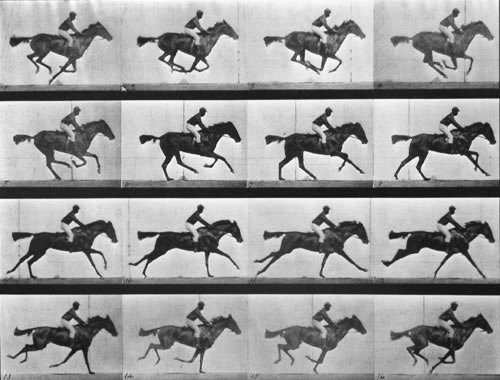
The way artists painted running horses changed forever once artists saw photos by pioneering photographer Edweard Muybridge.
Horses move their feet so quickly when they’re galloping that it’s impossible to isolate an individual phase of the action by observation alone. So it’s understandable that artists painted them with their legs held out hobby horse fashion. The painting above is by Alfred de Dreux from 1857.
Muybridge took his first fast-action photos in 1878, but they only became known in Paris in 1881, when Leland Stanford arrived with Muybridge and his lantern slides of running horses.
According to Gerald Ackerman, “They were first shown in a sort of primitive movie machine, at Meissonier’s house, and Gérôme was among the guests, as were Degas, Bonnat, Moreau, and other artists.”
After that time, artists changed their way of seeing things forever. It's impossible to "unsee" something as visually compelling as Muybridge's photos. Today, the way we see and imagine the world is bound to be influenced by time lapse, slow motion, movie visual effects, and MRI photography, just to name a few ingredients of the visual stew we consume daily.
From “The Life and Work of Jean-Leon Gerome
” by Gerald Ackerman.
Previously on GJ: Action Poses and Photography
Labels:
Academic Painters,
Photography
Tuesday, September 4, 2012
Line of Action
I'm not going to write a whole treatise on the "line of action" because the veteran Disney animator Preston Blair already did.
From his book Animation: Learn How to Draw Animated Cartoons (How to Draw Series 26)
, which has been republished as Cartoon Animation
.
You can also find versions of it online.
From his book Animation: Learn How to Draw Animated Cartoons (How to Draw Series 26)
You can also find versions of it online.
Labels:
Animation,
Figure Drawing
Monday, September 3, 2012
Reality vs. Screen Illusion
Rob Legato creates visual effects for big-budget movies.
(Video link) In this TED talk, he shares how he created effects sequences for Apollo 13, Titanic, and Hugo. In the first two cases, actual documentary film footage exists of some of the scenes he was visualizing. The real footage served as a reality check against the cinematic invention.
One of the surprising revelations is that our sense of what looks real is greatly influenced by the emotional processes of our memories, which reorder reality into a composite fiction.
That emotionally tinged version of reality is what moviemakers need to bring to life if they want to create convincing illusions. The same general principle applies to painting. Often it's necessary to go beyond optical or photographic realism in order to achieve psychological realism. It's the difference between mere accuracy and true believability.
------
Rob Legato on TED: The Art of Creating Awe
Labels:
Effects/Phenomena,
Movie Studios
Sunday, September 2, 2012
Soft Robots
Soft robots make use of pliable structures instead of hard forms like gears, pistons, and hinges.
(Video link) Engineers can now design flexible artificial creatures inspired by the octopus, earthworm, starfish, or jellyfish. Most prototypes move by means of air pumped into sectional chambers. Although the current soft robots are small and clumsy looking, tethered to their air supplies, they have a striking "alive" quality.

A new paper in Science magazine demonstrates how they can change color for camouflage or display. Other morphing blob-like bots can squeeze through narrow spaces.
Whether the soft forms are used alone or combined with hard forms for armor or skeleton, these breakthroughs suggest new possibilities for concept artists and mech designers who are trying to dream up organic-looking artificial beings.
Imagine creepy slug-bots, graceful gas-bag air floaters, or (ahem) sexy robots.
----
Image from Innovation News Daily
For other striking advances in robotics, check out:
Big Dog
Nano Quad Rotors
Labels:
Rabbit Trails
Saturday, September 1, 2012
At the Edge: One Week Left
There's just a week left of the exhibit "At the Edge: Art of the Fantastic" at the Allentown Art Museum in Pennsylvania. The show has turned out to be one of the most popular in the museum's history.

The organizers have said there will probably never be a larger or more comprehensive museum show of imaginative artwork in our lifetimes. It covers the field from its nineteenth century forebears to the 21st century. The fun is over September 9.
-----
See the reviews on the blogs Underpaintings and Lines and Colors
Friday, August 31, 2012
BLUECANVAS Interview
The worldwide artist network known as Bluecanvas has just released an exclusive interview that I did with them.
(Video Link) The interview explores how Dinotopia came into being and the relationship between art, science, and imagination. Interview by Shana Nys Dambrot.
----
Visit the Bluecanvas website
Subscribe to the Bluecanvas magazine
Dinotopia: The World Beneath
Dinotopia exhibition at the Lyman Allyn Art Museum.
To read the complete interview, and to see the full range of images, you'll have to pick up Issue 14 of Bluecanvas magazine, which will be available in late November.
Cast Shadows and Form
One way to define the contour of a landscape is by means of cast shadows. In late afternoon, the shadows from trees or utility poles wrap over hills, jump up walls, and drop down over curbs.

Creating bands of light and dark adds a great deal of depth to a landscape, and it gives you something to place light or dark figures against.
Labels:
Lighting,
Plein Air Painting
Thursday, August 30, 2012
Mucha in Iowa
Blog reader Amber Wallin recommends the museum exhibition
Alphonse Mucha: Inspirations of Art Nouveau at the National Czech & Slovak Museum & Library in Cedar Rapids, Iowa. She said it was worth the six hour drive from St. Paul, Minnesota.
She says, "I hadn't realized how large a format his litho prints were, and that--of course--reproductions of his work don't begin to accurately convey his palette! The man apparently frequently used metallic inks that are brilliant in person but turn flat and dull when reprinted. They also feature dozens of his family and model photographs pulled from glass negatives. Given the limitations of photography compared to today's, he was just as talented a photographer as he was a painter!"
The show is up until the end of December.
Thanks, Amber.
Labels:
Academic Painters,
Museum Visits
Subscribe to:
Posts (Atom)


_.jpeg)