Thursday, May 10, 2012

Hazy Day in Bridgewater


It was a hazy day in Bridgewater, Massachusetts, an unremarkable street corner. Nothing special happened. 


The picture is 5x8 inches, watercolor with white gouache over pencil and brown fountain pen. 
-----

Wednesday, May 9, 2012

Elaine's Romance Covers


If I had to give a prize for the most delightfully weird romance cover, it would have to go to "The Hungry Ones" from 1966.

Whatever his pickup line is, she seems to be taking him seriously. Should be an interesting date. What he hasn't told her yet is that she's got to fit into his VW with 19 of his friends.

The cover is the work of Elaine Duillo (b. 1928), a prolific and talented artist whose cover paintings defined the look of paperback books from the 1960s through the 1990s.

Like all of her contemporaries: James Avati, James Bama, Pino Daeni,  and Bob McGinnis, she was adept at crystallizing a book's appeal into an arresting image that made you itch to pick it up and start reading. As a woman working a field mainly dominated by male artists, she overcame many discouraging remarks and kept producing work of the highest caliber.


Her work and career are spotlighted in an interview feature in the current issue of Illustration magazine, Issue #37.

Elaine started doing gothic covers, which evolved into the familiar genre of romance covers, where a half-clad, muscle-bound hero with long flowing locks embraces a wild woman in an exotic or historical setting. Elaine helped to make the model Fabio famous. He posed for 19 of her covers.

She worked from black and white photographs of professional models in real costumes. Her painstaking painting process used acrylic paint in fairly transparent layers, which made changes difficult. She retired in 2003.

The current Illustration magazine also features 1950s glamour illustrator Coby Whitmore, one of the Famous Artist School instructors. [Edit--he actually wasn't in the FAS, that would be Jon Whitcomb--thanks, Steve.]
----
Thanks to Mark Frauenfelder of BoingBoing for mentioning this post.
----
More GJ posts about pop culture rabbit trails.
-----
Illustration Magazine (preview the whole issue in thumbnail form)
---
Elaine was inducted into the Society of Illustrators Hall of Fame in 2003 

Tuesday, May 8, 2012

Violinist

Here's a sketch I did last night at a concert of the Bard College Orchestra. I was sitting about four rows back. 

Since some of you have asked about materials, here's the lowdown: I was using a black watercolor pencil and three waterbrushes. One was filled with Higgins Eternal ink, another had plain water, and a third contained blue-black fountain pen ink. The sketchbook was a Moleskine watercolor notebook.

Previous concert sketches on GJ:
Horn Player
Mirko Listening
Club Passim Gig
Concert Sketching
Shapewelding Sketching 
The Cello and the Pencil

Sean Murray Kickstarts Gateway


(Video Link) Sean Andrew Murray, concept artist for Big Huge Games (38 Studios), has been developing his own fantasy universe called Gateway.


He describes his Gateway as a "vast and wondrous city... a little bit steampunk, a little bit fairy tale, and a big helping of fantasy."

He has launched a Kickstarter campaign to invite supporters to fund production of the first book. He plans to work for the next year on the 65 or so pieces of artwork for his contemplated 100-page field guide called "Book of Wizards." With three weeks still to go, he has already met his Kickstarter target, but more support will make a great concept even bigger.
-----

Monday, May 7, 2012

Nose Room

Portrait painters sometimes use the term "nose room" for the extra compositional space allotted for the direction that a face is looking. 

There seems to be a psychological need to give the face extra room to inhabit, compared to the back of the head. This portrait is by Albert Edelfelt (1854-1905) a Finnish-Swedish painter who studied under Gerome.


In this shot from the Ridley Scott film "Kingdom of Heaven," the character is given nose room since he is looking to the right side of the screen. For moving subjects, such as a car, extra space is given in front of the direction of movement, and that's often called "lead room."

Whenever I hear a rule I start thinking of the exceptions. Are there good reasons to violate the nose room principle?


Yes. Putting space behind the head can suggest detachment, alienation, or reverie. It makes the person seem somehow less accessible or more mysterious. This painting by the brilliant rule-breaker Andrew Wyeth shows his subject apparently looking out a window that we can't see.

It invites us to wonder what's inside her mind or outside her house. Even the title takes you beyond the frame: "And Bells on Her Toes."
----
Wyeth painting from the Mississippi Museum of Art
Book: Andrew Wyeth: Memory & Magic


Sunday, May 6, 2012

Warm below, cold above

The 19th century German instructor Heinrich von Zügel offered his students a memorable tip to help them with color and light as they painted animals outdoors.

Hermann Ebers recalled, "His system was both simple and enlightening. Objects close to the ground were painted in warm tones, somewhere between yellow and brown. Towards the sky the colors are influenced by cold, playing into blue. Vertical surfaces finally show violet influenced tones. "


Ebers continues, "I wrote a humorous song about putting that scheme on an animal, that I had to sing on stage during a live performance:

"The warm part is placed on the belly,
The cold part in the highest light,
The breaking of light is a breeze,
Where? No one knows."

Here's a photo I took on our walk this morning which illustrates the point. In general, on an animal, the warmer areas are lower down the form. But there are exceptions: Note that the pasterns (just above the hoof) are cool, and the area beneath the neck is warm.

A more precise rule might be that the downfacing planes are warm and the upfacing planes are cool.  All these effects are clearest on the shadow side of any white form, especially with a dirt-covered ground and a blue sky.
-----
Previously on GurneyJourney: Downfacing Planes

Saturday, May 5, 2012

Beware the Bog Men

Along the shores of the Hudson River, the railroad line isolates muddy coves. That's where the bog people live.


At high tide they look like the roots of trees washed down by floods. But as the tide goes down and the sun goes down you can see their glistening eyes watching you. 

Plein-air painters working unaware along the shore sometimes feel a tendril wrap around their ankles. So when I sketched this guy, I kept my escape route always in view. 

Friday, May 4, 2012

Frank and the kitten

Here’s a portrait of my son Frank that I painted from life when he was six years old.


At that age, it was basically impossible to get him to hold still for an hour-and-a-half portrait, except for this unusual circumstance.


We were staying on a farm in Ireland, and he discovered a kitten that was being harassed by dogs. The dogs kept playing with the poor thing, picking it up in their mouths, until it got soaking wet and completely exhausted. 


Frank rescued the kitten and put it in his lap. It fell instantly asleep under his protection. For as long as it slept, he held as still as a statue.
The painting is 10 x 8 inches in oil.

Thursday, May 3, 2012

Parodies of Munch's "Scream"

Edvard Munch's 1895 pastel "The Scream" sold last night at Sotheby's in New York for $120 million, setting a record for the most expensive piece of art ever sold at auction. The sale eclipsed the previous record of $106 million for Picasso's "Nude, Green Leaves, and Bust."

Like the Mona Lisa, American Gothic, or any other iconic image, The Scream has spawned countless parodies. The ones above are by Arvid Andreassen, Erro, Mad Minerva , and Ihansen

Read more....
13 Coolest Mona Lisa Parodies
American Gothic Parody Blog
BBC report on sale of Munch's Scream


Wednesday, May 2, 2012

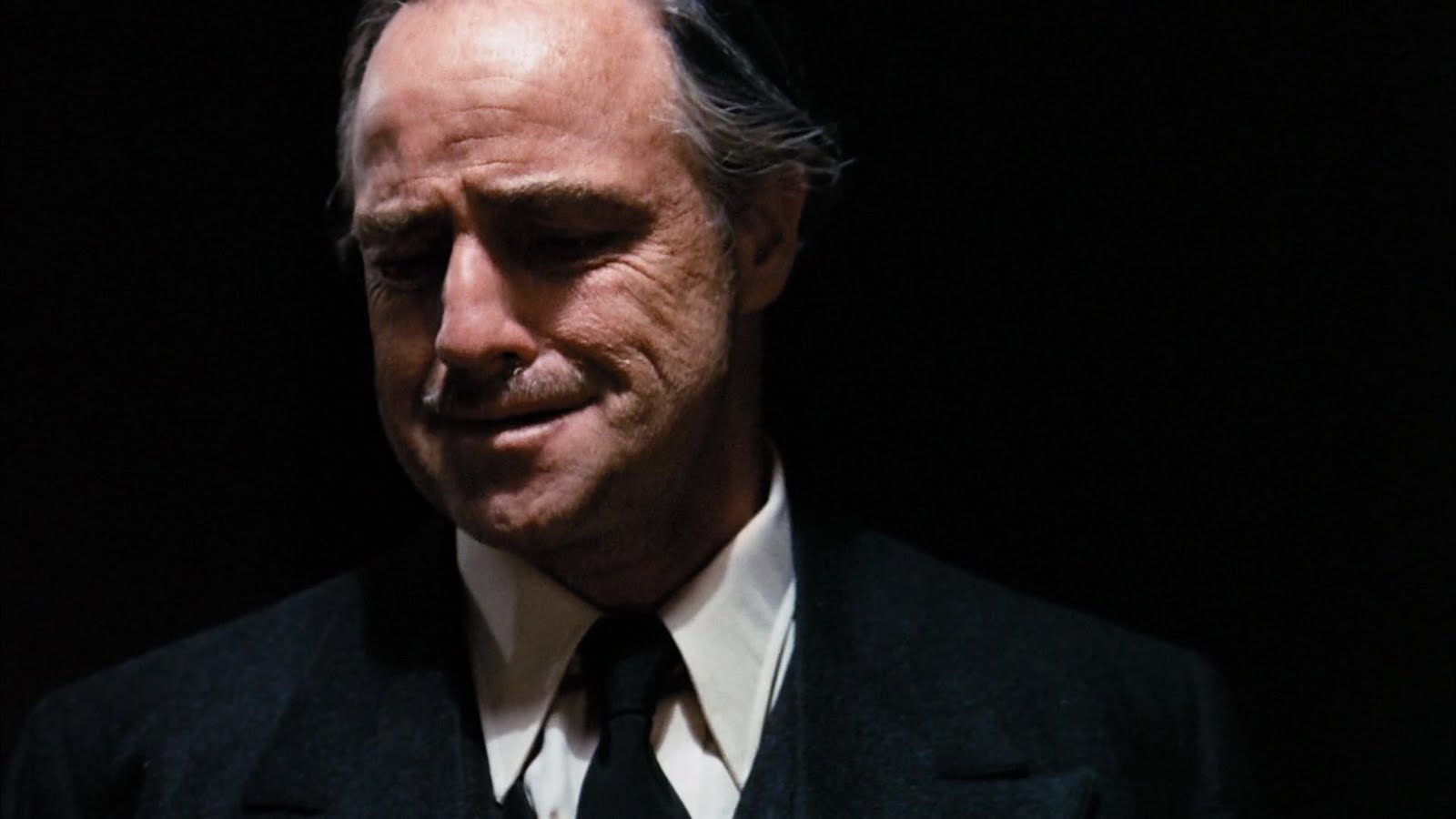
Top Lighting in Godfather

In a previous post, I mentioned that top lighting can lend a dramatic effect to a character by concealing his eyes. Since the eyes are the chief agents of expression, the character's thoughts are left in doubt.

A good example is the lighting on Vito Corleone, played by Marlon Brando, in The Godfather.


(Video Link) The director of photography for the film, Gordon Willis used it in several scenes, and he also underexposed the film. 

Willis explains that he needed to use overhead lighting to bring out Brando's unique makeup. "I got a lot of criticism," Willis admits, "because they said, well, you can't see Brando's eyes....You saw this mysterious human being thinking about something, or about to do something, but you didn't really know what the hell was going on." 

Previously on GurneyJourney: Top Lighting