Wednesday, February 5, 2014

Zhang Hong Nian

I drew this portrait of my friend Zhang Hong Nian at his home in Woodstock, New York.


Hong Nian grew up in China, studying academic realism at the Central Art Academy in Beijing. After the Cultural Revolution, he was sent for four years to a forced labor camp, where he was not allowed to create art. In the 1980s he came to the United States to study Western painting and to exhibit his work. Today he is one of the most celebrated Chinese-American painters and teachers, and is married to portrait artist Lois Woolley.
---
Zhang Hong Nian's website


Cyriak's Animations


Cyriak is an animator whose video Cows & Cows & Cows has logged more than 25 million views.
His videos typically show animals moving to a dance beat through increasingly surrealistic transformations. The results are cute, disturbing, and mesmerizing.


In this documentary, we meet the artist in his Brighton, England studio and visit his sources of inspiration: video games in the local arcade, pickled specimens in the museum, and animal antics on a local farm.

His process starts with digitally cut-out photos and stock videos, animated with Adobe Aftereffects. Cyriak's latest video is called Chimpnology

Tuesday, February 4, 2014

Scintillating Scotoma

A scintillating scotoma is an optical effect related to migraines, where a glowing aura forms in the visual field, like a shimmering ring or arc that lasts about 15 minutes. 


Here's an artist's depiction. In my experience, the ring expands slowly outward from the center, and it is composed of zigzag patterns that move around the ring, rather than little colored bubbles, as is indicated here. The aura creates a blind spot in the area of the shimmering ring. At the Wikipedia page on the subject, there are some animated gifs that people have created to simulate the effect.

Whenever I get one, I refer to it as the "Mystic Donut."


Here's another animated simulation (Thanks, Derek).

For me the effect is most often triggered by a cup of coffee and a sudden exposure to bright light. The phenomenon is caused by a spreading wave of neural firing called a cortical spreading depression in the optical cortex in the back of the brain. It doesn't happen on the retina, as in a retinal migraine, which has a monocular effect.

Unlike some other kinds of migraines, there's no pain associated with scintillating scotomas, and I find them kind of fun, as long as I'm not reading or driving.

Wikipedia on Scintillating Scotoma

Monday, February 3, 2014

Are we out of the Uncanny Valley?


Popular Science put together this video summary of the phenomenon of the uncanny valley in robotics, computer animation, and games. (Link to video)

The term "uncanny valley" was coined by Japanese roboticist Masahiro Mori in 1970. It refers to how artificial characters become more and more attractive as they become more realistic—up to a certain point, when they become creepy and repellant.

Another example is the rampaging baby in Pixar's early experiment "Tin Toy." (Video link)

Scientific American article suggests some explanations for why these failed lookalikes put us on edge. The phenomenon might be related to the unconscious switchover that happens when we believe something to be truly human. Our rising empathy in what we believe to be human can be betrayed by a simple failure of eye contact or head movement, invoking our concern or disgust at seeing a fellow human who is ill.


A related dreadful feeling happens when we see a Madame Tussaud waxwork, only to discover that it is real. This video shows such a prank as fan girls pose with what they think is their favorite boy band. (video link).

Masahiro Mori's paradigm suggests that there's a way out of the valley on the far end, as we approach very accurate simulation. Are we there yet? Have you seen anything recently in the realm of robotics or CGI simulation that you feel is truly appealing? If so, please let me know in the comments.

Previously on GurneyJourney:
Activision reveals real-time face simulation
Bert Untooned

Sunday, February 2, 2014

Book Review: Painting on Location

David Curtis is one of the leading plein-air painters, working in both watercolor and oil in the United Kingdom. He tackles complex scenes with admirable fluency and accuracy, and is one of the contemporary masters of contre-jour lighting.

For both dedicated fans and people new to his work, his newest book, Painting on Location: Secrets to Plein Air Painting, is an excellent presentation of his working methods, with many large reproductions of paintings that don't appear in previous books on Curtis's work.

His subject matter includes primarily coastal views, city scenes, and rural landscapes—no portraits or still lifes.


Curtis typically works fairly small in oil. Most of his paintings are around 8x10 or up to 12x16 inches. In his book he discusses how speed and confidence are affected by the scale of the work, and by other challenges such as limited time and changing light.

The book gives equal weight to his watercolors, which makes it valuable to specialists in either oil or watercolor, or to artists who want to branch out to a new medium. There are a few step-by-step sequences, photos taken of the motif for comparison, and photos of the painting rig.

Here's a video shot on location that shows some of the watercolor techniques in action. Curtis confidently drops color into wet washes in the early "ghost wash" stage. As he says, "Observe once, observe twice, and dive in."

(Video link) And here's another video trailer showing his oil techniques.

...also available from the North Light bookstore

Saturday, February 1, 2014

Drawing by Dean Cornwell


This figure study by Dean Cornwell (1892-1960), probably done from a live model, is a beautiful example of designing the forms, and not copying accidental details.


The forms are simplified with an attention of straight lines versus curved lines, and a geometric statement of the disk-shaped cuffs and neck ruff. He's careful to draw the centerline down the torso, and to think of the folds of the cape as strong columnar tubes. Cornwell often remarked about the difference between folds, which are structural, and wrinkles, which are accidental.

It was done as a study for the Sir Walter Raleigh murals in the Warwick Hotel in New York. 

Friday, January 31, 2014

J. Gurney's Daguerreotype Gallery

That would be Jeremiah Gurney, hailed as "the finest daguerreotypist in Gotham." He opened the first American photo gallery in 1840. His establishment at 349 Broadway in New York "consisted of nine spacious rooms, devoted exclusively to this art."


Thursday, January 30, 2014

My Eighth Grade Portrait Disaster

My eighth grade art teacher, Mr. Kinear, asked me to come up to the front of the classroom. He turned me to face the class and put the question to me in his big public voice: 

"Jim, would you be willing paint a picture up here in front of the whole class?" 
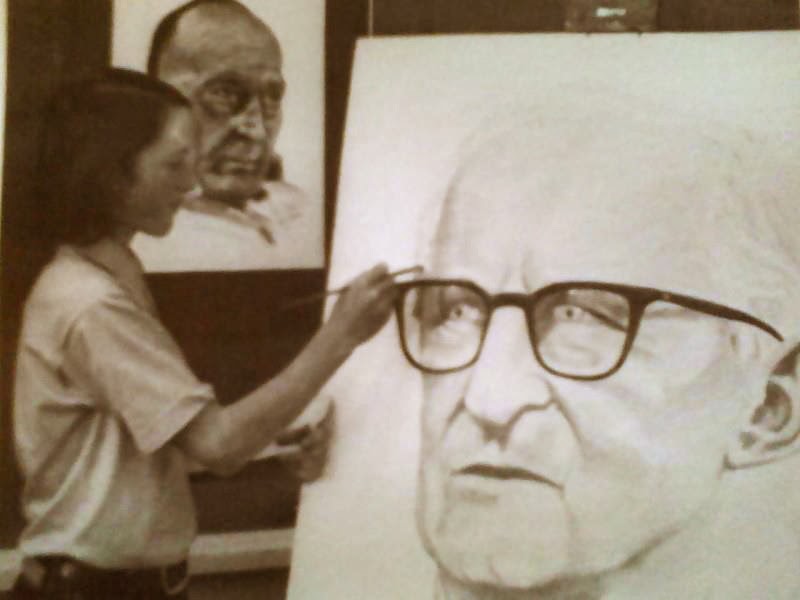

"Um. Sure," I said. My reflex was to say yes first and dig myself out later.

"Here, you can use my easel."

He dragged his easel, squeaking horribly, across the linoleum floor. He started twirling the cranks and the top went up like a guillotine. Everyone set down their pencils and stopped working on their contour drawings.

I was the entertainment.

Suddenly I wanted to rejoin my peers, blend in, and become invisible again.

There was another problem. I had no idea how to paint a portrait in oil. I had never painted anything in oil. No one in my family painted, at least not since I was born. I had seen a few tubes of my mom's old paint box, but I couldn't even get the caps off. I didn't know how to mix colors or thin the paint or how to use the brushes. I never saw anyone do an oil painting. Middle schoolers didn't paint in oil. We used charcoal or ink or poster paint.

"Don't worry, I'll get you set up," Mr. Kinear said, sensing my rising panic. He took out his personal tubes of paint and uncapped each one with a grand flourish.

"Viridian...Alizarin...Burnt Sienna," he said. I was hearing some of these names for the first time. I didn't dare admit my ignorance to him. He had chosen me as the star student. This was my chance to shine and to impress the girls, because I was way too shy to talk to them.

What was I supposed to paint? Mr. Kinear handed me a photo of a retired principal. He was a rather hard-faced old bird, not exactly a favorite with the students, and certainly not with me. I had been called into his office a couple of times on minor infractions, and he seemed to me rather short on humor or sympathy.

I brushed my long locks of hair back over my ears and tried to focus. I had been to an art museum a few times and had seen a Rembrandt. I had seen Norman Rockwell's book on illustration. Those guys used oil, didn't they? If they could do it, why couldn't I?
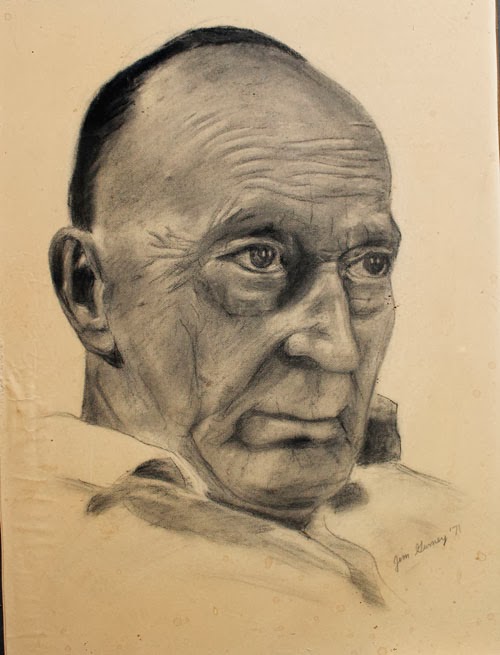

I had drawn some faces before. Above is a charcoal portrait that I did at home to show Mr. Kinear. My idea of a portrait was to make the face really big so that it filled most of the frame. I knew I could draw fairly accurately.

I started by drawing the face with a pencil. Then, as the class watched my every move, I squeezed out the paints and started mixing and dabbing on color. How do you mix a flesh tone? It wasn't pink exactly. I tried mixing burnt sienna with white: white to make it lighter and black to make it darker. The principal was taking on a ghoulish pallor.

I had a lot of trouble with his eyes. Everything I did made him look more and more like a turkey vulture, glaring back at me in a hungry sort of way, like he wanted to pick the flesh off the bones of my carcass.

After a couple of weeks of effort, I finished. I was surprised when Mr. Kinear declared the final painting a success. Newspaper reporters came and took photos. It was decided to hang the finished portrait in the cafeteria, high up on the wall, where the principal could cast his gaze down over everyone eating their lunches. I was proud, but also embarrassed when I stood there in front of everybody for the unveiling. I was a hero. The girls liked me, and it was all because of my art.

The next day, my pride came crashing to the ground when I came into the cafeteria, and saw that my portrait had been the target of a food fusillade. Big hunks of bologna stuck with mayonnaise to his cheek. Strings of spaghetti festooned his forehead.

I never really knew if they messed up the portrait because it was a poor painting, or because he was a poor principal, or just to pay me back for being the head student. Probably a little of all three. It was my first taste of public opinion, and I learned a very important lesson: The nail that sticks up above the rest will get hammered down first.


Wednesday, January 29, 2014

Chromatic Snow Sparkles


Looking at this photo that I just took, you might assume that it's a view of the stars and planets in the night sky, but it's not that at all.

It's a view looking down at the snow outside our breakfast window. The colored lights are sparkles of sunlight reflected and refracted internally inside snow crystals. Like a prism or a rainbow, the hexagonal crystals break the light into component wavelengths, giving the observer a variety of colors sampled from the rainbow: red, magenta, yellow, cyan, blue, and violet.

I took the photo with a digital SLR underexposed enough for the colored sparkles to register.

The conditions today are perfect for chromatic snow sparkles. It snowed three days ago, and has stayed below freezing since then, allowing the crystals to grow larger. This morning the temperature was five degrees Fahrenheit. 

It appeared to me that the colored sparkles are most pronounced about 45 degrees away from the sun. In the photo above, that band passes through the right central part of the picture, with the sun coming from the left. 

If you look at the sparkles on an angle farther away from the sun—or closer to the sun, the chromatic effect is much less noticeable.

Related previous post: Annular Highlights
Related topic: Sun dogs (rainbow effects on ice crystals in the sky near the sun)

Tuesday, January 28, 2014

So Long, Pete Seeger

Yesterday, folk singer Pete Seeger died at age 94. I heard him perform several times at music festivals in the Hudson Valley of New York state, where he lived. 


That's him in the middle of the group of three faces at the bottom of this sketchbook page. Whenever Pete got up on stage, he always got the audiences caught up in the choruses.


Another way we got to know Pete Seeger was through our tattered copy of his songbook, a collection of classics like "Clementine" and "If I Had a Hammer" that we often sang together at home in the evenings. In 1991, When my son Dan was a four-year-old budding accordion player, he wrote Pete a fan letter, and Pete wrote back on a postcard drawn by Ed Sorel showing Pete with his banjo trying to outrun the Horsemen of Time.

At his concerts, Pete made every person feel that they had a good enough voice and that it was worth joining in. And he made everyone believe that the dream of a peaceful world is possible, not just by dreaming about it, but by singing about it it or painting a picture of it.

More about Pete Seeger at Wikipedia
More about my son Dan at his band website YanksBand.com or his music streaming company ConcertWindow