Tuesday, February 9, 2021

Computer-Generated Empty Spaces

Posted by _gnarlybrown on the subReddit "kenopsia"

There's a lonely feeling when you're traveling through endless abandoned hallways in the back of empty malls, conference centers, or hotels.


(link to YouTube) Computers can generate videos of endless hallways leading through empty conference rooms. It's an eerie, almost dreamlike effect.

These algorithmically-generated spaces can be endless stairways or maze-like rooms, and they're often used in video games.


They're also called "liminal spaces," and there are communities on the internet where people share photos and artwork that portray this feeling. Here's a video on YouTube that explores the topic.

Thanks, Kenneth Marc.

Monday, February 8, 2021

Does Sketching Cure Inattentional Blindness?

Here's another "The Ask" feature coming up in The Artist's Magazine.


I mention that "I feel like my eyes aren't even open until my observation is focused by drawing or painting. Even an hour later, I keep discovering things that escaped my notice at first: 'Where did that telephone pole come from?'"

There's a name for what I'm talking about: "inattentional blindness." Wikipedia says that it occurs "when an individual fails to perceive an unexpected stimulus in plain sight, purely as a result of a lack of attention rather than any vision defects or deficits. When it becomes impossible to attend to all the stimuli in a given situation, a temporary “blindness” effect can occur, as individuals fail to see unexpected but often salient objects or stimuli."

I did a post about inattentional blindness back in 2015, and there I shared the famous video of the guy in a gorilla suit walking through two teams of people passing a ball back and forth. 

Why does painting from life help us to see beyond our habitual blinders? It's a special kind of visual mindfulness that requires us to focus sequentially on different qualities of a scene. First, when we choose a subject, we try to see the gestalt in thumbnail terms. Then we concentrate on attributes of the scene, such as proportions, line of action, or perspective while we're starting to draw the scene. After that we might think about value relationships, textures, or color contrasts. 

But even with this heightened and sequentially strategized perception, we still only see what we're looking for. Art teachers often say that learning to paint is really about learning to see. That's true, but it only captures a small slice of the truth. We only see a small slice of the world at any given time. In fact, what we see is not objective reality, but rather a representation that is manufactured in our heads. We don't photograph the world like a camera. What we see are the predictive models that we store in our own brains. 

Sunday, February 7, 2021

White Marmorean Flock

I mentioned sculptor Vinnie Ream a while back. She was a member of a group of American women sculptors in Italy dubbed by Henry James as the "White Marmorean Flock." 

Statue of Thomas Hart Benton by Harriet Hosmer, Saint Louis, Missouri, 1868

The term refers to a group of expatriate women sculptors who worked in a classical style. The names include Louisa Lander, Harriet Hosmer, Anne Whitney, Emma Stebbins, Edmonia Lewis, Margaret Foley, Florence Freeman, and Vinnie Ream.

Zenobia in Chains by Harriet Hosmer (1830-1898)

In Italy they were able to exist independently from marital and domestic commitments that typically ended the budding careers of young women artists in America. 
Harriet Hosmer, surrounded by with her assistants and carvers in Rome

Harriet Hosmer was one of the first women to support herself fully on her income from sculpting. She said: "I honor every woman who has strength enough to step outside the beaten path when she feels that her walk lies in another; strength enough to stand up and be laughed at, if necessary."

Louisa Lander, sculpture of Virginia Dare of the lost colony of Roanoke, 1859
----
Related Previous Posts: 
The White Rabbits (Women Sculptors in Chicago)

Read more about the White Marmorean Flock:


Saturday, February 6, 2021

Gaston La Touche


Gaston La Touche (French, 1854 – 1913) was a painter who captured the dreamy spirit of gardens, festivals, dancers, fountains, and fireworks.
----
See more samples and read my previous post on Gaston La Touche
Obituary in American Art News, 1913
Book: Gaston la Touche
Wikipedia on Gaston la Touche
Online biography at Gastonlatouche.com

Friday, February 5, 2021

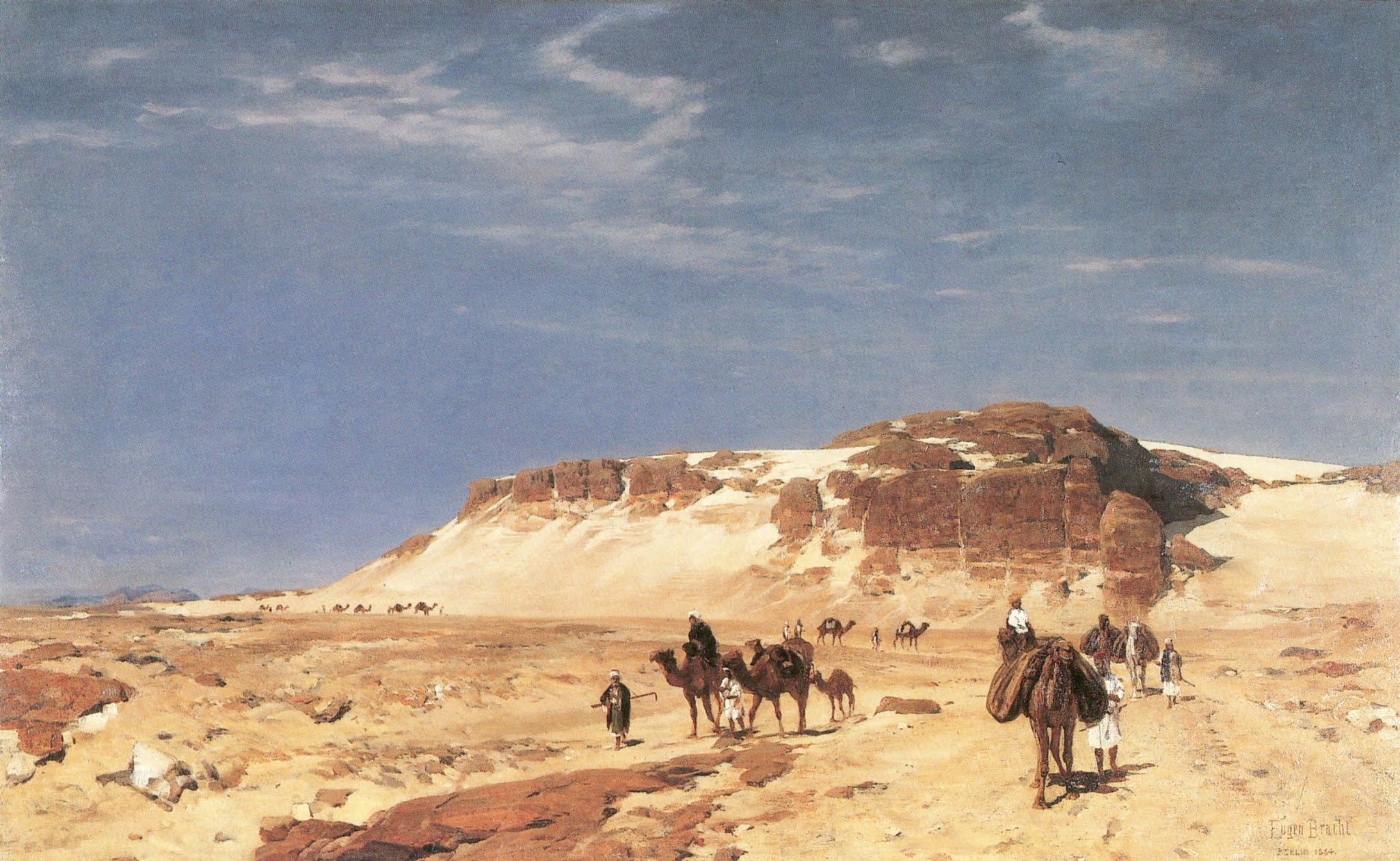
Eugen Bracht's Dramatic Landscapes

Eugen Bracht (1842 – 1921) was a German landscape painter known for his dramatic mountainscapes. But he also painted vistas of wide-open plains. 

Eugen Bracht, Matterhorn

He painted the Matterhorn many times in various lighting conditions. This one is front-lit, normally a difficult lighting arrangement to pull off. The reflection is neatly placed in the pool of glacial meltwater.


He also found drama in less dramatic motifs, open meadows or heathlands in brooding, cloudy weather.


Although his origins as a painter were academic, Bracht was receptive to impressionist ideas, and he painted scenes like this in the open air.


When he painted scenes from the Near East and north Africa, he liked to interpret the scope and scale of the landscape.


His forest studies explored ways to simplify the immense complexity of the subject, sometimes using mist and atmosphere and broadly applied strokes of paint. 

Hoesch iron and steel works, Dortmund 1907

After 1900 he became interested in the moods of the industrial landscape.
---

Thursday, February 4, 2021

Delicate Textures in Gouache and Watercolor

Here are a few examples of artists who created realism by building up delicate textures. 

John Henry Hill (1839-1922) used fine strokes to suggest foliage. 

These crosshatched textures resembled the strokes of engravings and were sometimes referred to as "chopped straw." 

 
William Henry Hunt (1790-1864) was a follower of English art critic John Ruskin, who coined the term:
"It is better to lay the uppermost colour in rather vigorous small touches, like finely chopped straw, over the under one, than to lay it on as a tint, for two reasons : the first, that the play of the two colours together is pleasant to the eye ; the second, that much expression of form may be got by wise administration of the upper dark touches."


In the watercolors / gouaches of William Trost Richards (1833-1905), the small strokes vary a bit from warm to cool, giving the surfaces some chromatic vibrancy.


Henry Roderick Newman (1843-1917) must have taken days to do a painting like this, but it can also be a speedy method. 

Ruskin said, "The use of acquiring this habit of execution is that you may be able, when you begin to colour, to let one hue be seen in minute portions, gleaming between the touches of another." He advised his students to work slowly and delicately, using the point of the pencil or brush “as if you were drawing the down on a butterfly’s wing.”

Watch the whole video on YouTube,

Wednesday, February 3, 2021

Painting Techniques with Delicate Textures

Here's a watercolor/gouache technique that was popular in the 19th century. (Link to YouTube Video) . 

The method involves building up textures in at least two layers of paint with delicate brushstrokes. It contrasts drybrush strokes and wet-into-wet touches.

More info about those artists I mentioned: 

Tuesday, February 2, 2021

Wounded Charioteer

Sketches arrive early in the planning process for a National Geographic article. By means of these rough, tentative sketches, the art director must convince the magazine's editor to allot valuable space in the article for illustrations.
Wounded charioteer. Pencil sketch for a 
National Geographic article on the Etruscans 1987.

You're competing against the writer (who has reams of text), and the photographer who has hundreds of gorgeous, finished photos.

Sometimes the editor's knife cuts out a lot of visual ideas that might have made exciting paintings, but they didn't add enough to the story.

Monday, February 1, 2021

Ladies' Manual of Art

The Ladies' Manual of Art was published in 1887. 

The title page appears at first to be about dainty, decorative artistic pastimes—until you get to the end and it mentions taxidermy.

The final chapters give detailed descriptions of skinning and stuffing serpents and crocodiles, preserving spiders, and dealing with the skins of large mammals. 
----


Sunday, January 31, 2021

The Microscopic Sculptures of Hagop Sandaldjian


The sculptures of Hagop Sandaldjian are so tiny that they can't be fully appreciated with the naked eye. You need a magnifying glass to make out the details.

Sandaldjian's interest in tiny sculptures grew out of his expertise in the ergonomic study of how to refine muscular movements and breathing when we use tools. 


The Museum of Jurassic Technology of Los Angeles displays some of Sandaldjian's work.

According to the museum's website:
"Born of obsessive devotion, an individual figure could take as many as fourteen months to finish. Each sculpted micron represented not only endless hours of toil, but exacting travail fraught with peril, as his work could so easily be destroyed or lost. An unexpected sneeze or misdirected breath could blow away a microminiature with hurricane force, while a casual movement could sabotage the work of months. Since even a pulse in his fingers could cause an accident, Sandaldjian ultimately learned to apply his decisive strokes only between heartbeats."